
The Underwriting Question Every Covenant Must Answer
When a middle market credit deteriorates, it rarely collapses overnight. It drifts (through softening margins, rising inventory, and quiet revolver draws) before the lender realizes the capital structure is under stress. The discipline that separates experienced credit officers from reactive ones is not the ability to identify problems at default. It is the ability to engineer early-warning mechanisms directly into the loan agreement before the first dollar is funded.
That mechanism is the maintenance covenant.
Covenant design is not a legal formality. It is an underwriting tool: one that defines the lender’s intervention rights, calibrates the permissible risk envelope for the borrower, and creates contractual tripwires that trigger lender protections before cash flow stress becomes a liquidity event. According to the Federal Reserve’s Interagency Guidance on Leveraged Lending, stress testing projections for one or more downside scenarios, including a covenant breach, is a minimum expectation for institutions engaged in leveraged lending. Covenant architecture must be built with that breach scenario explicitly in mind.
The Analytical Framework: Building Covenants That Actually Work
Effective covenant design begins before the term sheet is drafted. It begins with a rigorous bottom-up analysis of the borrower’s cash flow variability, cost structure, and historical EBITDA volatility. The covenant package should be calibrated to the borrower’s financial profile, not templated from the prior deal.
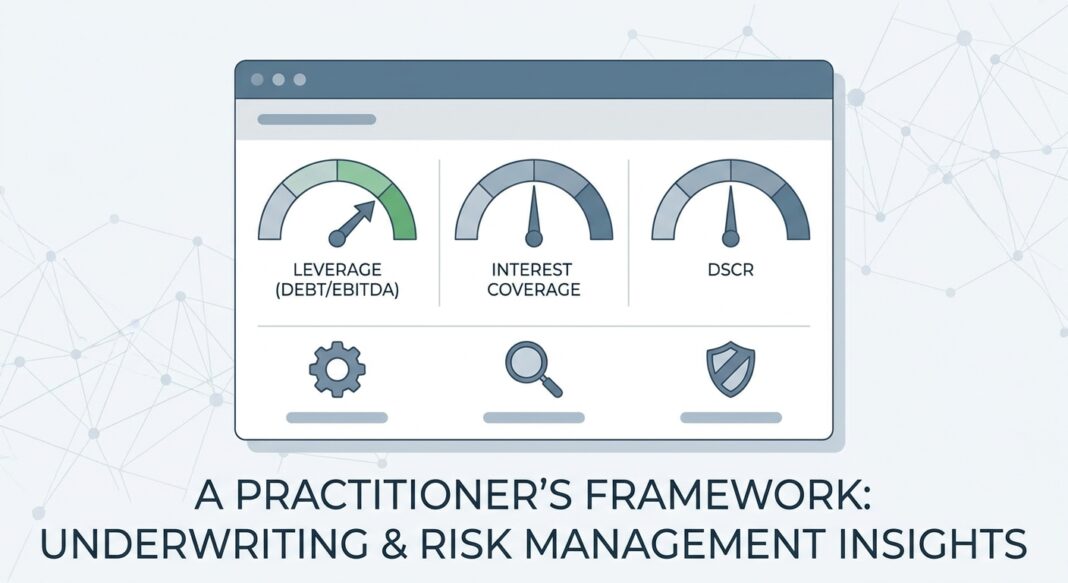
Institutional lenders typically structure maintenance covenants around three core financial ratios, each serving a distinct monitoring function:
- Maximum Total Leverage (Debt/EBITDA): The primary test of capital structure sustainability. Measures how many years of operating cash flow are required to retire total debt. Set too loosely, it provides no early warning. Set too tightly, it creates unnecessary technical defaults in normal operating variance.
- Minimum Interest Coverage (EBITDA/Interest Expense): The liquidity sentinel. Signals whether the borrower can service its fixed obligations from operating earnings. A coverage ratio falling below 1.5x should trigger intensive monitoring protocols.
- Minimum Debt Service Coverage Ratio (DSCR): The most comprehensive test, incorporating mandatory amortization alongside interest. A DSCR below 1.0x means the borrower cannot service debt from operating cash flow, a structural signal that the capital structure is fragile relative to current earnings.
The OCC’s Rating Credit Risk Handbook emphasizes that the criteria for assigning risk ratings (and by extension, for setting covenant thresholds) must be clear and precisely defined using both objective metrics like cash flow coverage and debt-to-worth, and subjective factors like management quality and willingness to repay.
Walking Through the Calculations: A $10M EBITDA Manufacturing Borrower
Consider a specialty manufacturer with $10.0 million in trailing twelve-month normalized EBITDA, $40 million in total debt at a blended cash interest rate of 8.5%, and $1.5 million in mandatory annual amortization. Maintenance capex is $2.0 million per year.
Base Case Metrics:
- Total Leverage: 4.0x (Debt/EBITDA)
- Interest Coverage: 2.94x ($10.0M / $3.4M interest)
- DSCR: 1.55x (EBITDA less capex divided by total debt service)
- Free Cash Flow After Debt Service: +$2.3M
A sound covenant structure for this borrower would set the leverage covenant at 5.0x maximum: providing roughly 25% headroom to base case EBITDA before a breach is triggered. The interest coverage floor would be set at 1.75x minimum, and the DSCR floor at 1.10x minimum. These thresholds are not arbitrary: they are calibrated so that a meaningful deterioration in business performance, not routine quarterly variance, is required to breach the covenant.
Now apply a downside scenario: a 10% revenue decline with 200 basis points of margin compression drives EBITDA to $8.4 million. Leverage rises to 4.8x, still inside the 5.0x covenant. Interest coverage falls to 2.47x, still inside the 1.75x floor. The lender has advance notice that the borrower is drifting toward the boundary, triggering enhanced monitoring, but no technical default yet.
In a severe stress case (a 25% revenue shock with 450 basis points of margin compression, consistent with observed 2008–2009 industrial sector drawdowns) EBITDA falls to $6.1 million. Leverage breaches at 6.6x. DSCR falls to 0.94x, below 1.0x. This is the covenant’s moment of purpose: the breach activates lender remedies (standstill rights, equity cure requirements, and potential acceleration) well before the borrower runs out of liquidity.
What Institutional Lenders Require: Standards and Red Flags
The Interagency Leveraged Lending Guidance establishes that supervisors commonly view the ability to fully amortize senior secured debt (or repay at least 50% of total debt over a five-to-seven year period) as evidence of adequate repayment capacity. When projected cash flows make refinancing the only viable exit, the credit will generally receive an adverse rating regardless of recent underwriting quality.
The Basel Committee’s 2025 Principles for the Management of Credit Risk reinforce that covenant monitoring must be embedded in an ongoing credit administration system, one that ensures continuous analysis of a borrower’s ability and willingness to make contractual payments, with timely identification of deteriorating credits for classification and potential corrective action.
The most common covenant design failures observed in middle market lending include:
- EBITDA add-back creep: Permitting aggressive or unverified adjustments in the covenant EBITDA definition that artificially inflate headroom and mask true leverage. Covenants must reference a clearly defined, audited EBITDA construct with add-back caps.
- Covenant-lite structures on volatile borrowers: Removing maintenance covenants from credits with high fixed-cost structures or cyclical revenue profiles eliminates the lender’s early-warning system precisely where it is most needed.
- Static thresholds in growth credits: Setting leverage covenants that do not step down as the borrower deleverages provides no incentive for disciplined capital allocation and weakens lender oversight over time.
- Overly optimistic projections: The Interagency Guidance explicitly identifies cash flow analyses that rely on unsubstantiated projections of sales, margins, and M&A synergies as a primary underwriting deficiency.
The OCC’s Concentrations of Credit guidance adds a portfolio-level dimension: stress testing must account for correlated covenant breaches across borrowers in the same industry or with shared economic exposures, not just individual credit deterioration in isolation.
Covenant Underwriting Checklist
- ✅ Normalize EBITDA independently: Do not accept the sponsor model. Remove non-recurring items with documentation and cap add-backs at no more than 15–20% of reported EBITDA.
- ✅ Run three scenarios before setting thresholds: Base case, downside (mild recession), and stress (severe demand shock). Covenant thresholds must provide meaningful headroom in the downside without being breached by normal operating noise.
- ✅ Define the EBITDA covenant construct explicitly: Specify which add-backs are permitted, cap synergy credits, and tie the definition to audited financial statements.
- ✅ Build in step-down schedules: Leverage covenant maximums should tighten annually as the borrower is expected to deleverage. Flat covenants over a five-year term are a structural weakness.
- ✅ Negotiate equity cure mechanics carefully: Define the number of permitted cures, the cure amount cap, and whether cured equity is added to EBITDA or used to repay debt.
- ✅ Test covenant headroom quarterly: As part of ongoing credit monitoring, recalculate headroom at each financial reporting cycle and escalate to senior credit officers when headroom falls below 15%.
- ✅ Document the breach scenario explicitly in the credit memo: The credit approval package should state the EBITDA level at which each covenant is breached and what lender remedies are triggered at that level.
Key Takeaways
- 🔹 Covenants are underwriting instruments, not legal boilerplate. Their thresholds must be calibrated to the borrower’s specific cash flow variability and cost structure, not templated from prior transactions.
- 🔹 Headroom calibration is the critical design decision. Maintenance covenants set at 25–35% headroom to base case EBITDA provide lenders with an early-warning trigger before cash flow stress becomes a liquidity event.
- 🔹 EBITDA definition quality determines covenant integrity. A well-structured leverage covenant tied to an aggressively adjusted EBITDA construct is not a covenant; it is a false sense of protection.
- 🔹 Step-down schedules enforce deleveraging discipline. Covenants that tighten annually create a contractual expectation of debt paydown and give lenders recourse if the borrower fails to deleverage as projected.
- 🔹 Portfolio-level covenant monitoring is as important as individual credit monitoring. Correlated covenant breaches across sector concentrations can accelerate into systemic portfolio stress, requiring lenders to aggregate breach exposure, not just track it deal by deal.


