
The Story: A Man Who Once Dug Holes in Roads Just Pocketed £420 Million
Julian Hearn left school at 16. He worked retail. He spent two years digging holes in roads. By 2026, he had just sold Huel, the nutritionally complete meal-replacement brand he founded in a UK kitchen in 2014, to Danone for approximately €1 billion, personally netting an estimated £420 million in the process.
That number alone is remarkable. What makes it genuinely instructive is how much of his own company he still owned when Danone’s check cleared.
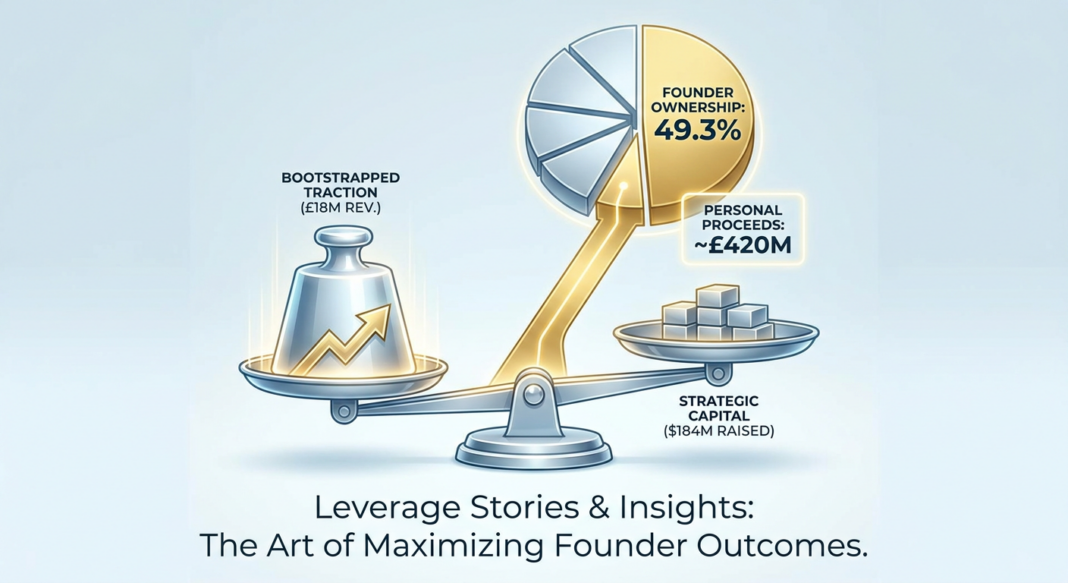
After raising $184 million across three funding rounds: a Series A led by Highland Europe, a Series B, and a growth round led by Morgan Stanley’s 1GT fund, Julian Hearn retained 49.3% of Huel at exit, according to Companies House filings reviewed by financial analysts. Most founders who raise that level of institutional capital end up owning 15–25% at exit. The gap between 49% and 20% on a €1 billion sale is not a rounding error. It is approximately £180 million in additional personal proceeds.
This is a story about capital discipline. It is also a masterclass in the difference between raising capital and surrendering your company.
Sources: thefoodstack.substack.com | creatorsblueprint.co
The Decision: Raise When You Have Leverage, Not When You Need It
The most consequential capital decision Hearn made was one he delayed. He bootstrapped Huel to £18 million in revenue before approaching a single institutional investor. That choice (to build real, paying-customer traction before sitting across the table from a VC) redefined every term sheet that followed.
Here is why that sequencing matters mathematically. When a founder raises a Series A at near-zero revenue, they typically accept a pre-money valuation of 1–2x projected revenue, which on early-stage projections can be speculative. Hearn raised his Series A when Huel already had £18 million in actual, recurring revenue. At that stage, investors valued the business at 3–4x revenue, implying a pre-money valuation closer to £60 million. He gave up approximately 20% for £20 million. A pre-revenue founder raising the same amount would have surrendered that same 20%, but at a valuation of £8–12 million, effectively selling ownership at a fraction of the price.
The subsequent rounds followed the same logic. By the time Huel raised its growth round, revenue was approaching £230 million, and the company gave up only 17% dilution for £100 million. Each round was preceded by proof, not promises.
This is the architecture of a non-dilutive mindset applied within an equity-raising context: raise minimum necessary capital, raise it as late as possible, and raise it only when traction has already shifted the valuation in your favour. Hearn never used external capital as a substitute for building a real business. He used it to accelerate one that already existed.
Source: thefoodstack.substack.com
The Outcome: What 49% Ownership Actually Looks Like on a €1 Billion Exit
When Danone completed the acquisition of Huel in 2026, the waterfall told the story cleanly:
- Julian Hearn (49.3% ownership): approximately £420 million in personal proceeds
- Highland Europe (Series A lead): estimated 6–7x return on their position
- Morgan Stanley 1GT (growth round lead): approximately 2x return
- Employee option holders: collectively approximately £76 million
Now consider the counterfactual. Had Hearn raised his Series A pre-revenue (following the conventional VC path of pitching on a deck and a dream) and had he gone through four or five rounds of institutional capital over twelve years, independent financial analysis suggests he would have retained somewhere between 15–22% at exit. On a €1 billion sale, that is a personal outcome of roughly £125–180 million versus the £420 million he actually received.
The underlying business performance validated the premium Danone paid. Huel’s gross margins recovered from 55% in 2022 to 59% by 2024, driven by the company’s decision to build its own manufacturing facility in Milton Keynes rather than rely on contract manufacturers. EBITDA doubled in a single year from £9.8 million to £18.2 million. Marketing efficiency improved as the brand scaled, the opposite of what typically happens to DTC companies chasing growth. Danone paid an estimated 17–20x EBITDA, a premium multiple justified by those fundamentals.
The €1 billion headline was earned by the business. The £420 million personal outcome was earned by the capital strategy.
Sources: creatorsblueprint.co | thefoodstack.substack.com
The Other Side of the Ledger: When Debt Without Discipline Destroys Everything
Huel’s story is about equity discipline under a fundraising model. But no article on capital structure in 2026 is complete without the counterweight: Divvy Homes, which sold to Brookfield Properties for $1 billion in early 2025, and left founders and common shareholders with precisely $0.
Divvy was a rent-to-own housing platform that raised over $400 million in venture equity and, in October 2021, took on approximately $735 million in debt financing to fund home purchases. When interest rates surged in 2022, the model fractured: new home acquisitions paused, three rounds of layoffs followed, and the $735 million sat on the balance sheet demanding repayment regardless of market conditions. When Brookfield acquired the portfolio at $1 billion, the debt consumed the proceeds before any equity holder (founder or otherwise) saw a dollar.
CEO Adena Hefets acknowledged in a shareholder letter that after repaying outstanding debt, covering transaction costs, and fulfilling liquidation preferences, no proceeds remained for common shareholders.
The lesson from Divvy is not that debt is bad. It is that debt raised against a model that has not been stress-tested for rate environments, market cycles, or exit floor scenarios is a bet that raises the minimum acceptable exit price: often above what the market will ultimately pay. Every dollar of debt is a dollar that gets paid before you do. At a $1 billion exit with $735 million in debt, the math was unforgiving.
Source: saastr.com
The Lessons: A Framework for Founders Facing the Same Capital Decision
Huel and Divvy sit at opposite ends of the same capital strategy spectrum. One founder bootstrapped to traction and raised minimally at inflection points. The other raised maximum capital at peak market euphoria and structured it in a way that eliminated all downside buffer. Both companies built real things. Only one founder got paid.
The principles that separate these outcomes are not complicated, but they are consistently ignored under the pressure of growth targets and competitive fundraising environments:
1. Raise at inflection, not at aspiration. Every round Hearn raised was backed by revenue that already existed. Valuation is a negotiation, and traction is your leverage.
2. Non-dilutive thinking is a philosophy, not just a product type. Hearn used equity financing, but he applied non-dilutive discipline to how he timed and sized every round. Capital strategy begins before you pick the instrument.
3. Debt raises your floor, not just your ceiling. Every dollar of debt you take on raises the minimum exit price at which your equity is worth anything. Before signing, model the exit scenarios where the debt consumes the outcome, not just the scenarios where it accelerates it.
4. Operational fundamentals create exit optionality. Huel’s vertical integration, improving margins, and marketing efficiency gave Danone a strategic rationale to pay a premium. Strong operators attract better capital on better terms, at every stage.
5. The right partner matters more than the headline number. As George Alifragis of Metropolitan Partners Group has noted in his work with founder-led companies, capital strategy is really company strategy. Debt or equity, the partner you choose either accelerates your vision or redirects it. The term sheet is only the beginning of that relationship.
Source: blog.thunder.vc
Key Insights
- 🔑 Bootstrap to traction, then raise: Huel’s decision to reach £18M in revenue before its Series A compressed dilution from a potential 40%+ across early rounds to approximately 20%, a discipline worth an estimated £180M in additional founder proceeds at exit.
- 🔑 Ownership percentage at exit is determined by decisions made years earlier: Most founders lose the equity battle not at exit, but at their first or second funding round, when valuation is lowest and dilution is steepest.
- 🔑 Debt is not non-dilutive if it exceeds your realistic exit floor: Divvy’s $735M in debt was technically non-dilutive to the cap table. Economically, it diluted the founder’s outcome to zero. Debt shrinks the pie before ownership percentages ever apply.
- 🔑 Operational excellence creates capital optionality: Huel’s improving margins, vertical integration, and marketing efficiency gave the company leverage in its exit process. Strong unit economics attract strategic buyers willing to pay premium multiples.
- 🔑 Capital structure is the strategy: The instrument you choose (debt, equity, hybrid, or minority recap) determines not just your cost of capital today, but who participates in the upside you spend years building. Design the structure before you need the capital.


