
The Story: A Billion-Dollar Exit, a Zero-Dollar Payout
In January 2025, Brookfield Properties acquired Divvy Homes for approximately $1 billion. On paper, that sounds like a win. A venture-backed startup, founded in 2016, that helped nearly 2,000 families rent-to-own their homes across 20 U.S. cities, purchased by one of the world’s largest real estate operators for ten figures. Champagne corks should have been flying.
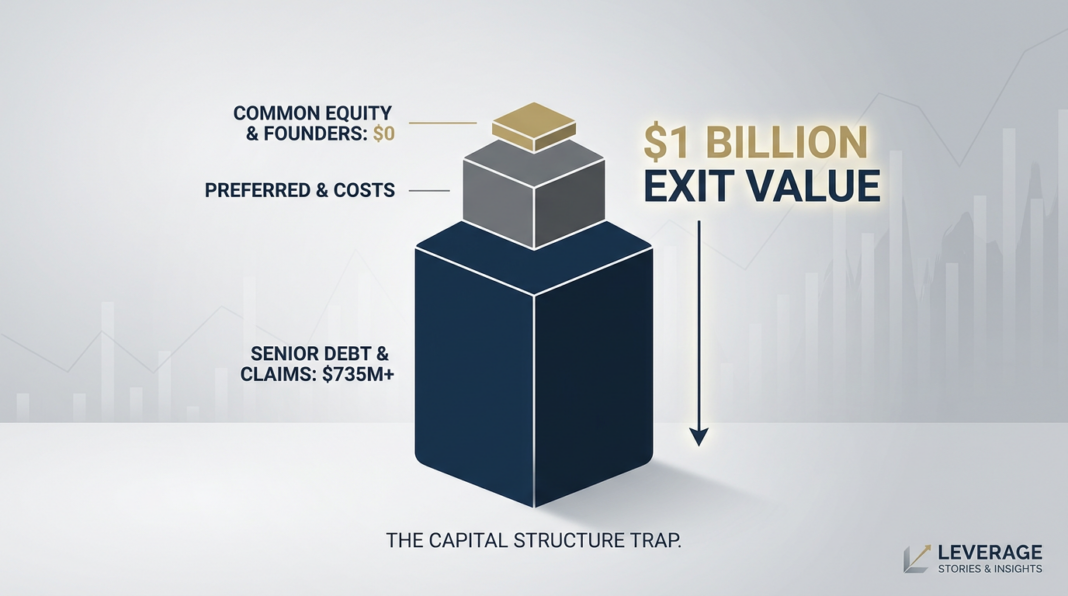
They weren’t. Not for the founders. Not for most of the early investors. In a letter to shareholders, Divvy CEO Adena Hefets disclosed that after repaying outstanding debt, covering transaction costs, and satisfying liquidation preferences for preferred shareholders, common stockholders and founders received zero proceeds. Literally nothing. As SaaStr reported, this was not a failure story in any traditional sense, the assets were genuinely worth $1 billion. It was, instead, a capital structure story.
And the capital structure (specifically, the debt) consumed everything.
The Decision: $735 Million in Debt at the Peak of Zero-Rate Euphoria
Divvy’s model was elegant and capital-hungry in equal measure. The company purchased homes on behalf of aspiring buyers, rented them back at a monthly rate, and set aside a portion of each payment toward a future down payment. After three years, the renter could buy the home outright. To scale this model, Divvy needed to own houses, thousands of them, which meant the company was essentially a real estate fund dressed in startup clothing.
Over its life, Divvy raised more than $400 million in venture equity from top-tier firms including Andreessen Horowitz and Tiger Global, reaching a peak valuation of $2.3 billion off a $200 million Series D in 2021. Then, in October 2021, at the absolute zenith of the zero-interest-rate era, Divvy layered on approximately $735 million in debt financing.
The logic, at the time, was airtight: debt was historically cheap, the housing market was booming, and debt is non-dilutive. The founders kept their ownership percentages. The cap table didn’t change. What could go wrong?
“Debt doesn’t dilute your ownership; it dilutes your outcome.”
This is the distinction that too few founders truly internalize. Equity dilution reduces your slice of the pie. Debt shrinks the entire pie before you ever get to eat. Every dollar of debt borrowed is a senior claim on the future: a dollar that gets paid back before a single founder, employee, or common shareholder sees a cent.
The Outcome: The Math That Doesn’t Care About Effort
When the Federal Reserve began its aggressive rate-hiking cycle in 2022, Divvy’s model cracked at every seam simultaneously. The cost of their debt financing rose. Their customers’ ability to qualify for mortgages, the entire end-state of the rent-to-own product, collapsed. New home acquisitions were paused. Three rounds of layoffs followed. By the time Brookfield closed its acquisition in early 2025, most of Divvy’s team had already been let go.
The exit waterfall told the brutal story in numbers:
- $1 billion: Acquisition price paid by Brookfield Properties
- $735 million+: Debt principal and costs, paid first as senior claim
- Remaining proceeds: Absorbed by transaction costs and liquidation preferences on preferred stock
- Common shareholders and founders: $0
The tragedy of the math is its indifference. Divvy had raised the floor of what constituted a “successful” exit to somewhere above $1 billion, which happened to be almost exactly what Brookfield paid. Before the debt, a $500 million exit might have been a life-changing outcome for the founding team. After $735 million in debt, that same $500 million exit wasn’t enough to pay back the lenders, let alone anyone else. The ceiling never moved. The floor rose to meet it.
There was no management carve-out to soften the blow, either. Brookfield was acquiring a portfolio of roughly 7,000 homes, an asset deal, not a talent deal. They already had their own operating infrastructure. There was no team left to retain, and therefore no negotiating leverage for the carve-out that might have salvaged something for the people who built the company, as SaaStr noted in their analysis.
The Counterfactual: What a Disciplined Capital Structure Might Have Looked Like
Contrast Divvy’s path with the framework described in guidance for mid-market operators navigating today’s private credit landscape. As Bridge Connect outlines, the key principle for founders and operators is to maximize appropriately structured debt before selling common equity, but to size that debt against realistic downside scenarios, not peak-cycle optimism.
Consider a hypothetical alternative: Divvy, instead of taking $735 million in a single debt tranche at peak 2021 valuations, structures a more conservative asset-backed facility sized at 40–50% of its home portfolio value, closer to $300–350 million. The growth is slower. The footprint is smaller. But the debt-service coverage ratio is tested against a world where rates rise 400 basis points and home transaction volumes fall 30%. In that world, a $700 million or $800 million exit, far easier to achieve, delivers real proceeds to founders and early investors.
The lesson isn’t “don’t use debt.” The lesson is: debt sized against stress-tested scenarios preserves optionality; debt sized against peak-cycle assumptions destroys it.
The Lessons: A Framework for Capital Decisions Under Pressure
The Divvy story isn’t unique. It rhymes with every over-leveraged deal that looked perfectly rational at signing and catastrophic at exit. The principles it surfaces are worth internalizing regardless of whether you’re a founder weighing a debt facility, an operator considering a leveraged recap, or a family office evaluating a private credit investment.
1. Know Your Minimum Viable Exit: Before You Borrow
Every dollar of debt raises the floor of the exit price at which your equity is worth anything. Model this explicitly. What does your waterfall look like at your base case exit? At 70% of that? At 50%? If the answer at 70% is “founders get zero,” the debt load is too high regardless of how attractive the rate looks today.
2. Non-Dilutive Doesn’t Mean Risk-Free
The phrase “non-dilutive” has become a siren song in founder circles. Debt doesn’t touch the cap table; that part is true. But it installs a senior creditor with a legal claim on every asset before equity holders see a penny. Founders who confuse “doesn’t dilute ownership” with “doesn’t dilute outcome” are making a category error with generational consequences.
3. Model for Rate Cycles, Not Rate Points
Divvy’s debt was priced in a zero-rate world. The business model was stress-tested against a zero-rate world. When rates changed, as they always eventually do, the entire underwriting thesis broke simultaneously. Any capital structure built on floating-rate debt or rate-sensitive business models must be stress-tested across a full rate cycle, not a single favorable point in time.
4. Match Debt Structure to Asset Life and Revenue Durability
Capital-intensive models that own hard assets (homes, equipment, infrastructure) can support meaningful debt if that debt is matched to the asset’s cash flow durability and liquidation value. The failure mode is when debt is sized to growth projections rather than to asset recovery values in a distressed scenario. As the VC Beast capital stack framework puts it: the lender’s maximum leverage is not automatically the right leverage.
5. The Right Partner Structures for Both Sides of the Cycle
The best debt partners (whether senior lenders, private credit funds, or mezzanine providers) have seen full cycles. They will push back on structures that look aggressive at the margin, not because they’re being conservative, but because they know what happens when the margin disappears. If your lender isn’t stress-testing the deal with you, that’s a warning sign, not a green light.
Key Insights
- Debt is a senior claim on your future, not free money: Every dollar borrowed ranks ahead of every dollar of equity. Founders who treat debt as non-dilutive without modeling the exit waterfall are setting an invisible trap for themselves.
- The floor matters more than the ceiling: Debt raises the minimum exit price at which equity is worth anything. Before borrowing, know exactly where that floor sits, and whether your realistic exit range is above it.
- Cycle-sensitive models demand cycle-tested capital structures: Businesses exposed to interest rate risk, housing markets, or consumer credit need capital structures that survive a full rate cycle, not just the rate environment at signing.
- Matching debt to asset recovery value, not growth projections, is the discipline that separates sound leverage from dangerous leverage: Growth projections are assumptions. Recovery values are floors. Size debt to floors.
- A $1 billion exit can still mean $0 for founders: Exit size and founder outcome are not the same number. The capital structure (debt, preferences, transaction costs) lives between them. Always model the waterfall, in every scenario, before signing any financing.


