
The Most Important Question in Private Credit
Before evaluating yield, fees, or fund structure, every participant in a private credit transaction (whether an institutional lender, a business development company (BDC), or a business owner raising capital) needs to answer one foundational question: where in the capital stack does this loan sit? That single answer determines repayment priority, loss exposure, and the return investors reasonably should expect in exchange for their risk.
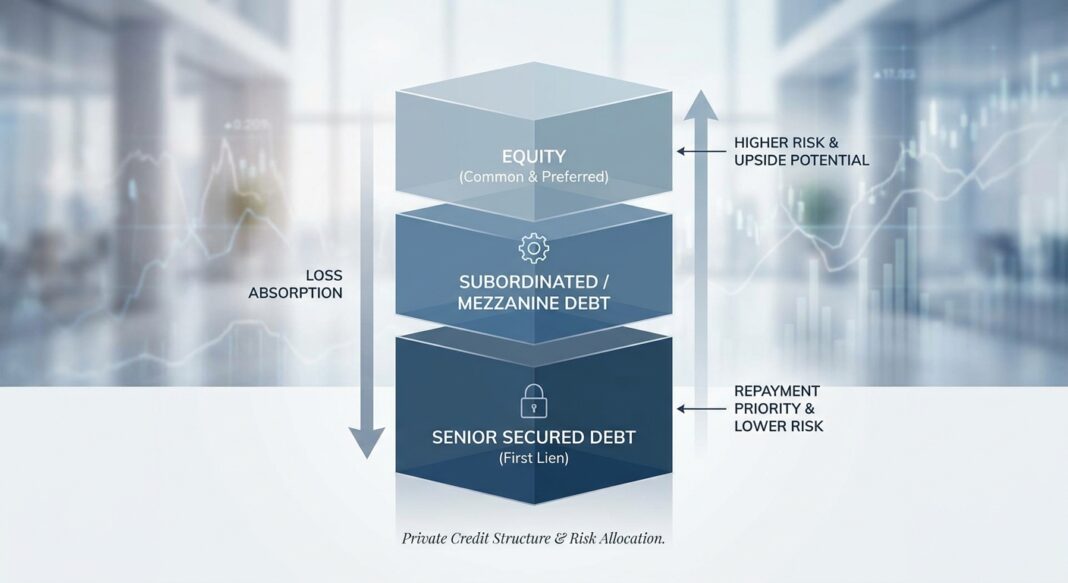
The capital stack is not a metaphor. It is a legally enforced hierarchy of claims on a company’s assets and cash flows. When a borrower cannot make its payments, the capital stack decides who gets made whole first, and who absorbs losses first. Understanding this mechanism is arguably the most important concept in private credit.
What the Capital Stack Actually Is
Think of the capital stack as a repayment line at a bank window. The lenders and investors who financed a company each stand at a different position in that line. Senior secured lenders stand at the front. Common equity holders stand at the back. Everyone in between (subordinated debt, mezzanine lenders, preferred equity) occupies a middle position that determines both their risk exposure and their expected return.
According to BIP Wealth, the layers from lowest risk to highest risk are typically structured as follows:
- Working Capital / Revolving Credit: Short-term obligations that fund daily operations. First in line, lowest yield.
- Senior Secured Debt: Backed by collateral and contractually first in line among long-term creditors. This is the primary focus of most direct lending strategies.
- Subordinated Debt: Repaid only after senior lenders are made whole. Carries higher yield to compensate for lower priority.
- Mezzanine / Convertible Debt: A hybrid layer that may convert to equity under defined conditions. Offers downside protection with selective upside participation.
- Preferred Equity: Ownership with priority over common shareholders for dividends and liquidation proceeds, but still junior to all debt.
- Common Equity: Last in line. Bears maximum risk, but retains maximum upside if the company thrives.
Every layer earns a different return precisely because every layer absorbs a different level of risk. This is not convention; it is the structural logic that makes the entire private credit market function.
A Concrete Example With Real Numbers
Consider a hypothetical middle-market company, a regional manufacturing business with $20 million in annual EBITDA, being acquired in a leveraged buyout at a 6x EBITDA multiple, implying a total enterprise value of $120 million. The acquisition is financed with the following capital stack:
- Senior Secured Term Loan (Direct Lending): $60 million: 50% of enterprise value, first lien, SOFR + 575 bps
- Subordinated / Mezzanine Debt: $20 million: 17% of enterprise value, second lien, fixed 13%
- Sponsor Equity: $40 million, 33% of enterprise value
Now imagine the company hits a cyclical downturn and enterprise value drops 35% to $78 million. At that value, what happens to each layer?
- The senior secured lender recovers $60 million fully, still covered by a $78 million asset base.
- The mezzanine lender recovers $18 million of their $20 million, a 10% haircut.
- The equity sponsor recovers nothing. Their $40 million is wiped out entirely.
The equity cushion beneath the senior secured lender, in this case $60 million of junior capital, had to be fully eroded before the senior lender faced any credit loss. That buffer is not incidental. It is the structural protection that private credit managers specifically underwrite when they originate senior secured loans. According to Blackstone, average loan-to-value ratios in direct lending have remained conservative in recent years, preserving a meaningful equity buffer that must be depleted before senior debt is impacted.
Where the Market Stands Today
The private credit market has grown significantly over the past decade, driven in large part by the structural retreat of banks from leveraged lending following post-GFC regulatory changes. According to Long Angle’s 2026 Private Credit Investment Guide, private credit assets under management were estimated at over $2 trillion in 2025 and are projected to reach $4.5 trillion by 2030. Bank lending as a share of U.S. GDP declined from approximately 59% in Q4 2008 to 44% as of Q1 2025, a gap that private capital has stepped in to fill.
According to PitchGrade’s Private Credit Primer (Q1 2026), global private credit AUM exceeded $1.7 trillion as of Q1 2026, with direct lending spreads for middle-market borrowers running at approximately SOFR + 500–650 basis points. The same source notes that recovery rates on senior secured direct loans historically range from 65–80%, meaningfully higher than high yield bonds at approximately 40%, largely because of the structural position and covenant protections senior lenders negotiate.
Per the LSTA’s Private Corporate Credit FAQ, private corporate credit now accounts for less than 6% of total U.S. corporate debt outstanding, suggesting the asset class remains a meaningful but not dominant portion of overall credit markets, despite its rapid growth.
| Metric | Data Point | Source |
|---|---|---|
| Private Credit AUM (2025 est.) | >$2 trillion | Long Angle, 2026 |
| Senior Secured Recovery Rate (Direct Lending) | 65–80% | PitchGrade, Q1 2026 |
| Middle-Market Direct Lending Spread | SOFR + 500–650 bps | PitchGrade, Q1 2026 |
| PCC Share of U.S. Corporate Debt | <6% | LSTA FAQ, Nov 2024 |
| Direct Lending Premium Over BSL | ~200 bps historically | Blackstone, 2025 |
Decision Framework: Investors and Operators
For Investors Evaluating Private Credit Funds: The first question to ask of any private credit manager is not the target yield; it is the target position in the capital stack. A fund targeting 14% returns through subordinated or mezzanine lending occupies a fundamentally different risk profile than one targeting 10% through senior secured first-lien loans. According to BIP Wealth, a subordinated debt fund and a senior secured direct lending fund are both technically “private credit,” but they stand at very different positions in the repayment line. Investors should evaluate: (1) lien position, (2) loan-to-value ratios at origination, (3) covenant structure, and (4) the size of the equity cushion sitting beneath the fund’s loans.
For Business Owners Raising Capital: Your position in the capital stack determines both the cost of your capital and the operational obligations attached to it. Senior secured debt carries the lowest interest rate but typically includes the most protective covenants: maintenance covenants, financial reporting requirements, and lender consent for material transactions. Mezzanine debt costs more but may offer greater flexibility. Equity dilutes your ownership entirely. Understanding these trade-offs, not just the headline rate, is essential before signing any credit agreement.
Key Takeaways
- Position determines priority. In any credit event or liquidation, the capital stack legally determines who recovers first. Senior secured lenders are structurally first in line among long-term creditors.
- Yield reflects risk, not opportunity. Higher yields in subordinated or mezzanine debt are not free returns; they compensate for accepting a lower position in the repayment hierarchy and greater loss exposure.
- The equity cushion is the senior lender’s first defense. In a well-structured direct loan, junior capital must be fully exhausted before senior lenders face impairment. Underwriting that equity buffer is a core skill of private credit managers.
- Not all private credit is the same. The label “private credit” spans senior secured first-lien loans, mezzanine, distressed debt, and NAV lending, strategies with dramatically different risk profiles. Investors should always identify the stack position before evaluating any fund.
- Bank retreat has made capital stack literacy more important. As banks have stepped back from leveraged lending, private credit funds now occupy a more central role across the capital stack. Understanding where each fund participates (and what that implies for risk) is no longer optional for sophisticated allocators or borrowers.


