
The Story: Digging Holes, Building a Brand, Keeping Half
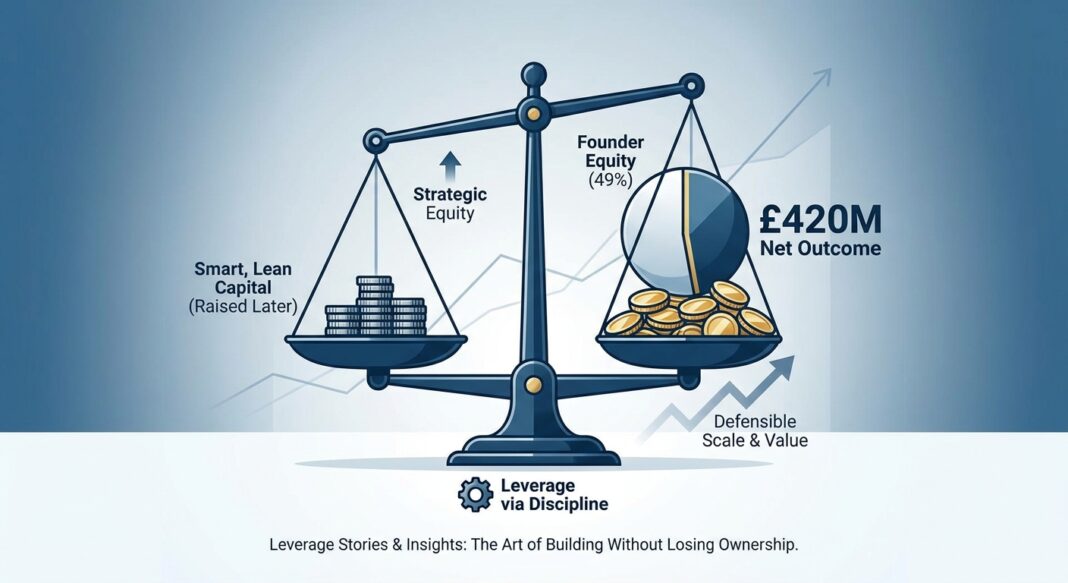
Julian Hearn left school at 16. He worked retail. He spent two years digging holes in roads. By 2026, he had sold his nutrition company, Huel, to Danone for €1 billion, and personally netted £420 million.
That figure isn’t remarkable just because of its size. It’s remarkable because of what it represents structurally: 49.3% of the exit proceeds going directly to the founder, after raising $184 million in outside capital across three funding rounds.
For context, most direct-to-consumer founders who raise comparable capital end up owning 15–25% at exit. The dilution treadmill (Series A, B, C, each round repricing the cap table) is so well-worn that founders often accept sub-20% ownership as the cost of doing business with institutional venture capital. Julian Hearn didn’t. And the reason why has almost nothing to do with clever legal structuring or protective provisions. It has everything to do with when he raised, how much he raised, and what he built before he raised.
According to analysis of Companies House filings and deal waterfall reporting published by creatorsblueprint.co, Hearn bootstrapped Huel to £18 million in revenue before approaching institutional investors for a Series A. That single decision, delaying outside equity until the business had real scale, is the foundational leverage move in the entire story.
The Decision: Raise Late, Raise Less, Raise Right
Most founders raise at the earliest possible moment. The incentive is obvious: capital extends the runway, funds the team, and buys time. But early-stage capital comes with an enormous hidden cost, a low valuation denominator that punishes founders with permanent, compounding dilution.
When Hearn raised his Series A, Huel was already generating £18 million in annual revenue. At a typical 5–6x revenue multiple for a DTC brand at that scale, the implied valuation was approximately £100 million. That meant giving up 20% at Series A cost him a meaningful but manageable slice of the company, not the 30–40% that founders surrender when they raise pre-revenue or at sub-£5M ARR.
Subsequent rounds followed the same discipline: raise capital when there’s a specific, defensible use case (vertical integration, manufacturing infrastructure, retail distribution) not simply to extend runway or accelerate a growth curve that the business couldn’t yet sustain organically. As thunder.vc notes in its analysis of operator-led capital decisions, the strongest founders use capital to solve structural problems, not operational uncertainty. Hearn raised capital to build manufacturing capability. He raised to go omnichannel. He did not raise to “figure out” growth.
The cumulative result: three rounds, $184 million raised, and a founder still sitting at 49.3% on the day the Danone wire cleared.
The Outcome: What 49% Looks Like at a €1B Exit
The Danone acquisition closed at €1 billion: a deal priced at an estimated 17–20x EBITDA, a premium multiple that reflected not just Huel’s revenue trajectory but its improving unit economics: gross margins recovering from 55% to 59% through vertical integration, contribution margins expanding from 21% to 29% over three years, and EBITDA doubling from £9.8 million to £18.2 million in a single year.
Danone didn’t pay a premium because Huel was the fastest-growing DTC brand. It paid a premium because the business had real economics, the kind that come from a founder who ran a company rather than a fundraising narrative. Marketing efficiency ratios (MER) improved from 2.44x to 3.31x as the company scaled, the inverse of what typically happens in performance-marketing-dependent DTC brands.
Julian Hearn’s £420 million personal return stands in sharp relief against the cautionary tale unfolding simultaneously in the U.S. market. Divvy Homes (a rent-to-own startup that raised over $400 million in venture equity and hit a $2.3 billion valuation) sold to Brookfield for $1 billion in early 2025. As saastr.com reported, after repaying $735 million in debt taken on at the peak of the zero-rate era in October 2021, covering transaction costs, and fulfilling liquidation preferences, founders and common shareholders received exactly $0.
Two billion-dollar exits. Two radically different outcomes. The difference was not hustle or product quality. It was capital structure.
The Contrast: When Debt Shrinks the Pie Instead of Growing It
The Divvy Homes story is not primarily a failure of business model execution; it is a failure of capital stack design. The company’s rent-to-own model was genuinely innovative and demonstrably impactful, helping over 2,000 families begin pathways to homeownership. But the business required buying real physical homes, and at scale, that meant massive debt. When interest rates surged in 2022, Divvy’s model broke along two axes simultaneously: financing costs rose, and customer mortgage affordability collapsed.
The lesson SaaStr surfaces is precise and worth internalizing: “Equity dilution reduces your slice of the pie. Debt shrinks the entire pie before you get to eat.” Every dollar of senior debt raises the minimum exit threshold at which equity has any value. At $735 million in debt, Divvy needed an exit above that number before a single dollar flowed to shareholders. The exit was almost exactly $1 billion, and the waterfall consumed everything before reaching founders or common holders.
This doesn’t mean debt is wrong. It means debt must be matched to the cash flow profile of the business, the interest rate environment, and realistic exit scenarios. As vcbeast.com puts it in its framework for sponsor-led capital stacks: “The lender’s maximum leverage is not automatically the right leverage.”
The Lessons: A Framework for Founders Facing the Same Decision
Huel’s story and Divvy’s story are not opposites; they are bookends of the same foundational question every operator faces: how do I fund growth without destroying the outcome I’m building toward? The answer is not always “use debt” and it is not always “raise equity.” The answer is contextual, structural, and deeply tied to the specific cash flow mechanics of your business.
Here is the framework that emerges from both cases:
- Bootstrap to defensible scale before raising equity. Every month you delay outside equity at a low valuation is equity you keep permanently. Hearn’s decision to reach £18M revenue before raising Series A preserved roughly 25–30 percentage points of ownership that would have evaporated in an earlier, lower-valuation round.
- Size capital raises to specific operational needs, not abstract runway. Capital raised for vertical integration, manufacturing, or market expansion has a clear ROI thesis. Capital raised to “buy time” simply delays the dilution conversation without building the underlying business case that protects valuation at the next round.
- Match debt to cash flow durability, not peak market enthusiasm. Divvy took on $735M in debt at the all-time low of the rate cycle. The structure made sense in a world of free money, and became fatal the moment that world ended. As George Alifragis of Metropolitan Partners Group observes via thunder.vc, debt is often cheaper than equity for businesses that are genuinely scaling, but only if the structure fits the business and the partner is aligned with the founder’s north star.
- Understand the waterfall before you sign the term sheet. Liquidation preferences, debt tranches, and transaction costs compound in non-linear ways. Model your exit at 0.5x, 1x, and 2x your target valuation. If the answer at 1x is “founders get $0,” your capital structure needs renegotiation, not your revenue model.
- Build for economics that command premium multiples. Huel’s 17–20x EBITDA exit multiple was not an accident. It reflected improving margins, marketing efficiency at scale, and vertical integration that created a defensible moat. Acquirers pay premiums for businesses that get better as they get bigger, not for high revenue with deteriorating unit economics.
Key Insights
- 🏗️ Timing beats terms. Raising equity at £18M revenue instead of £2M revenue preserved approximately 25–30 points of founder ownership for Julian Hearn, worth over £200 million at exit. No legal provision or protective clause can replicate the compounding advantage of raising at the right moment.
- 📉 Debt doesn’t dilute ownership; it dilutes outcomes. The Divvy Homes case is the clearest recent example: $735M in senior debt meant founders owned 100% of equity that was worth $0 at a $1B exit. Debt raises the floor you must clear before equity has any value.
- 📊 Capital structure is company strategy. The best capital decisions are not financing decisions in isolation; they are strategic decisions that determine who controls the business, who captures the upside, and what exit price constitutes a success.
- 🔁 Non-dilutive capital only works when matched to cash flow. Revenue-based financing, private credit, and asset-backed debt are powerful tools for the right business profile. For a capital-intensive model exposed to rate cycles, the same tools become existential risks.
- 🧮 Model the downside waterfall before you celebrate the term sheet. Every founder should run a full exit waterfall at multiple valuation scenarios, including scenarios below the current round price, before accepting capital structure terms. The moment of clarity should happen in a spreadsheet, not at the closing table.


