
The Growth-Stage Financing Gap: When Senior Debt Runs Out and Equity Costs Too Much
A growth-stage company (say, a $40M revenue B2B software business with $9M in EBITDA and a clear acquisition target in hand) sits in one of the most structurally awkward positions in the capital markets. Its senior lender will stretch to 3.0x–3.5x leverage. The acquisition requires 5.5x total leverage to close. Closing that 2.0x–2.5x gap with equity means issuing shares at a valuation that ownership finds punishing, and likely surrendering meaningful governance rights. This is the classic mezzanine financing scenario: a defined, bounded capital need that sits subordinate to senior debt but above equity in the capital stack, priced to reflect that risk, and structured with features that give lenders upside participation in lieu of hard collateral claims.
Mezzanine debt is not a fallback. Used correctly, it is a precision instrument that allows a growth-stage operator to complete a value-creating transaction without forfeiting the equity upside that justifies the acquisition in the first place. Understanding how to structure it, when to deploy it, and how to negotiate the critical terms separates operators who close deals from those who lose them to better-capitalized competitors.
Structure Breakdown: The Mechanics of Mezzanine Financing
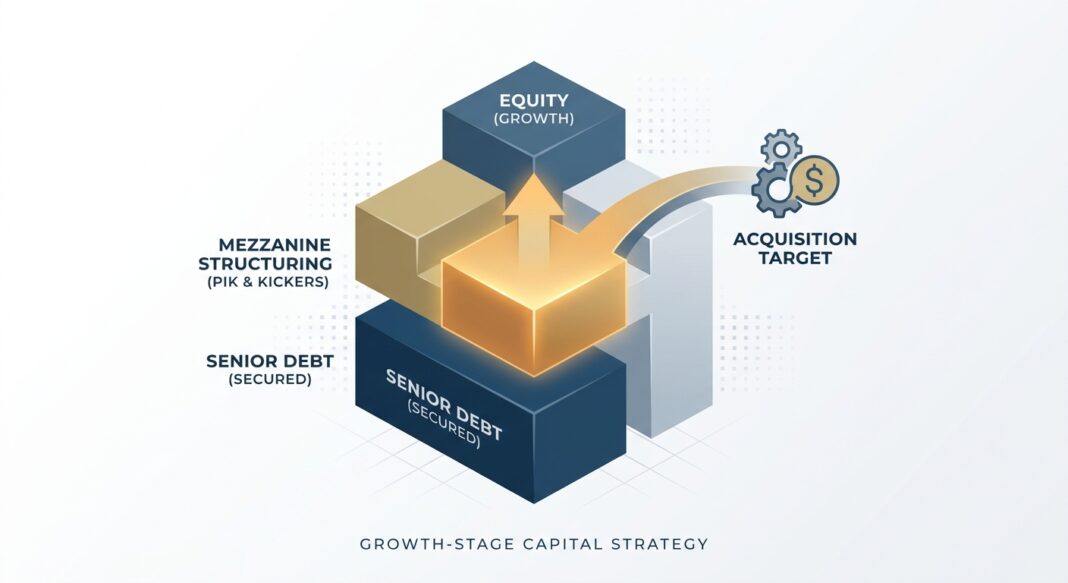
Mezzanine financing occupies the junior subordinated layer of the capital stack, sitting contractually below senior secured debt and above common equity. In an acquisition context, the capital stack typically looks like this:
- Senior Secured Debt (First Lien): 3.0x–3.5x EBITDA, priced at SOFR + 350–500 bps, fully cash-pay, secured by all assets.
- Mezzanine Debt: 1.5x–2.5x additional leverage, priced at 12%–18% all-in, structured as a blend of cash interest and PIK (payment-in-kind).
- Common Equity: Sponsor or founder contribution, typically 30%–45% of total capitalization in a sponsored deal.
Detailed Example: $50M Acquisition of a $100M EV Software Business
Consider a growth-stage SaaS company acquiring a complementary platform for a $50M enterprise value. The combined entity projects $12M in EBITDA post-close. Here is how the capital structure is built:
| Tranche | Amount | Leverage Turn | Pricing | Key Features |
|---|---|---|---|---|
| Senior Secured (First Lien) | $36M | 3.0x | SOFR + 425 bps | Cash pay, maintenance covenants, first lien on all assets |
| Mezzanine Debt | $20M | +1.67x (to 4.67x) | 13% cash + 2% PIK = 15% all-in | 5-year bullet, warrant coverage 3%–5% fully diluted, incurrence covenants |
| Equity (Rollover + New) | $14M | – | – | Common equity, pro rata governance |
PIK mechanics: The 2% PIK component means $400K of annual interest accrues to principal rather than being paid in cash, preserving liquidity in the critical first 12–18 months post-close when integration costs peak. The compounding effect means the mezz lender’s return accelerates if the loan runs to maturity, a deliberate incentive for borrowers to refinance early once senior capacity improves.
Warrant coverage: The 3%–5% equity kicker, typically structured as warrants exercisable at a nominal strike price (often $0.01 per share or a formula tied to the current round valuation), gives the mezz lender participation in the equity upside without requiring a board seat or voting rights. This is the structural trade-off: the lender accepts subordination and a bullet maturity in exchange for yield enhancement through warrants.
Mezzanine vs. Alternatives: Navigating the Cost-of-Capital Spectrum
The decision to use mezzanine rather than an alternative financing layer depends on two variables: how much additional leverage is available from senior lenders, and what equity dilution the ownership group is willing to accept at the current implied valuation.
- Unitranche (vs. Senior + Mezz): A unitranche facility from a direct lender consolidates senior and subordinated debt into a single instrument, typically priced at SOFR + 550–700 bps for growth-stage credits. The unitranche is simpler to execute and has no intercreditor complexity, but its all-in cost can exceed a blended senior/mezz structure by 100–200 bps at scale. For deals under $30M in total debt, unitranche wins on execution speed. Above $50M, the blended structure often prices better.
- Preferred Equity (vs. Mezzanine): Preferred equity sits above common but below all debt in liquidation priority. It offers dividend flexibility (cumulative PIK preferred is common) and avoids the fixed repayment schedule of debt. However, preferred equity is not tax-deductible, making its effective cost materially higher than equivalent-rate mezz debt on an after-tax basis. Operators with strong cash generation should favor mezz; early-stage or unprofitable businesses where covenants are unworkable may need preferred.
- Growth Equity (vs. Mezzanine): Bringing in a growth equity investor at this stage funds the acquisition but dilutes ownership, typically requires minority protections or board representation, and anchors future valuations to the current round price. If the acquisition is expected to drive significant multiple expansion, mezzanine preserves the equity upside for existing ownership.
Current Market Terms: What Mezzanine Looks Like in Q1–Q2 2026
The private credit market has remained active through early 2026, with direct lenders filling the space that broadly syndicated markets vacated for smaller and mid-market credits. Key structural benchmarks observed across recent deal activity and reported market data include:
- All-in mezzanine yields: 13%–18% for growth-stage sponsors, with the cash/PIK split determined by the borrower’s free cash flow profile. Cash-generative businesses are being asked to carry more cash interest; capital-light or reinvestment-heavy models negotiate higher PIK percentages. (Source: Pitchbook Private Credit Report, Q1 2026)
- Warrant coverage: 3%–7% fully diluted equity, with the lower end reserved for investment-grade-adjacent credits and the upper end for early-revenue or high-leverage situations. Exercise prices are being set at current round valuations rather than nominal, reflecting lender discipline after several vintage years of warrant underperformance. (Source: S&P LCD Middle Market Monitor)
- Leverage tolerances: Total leverage for growth-stage software acquisitions is being underwritten at 4.5x–5.5x EBITDA, down from the 6.0x–7.0x peaks of 2021. Senior lenders are holding at 3.0x–3.5x, leaving 1.5x–2.0x of structural gap for mezz. (Source: Debtwire Mid-Market Report, March 2026)
- Maturities: Five-year bullet maturities are standard, with call protection typically structured as 103/102/101/par over the first four years. No-call periods of 12–18 months are increasingly common in competitive processes. (Source: Pitchbook)
- Covenant packages: Mezzanine lenders are accepting incurrence-only covenant packages in sponsor-backed deals but insisting on maintenance covenants (typically a maximum leverage test at 6.0x–6.5x total debt/EBITDA) in non-sponsored or founder-led transactions where lender information rights and governance protections are lighter. (Source: S&P LCD)
The Gap Capital Playbook: Quantifying, Preparing, and Running the Mezzanine Process
Step 1: Quantify the Gap
Start with a clear sources-and-uses table. Define total acquisition cost (purchase price + transaction fees + integration reserve). Subtract available senior debt capacity (confirmed with your lead senior lender, not assumed). The remainder is your gap. Resist the temptation to over-lever the mezz tranche, lenders will stress-test your DSCR (debt service coverage ratio) and require a minimum of 1.10x–1.20x coverage on a fully loaded basis.
Step 2: Prepare the Information Package
Mezzanine lenders are underwriting to a 5-year hold and need to believe in the equity story, not just the debt coverage. Your CIM (confidential information memorandum) should lead with the post-close EBITDA bridge, the revenue retention rate of the acquisition target, and the integration roadmap. Include a detailed capitalization table showing the mezz lender’s warrant position in diluted scenarios. Lenders want to see the path to their exit, either a refinancing event or a sale.
Step 3: Run a Competitive Process
Solicit term sheets from at least three direct lenders and one to two subordinated debt funds. The competitive tension is the single most effective negotiating tool for reducing warrant coverage and loosening covenant packages. Even a second term sheet with inferior economics signals to your preferred lender that the deal is being actively marketed.
Negotiation Guidance: The Terms That Move the Deal
For Operators/CFOs:
- Warrant coverage is negotiable. Push for a cap on dilution in percentage terms rather than a fixed warrant share count; this protects you in down-round scenarios and simplifies future cap table management.
- Fight for PIK optionality. Rather than a fixed cash/PIK split, negotiate the right to PIK up to 50% of the coupon at your election in any given interest period. This preserves liquidity flexibility without committing to a compounding structure you may not need.
- Negotiate the call schedule early. If you anticipate a refinancing within 24 months (because senior capacity will grow with EBITDA), push for a 12-month no-call followed by par, rather than a 4-year premium schedule that penalizes an early exit.
- Incurrence vs. maintenance covenants: For businesses with seasonal or integration-related EBITDA volatility, maintenance covenants are a structural risk. Push for incurrence-only covenants tested on a pro forma basis, which only trigger upon affirmative corporate actions rather than being tested quarterly.
For Investors/Lenders Evaluating the Structure:
- Stress the DSCR at a 20%–30% EBITDA haircut. If coverage breaks below 1.0x in a stress case, the equity cushion is insufficient or the mezz quantum is too large.
- Confirm that warrant exercise mechanics are clearly defined and that anti-dilution provisions protect your economic position in future rounds.
- Validate that the intercreditor agreement with the senior lender permits PIK accrual without triggering a senior default, and that standstill provisions give the mezz lender adequate time to remedy before enforcement.
Key Takeaways
- Mezzanine bridges the structural gap between what senior lenders will underwrite (3.0x–3.5x EBITDA) and the total leverage a growth-stage acquisition requires (4.5x–5.5x), without forcing equity dilution at a suboptimal valuation.
- PIK interest is a liquidity tool, not a red flag. A well-structured PIK feature preserves integration-period cash flow and is standard in growth-stage mezz, the key is negotiating optionality rather than a fixed PIK obligation.
- Warrant coverage is the lender’s equity upside compensation for accepting subordination and a bullet maturity. Operators should negotiate coverage as a percentage cap and push for exercise prices anchored to current, not discounted, valuations.
- Competitive tension drives structure. Running a parallel process across three or more direct lenders is the single most effective way to compress warrant coverage, widen covenant headroom, and improve the call schedule.
- Incurrence covenants are attainable for sponsored or well-documented founder-led deals. They are materially superior to maintenance covenants for businesses navigating post-acquisition integration volatility, and operators should treat them as a non-negotiable starting position in any term sheet negotiation.


