
The Growth-Stage Acquisition Gap: When Senior Debt Isn’t Enough
A founder-led specialty distribution company generating $8M in EBITDA has identified a bolt-on acquisition priced at $60M, five times its standalone debt capacity. The company’s existing bank line is tapped. A private equity co-investor would demand meaningful dilution and board control. A unitranche lender quotes terms, but the leverage required pushes beyond what most direct lenders will clear on a single-tranche basis without equity support.
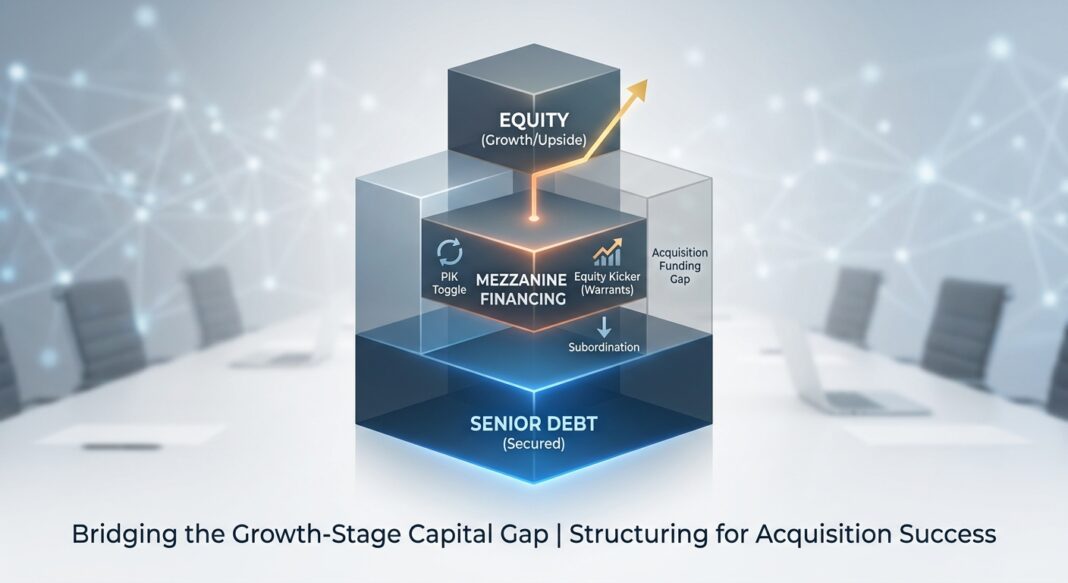
This is the growth-stage acquisition gap: the space between what senior secured lenders will advance and what equity holders are willing to give up. It is one of the most common (and most consequential) financing decisions a growth-stage operator will make. The instrument designed to bridge it is mezzanine financing: subordinated debt that sits below senior secured claims in the capital stack but above common equity, combining a current yield, a PIK toggle, and an equity participation feature to compensate lenders for incremental risk.
Understanding how to structure mezzanine correctly (its components, its cost, its covenants, and its negotiating levers) is not a theoretical exercise. It directly determines how much of your company you keep, how much cash leaves the business every quarter, and what your exit looks like.
Structure Breakdown: The Components of a Mezzanine Facility
Mezzanine financing is not a single instrument; it is a layered package assembled from several economic and structural components. Each component compensates for a different dimension of lender risk: default risk, recovery risk, and opportunity cost.
Component 1: The Debt Instrument Itself
Mezzanine is structured as subordinated unsecured or second-lien debt, typically carrying a fixed contractual interest rate. In the current market environment (as of mid-2026), all-in mezzanine yields for sponsor-backed middle-market deals are generally priced in a range that delivers low-to-mid teens total returns, with the cash-pay component often set between 8% and 11% per annum, supplemented by the PIK and equity layers described below. The instrument typically carries a 5-to-7-year term, with bullet repayment at maturity to preserve cash flow during the hold period.
Component 2: PIK Toggle
Payment-in-kind (PIK) interest allows the borrower to elect, under defined conditions, to accrue interest onto the principal balance rather than pay it in cash. This is not a concession; it is a structural feature that preserves liquidity during integration periods or cyclical downturns. A typical PIK toggle adds 100–200 basis points to the cash-pay rate when elected. Mezzanine lenders price the optionality into the overall return construct. Borrowers should negotiate the conditions under which PIK election is permitted: ideally tied to a minimum liquidity covenant rather than lender consent, which creates operational flexibility without requiring approval.
Component 3: Equity Kicker (Warrants or Co-Investment Right)
The equity participation feature is the instrument that separates mezzanine from straight subordinated debt. It takes two primary forms. Warrant coverage grants the lender the right to purchase a defined percentage of the company’s fully diluted equity at a nominal or fixed strike price, typically representing 3%–8% warrant coverage on a middle-market deal. Alternatively, a co-investment right entitles the lender to participate in a future equity raise alongside existing shareholders. Both mechanisms allow the mezzanine provider to participate in upside without bearing operating risk from day one.
Worked Example: $20M Mezzanine Tranche in a $60M Acquisition
Returning to the $60M bolt-on acquisition scenario, consider the following illustrative capital stack:
- Senior Secured Term Loan (Bank / Direct Lender): $32M at approximately SOFR + 450bps, 5-year term, first-lien position
- Mezzanine Note: $20M at 9.5% cash pay + 2.0% PIK (when elected), 6-year bullet, with 5% warrant coverage on fully diluted equity at a $1 nominal strike
- Rollover Equity (Founder): $5M of rolled equity
- New Equity (Investor / Sponsor): $3M cash equity
Total leverage sits at approximately 6.5x EBITDA on a pro forma combined basis. The mezzanine tranche enables the deal to close without a majority equity sale, preserving the founder’s ownership while bridging the gap between senior capacity and total deal value. The mezzanine provider’s blended return (cash interest, PIK accrual, and warrant value at a projected exit multiple) targets a mid-teens IRR.
Mezzanine vs. Alternatives: Trade-offs Across the Capital Spectrum
Mezzanine is not always the right tool. The capital stack decision is fundamentally a cost-versus-control-versus-flexibility optimization. Understanding where mezzanine sits relative to alternatives clarifies when to use it.
vs. Unitranche (Direct Lending)
A unitranche facility from a direct lender collapses senior and subordinated tranches into a single blended-rate instrument, simplifying documentation and eliminating intercreditor negotiations. It is faster to execute and increasingly available up to 7x leverage in the large middle market. However, unitranche pricing (typically SOFR + 500–600bps for a stretched deal) can approach or exceed the all-in cost of a bifurcated senior/mezz structure, and the lender retains more structural control. Where a company can clear the deal on a unitranche, the speed and simplicity are compelling. Where leverage requirements exceed a single lender’s appetite, the senior/mezz split is operationally necessary.
vs. Preferred Equity
Preferred equity sits below debt in the capital stack and above common equity. It typically carries no fixed maturity, accrues dividends (often PIK), and may include conversion rights. For businesses with irregular cash flow or early-stage operations, preferred equity avoids the covenant and maturity pressure of debt. The trade-off is cost: preferred equity providers target higher IRRs than mezzanine lenders, often 18%–22%+, reflecting the deeper subordination and longer hold optionality. Mezzanine is almost always cheaper for a profitable business that can service cash interest.
vs. Common Equity (Institutional PE)
Bringing in a control-oriented private equity sponsor solves the capital gap but at the highest cost in the stack: loss of operational control, a defined hold period, and a mandated exit process. For founders who prioritize independence or generational transition, mezzanine preserves optionality that a PE sale permanently extinguishes.
When Mezzanine Is Optimal
Mezzanine is the right instrument when: (1) the business generates sufficient free cash flow to service current-pay interest; (2) senior leverage capacity is exhausted but the deal math works on a blended basis; (3) the owner is unwilling or unready to accept majority dilution; and (4) there is a credible path to exit or refinancing within the mezzanine term that will monetize the warrant position at a return the provider finds acceptable.
Current Market Terms: What Mezzanine Looks Like in Mid-2026
The private credit market has continued to mature and expand through 2025 and into 2026. Several structural trends are shaping mezzanine deal terms in the current environment:
- All-in yields remain elevated: As reported by S&P LCD and corroborated by Pitchbook’s private credit deal database, middle-market mezzanine all-in yields for sponsored transactions have remained in the 12%–15% range on a blended basis (cash + PIK), reflecting the rate environment and sustained demand for subordinated capital from a busy M&A pipeline. Non-sponsored deals typically price wider.
- Warrant coverage has compressed on competitive processes: In well-run sponsor processes with multiple mezzanine providers competing, warrant coverage has tightened toward the 3%–5% range, compared to the 5%–10% range commonly seen in the prior rate cycle. Lenders competing aggressively on structure in a yield-rich environment have used warrant reduction as a differentiation lever.
- Covenant packages are predominantly incurrence-based for sponsored deals: Consistent with the broader private credit market, mezzanine documentation for sponsor-backed transactions has migrated toward incurrence-style covenant packages (tested only upon a defined action, such as additional debt incurrence or a restricted payment) rather than maintenance covenants tested quarterly. Non-sponsored and independent sponsor deals still frequently include one or two maintenance covenants, typically a minimum fixed charge coverage ratio.
- PIK elections increasingly require minimum liquidity triggers: Lenders have standardized PIK toggle mechanics to require a minimum cash or revolver availability threshold before the borrower can elect PIK, a structural improvement that protects lenders from strategic cash hoarding while giving borrowers genuine cyclical flexibility.
- Intercreditor agreements have become more lender-friendly: As direct lenders have taken larger senior positions, senior lenders have pushed for tighter standstill periods (typically 90–180 days) before mezzanine holders can exercise remedies. Mezzanine providers are negotiating carve-outs for equity enforcement on warrant positions, which are treated separately from debt remedies.
The Gap Capital Playbook: Quantifying, Preparing, Running the Process
Step 1: Quantify the Gap Precisely
Before approaching any lender, map the full capital stack requirement: total deal value, estimated senior debt capacity (typically 3.5x–4.5x EBITDA for a traditional bank, 5x–6x for a direct lender), available equity, and the residual gap. This gap is your mezzanine sizing target. Stress-test the cash interest coverage ratio at the proposed mezzanine rate, a minimum of 1.5x FCCR post-financing is the baseline most mezzanine providers require to underwrite a cash-pay instrument.
Step 2: Prepare the Mezzanine Information Package
Mezzanine lenders underwrite on free cash flow, not asset coverage. Your information package must include: three years of audited financials, a detailed trailing twelve-month income statement, a five-year financial model with clearly documented assumptions, a management presentation articulating the acquisition thesis and integration plan, and a pro forma capitalization table showing all tranches and the mezzanine provider’s warrant position at various exit multiples. Exit scenario analysis (showing the mezzanine provider’s return at 7x, 8x, and 9x EBITDA exit valuations) is not optional; it is how providers underwrite the equity component of their return.
Step 3: Run a Competitive Process
Even in the middle market, a competitive mezzanine process, engaging three to five providers simultaneously, compresses pricing and warrant coverage materially. Use a structured timeline: initial outreach and teaser distribution in week one, management presentations in weeks two and three, term sheets due in week four. Competition does not require a formal auction; parallel conversations with credible providers are sufficient to establish market tension.
Negotiation Guidance: The Terms That Matter Most
Once term sheets arrive, the negotiation hierarchy for borrowers should follow this priority order:
- Warrant coverage percentage: This is the most economically significant negotiating variable. Every percentage point of warrant coverage at a $1 strike price represents a direct transfer of exit value. Push hard here, particularly if you are running a competitive process. A reduction from 6% to 4% on a $100M exit is a $2M difference in founder proceeds.
- PIK election conditions: Negotiate the PIK trigger to be mechanical (linked to a measurable liquidity metric) rather than subject to lender consent. Consent-based PIK creates operational dependency on the lender at exactly the moment, cyclical stress, when you need autonomy most.
- Call protection: Mezzanine lenders typically require 2–3 years of call protection (make-whole or non-call period) followed by a declining prepayment premium. Negotiate the call schedule to align with your projected refinancing timeline, typically following a period of EBITDA growth that allows a refinancing into cheaper senior debt.
- Change of control provisions: Mezzanine documents almost universally include a mandatory prepayment trigger on a change of control. Confirm that the definition of “change of control” carves out permitted transfers (e.g., estate planning vehicles, intra-family transfers) relevant to your ownership structure.
- Information rights and board observation: Many mezzanine lenders request a board observation right. This is often negotiable to a quarterly financial reporting package in lieu of board access, particularly for closely-held businesses where management confidentiality is a concern.
Key Takeaways
- Mezzanine bridges the acquisition gap without surrendering control: For growth-stage operators who have exhausted senior debt capacity, subordinated mezzanine debt provides the incremental capital needed to complete acquisitions without accepting majority dilution, preserving ownership and strategic independence through the integration period.
- The all-in cost is a blended construct: Cash interest, PIK accrual, and warrant economics must be evaluated together, not separately. A lower cash-pay rate with aggressive warrant coverage can be more expensive in total than a higher cash-pay note with minimal equity participation.
- Competition drives structural improvements: Running a parallel process across multiple mezzanine providers, even informally, consistently produces better warrant coverage, lower PIK spreads, and more borrower-friendly covenant packages than a sole-source negotiation.
- Covenant design determines operational freedom: The shift toward incurrence-based covenants in sponsored mezzanine transactions reflects the market’s recognition that maintenance covenants generate unnecessary default risk in cyclical businesses. Non-sponsored borrowers should actively negotiate for incurrence mechanics wherever possible.
- Mezzanine is a transitional instrument, not a permanent structure: The optimal exit from a mezzanine facility is a refinancing into cheaper senior debt following a period of EBITDA growth, eliminating warrant dilution risk before an exit event and reducing the blended cost of capital as the business matures.


