
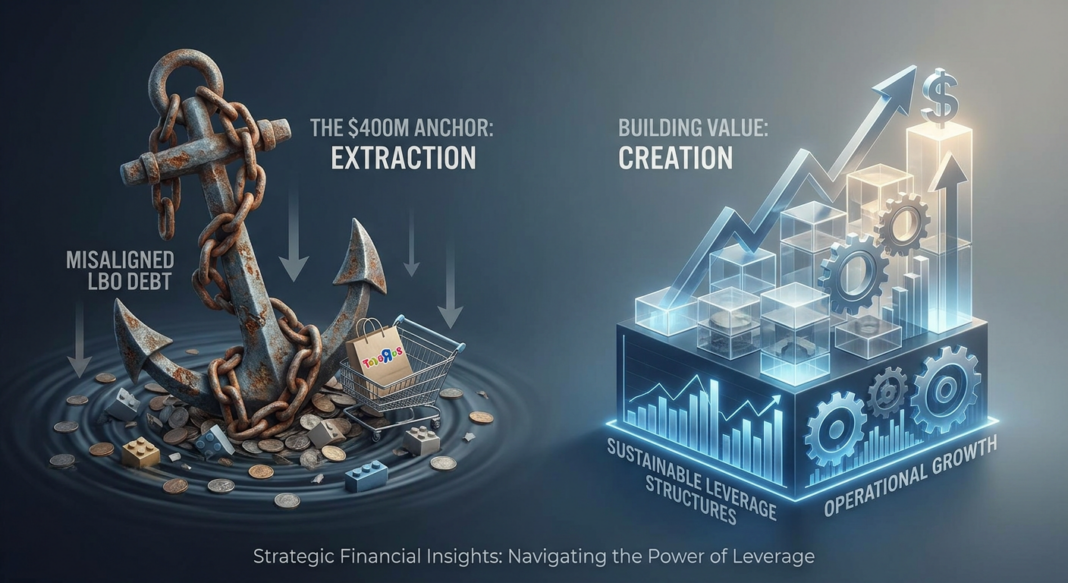
The Story: A Toy Store That Couldn’t Afford to Compete
In the summer of 2005, Toys “R” Us was still one of the most recognizable retail brands on earth. It operated roughly 1,500 stores across 38 countries, held an estimated one-in-five share of all U.S. toy sales, and, crucially, was still turning an operating profit. It needed modernization, not a funeral.
What it got instead was a $6.6 billion leveraged buyout led by three financial sponsors: KKR, Bain Capital, and Vornado Realty Trust. The consortium contributed approximately $1.3 billion of their own equity and borrowed the remaining $5.3 billion. Standard LBO mechanics. Except for one detail that would prove fatal: the acquisition debt was loaded directly onto Toys “R” Us’s balance sheet.
Overnight, the company’s total obligations ballooned to approximately $7.6 billion. A business that had operated with manageable leverage was now staring down annual interest bills of $400–$500 million: money that would never go toward renovating stores, building a competitive e-commerce platform, or investing in supply chain resilience. It would go, year after year, to debt service.
The obituaries that followed the company’s 2017 bankruptcy filing blamed Amazon. They blamed changing consumer habits, too many SKUs, an outdated website. Those forces were real. But they were not lethal in isolation. As the company itself acknowledged in its own bankruptcy declaration, its “overleveraged capital structure constrained it from making necessary operational and capital expenditures, including investing in the revitalization of stores.” The debt wasn’t a contributing factor. It was the primary weapon.
The Decision: Leverage as Extraction vs. Leverage as Creation
To understand what went wrong at Toys “R” Us, you have to understand the structural incentive problem at the heart of this type of deal. The sponsors didn’t merely load the company with debt; they then proceeded to extract value from it regardless of its condition.
Over the 12-year holding period, the private equity consortium extracted an estimated $470 million in management fees and dividend recapitalizations: even as the company’s competitive position deteriorated and its equity marched toward zero. The limited partners in those funds (pension funds, endowments, and institutions) recovered nothing. The final MOIC for LPs on the equity check was 0.0×.
This is the misalignment that defines extractive leverage: the people structuring and managing the deal had a path to positive cash flows regardless of outcome, while the company’s ability to survive depended on cash flow that was being systematically redirected to service debt and fund distributions.
Compare the capital decision faced at entry. At the time of the 2005 buyout, Toys “R” Us had reported EBITDA of roughly $662 million. The $7.6 billion in total debt represented a net leverage ratio of approximately 7× EBITDA: far above the 3×–6× range that analysts typically consider sustainable for a retail operating company. The math was visible on day one. There was no realistic scenario in which the company could simultaneously service $400–500 million per year in interest, invest in its competitive repositioning, and generate a return for equity holders.
The options had been clear: the sponsors could have contributed more equity, accepted lower leverage, and given the company room to breathe. Instead, the structure optimized for sponsor fee extraction, not operational longevity.
“The private equity firms acquired the company with borrowed money, then made the company responsible for paying it back.”, Bankruptcy filings & creditor lawsuits, 2017–2018
The Outcome: What $400 Million a Year Costs a Business
By 2017, Toys “R” Us filed for Chapter 11 protection with $5.2 billion in debt against $4.9 billion in assets. What followed was not a reorganization; it was a liquidation. In June 2018, the last U.S. stores closed. 33,000 workers lost their jobs, most without severance. Vendors were left holding unpaid invoices. Pensions were at risk. The brand that had shaped American childhoods for seven decades was gone.
The counterfactual matters. Remove the LBO debt, and Toys “R” Us was still profitable the year before its bankruptcy, reporting a loss only because of those debt payments, while continuing to control roughly 20% of U.S. toy sales. Competitors had been investing in omnichannel infrastructure. Toys “R” Us could not. It had no financial flexibility. Analysts described the structure as a trap: any downturn in sales, even a mild one, pushed the company to the brink, because the interest clock never stopped ticking.
The sponsors, meanwhile, faced no comparable consequence. Their management fee streams had run for 12 years. Their personal liability was structurally insulated from the company’s collapse.
Now consider a different kind of deal, executed just a few years later with a very different philosophy. In September 2024, Belron International: the global vehicle glass repair and replacement group behind Safelite, Carglass, and Autoglass, executed what Bloomberg reported as the largest PE-backed dividend recapitalization ever recorded. Backed by CD&R and Hellman & Friedman, Belron raised over €8 billion ($8.8 billion) in bonds and loans, using the proceeds to pay out approximately €4.3 billion to its investors. The company remained operationally intact, fully owned by its existing shareholder group, and valued at over €32 billion in subsequent transactions. Shareholders received liquidity. The business kept growing.
That is the structural difference between leverage used for creation versus extraction.
The Lessons: A Framework for Leverage That Builds Rather Than Burns
The Toys “R” Us collapse is not simply a story about too much debt. Debt at 7× EBITDA is a symptom. The disease is structural misalignment between how leverage is applied and who bears the consequences if it fails. Here is what the story teaches:
1. Coverage Is the Binding Constraint: Not the Multiple
A leverage multiple tells you how much debt sits on the balance sheet. An interest coverage ratio tells you whether the business can actually service it. The Toys “R” Us structure required the company to direct most of its annual EBITDA toward interest: leaving no room for capex, growth investment, or error. A healthy LBO maintains a debt-to-EBITDA ratio between 3× and 6×, structured so that the company can service obligations while still funding operations. When coverage disappears, the company stops being a business and becomes a debt repayment vehicle.
2. Leverage for Liquidity Works: When the Business Is Strong
The Belron recap is the right model. A dividend recapitalization, at its core, allows a company to borrow against its own value and distribute proceeds to shareholders, without selling equity, without diluting ownership, without triggering a sale process. Firms that use this tool successfully share a common profile: strong recurring cash flows, stable margins, predictable revenue, and sufficient earnings to service the incremental debt. The tool is the same; the underlying business health determines whether it liberates or suffocates.
In 2024 alone, dividend recap volume in the U.S. reached $81.3 billion: the second-highest year on record, as owners and PE sponsors used debt to return capital while exits remained delayed in a subdued M&A market. The record was set not by the most leveraged companies, but by the strongest ones.
3. Misaligned Incentives Are a Capital Structure Risk
When the people managing a leveraged structure can extract positive cash flows regardless of whether the equity survives, the incentive to protect the operating business is fundamentally weakened. This is not a moral argument; it is a structural one. Moody’s data confirms the pattern at scale: PE-backed companies defaulted at twice the rate of non-PE-backed companies between 2022 and 2024. In 2025, private equity firms were involved in 54% of the largest U.S. corporate bankruptcies, despite representing only about 7% of the economy.
4. The Right Leverage Structure Preserves Optionality
For founders, family offices, and owner-operators, the relevant question is not “should I use debt?” but rather “does this debt structure leave me in control of my own destiny?” A dividend recapitalization at conservative leverage lets an owner take chips off the table without inviting in a new shareholder with a five-year clock. A direct lending facility at 3–4× EBITDA funds an acquisition without diluting the founding family. Leverage, structured correctly, is not the enemy of ownership; it is the mechanism by which ownership is preserved while value is unlocked.
5. Context Determines the Tool
Debt is not inherently dangerous. The Toys “R” Us catastrophe did not happen because leverage exists. It happened because leverage of 7× was applied to a capital-intensive consumer business facing a secular competitive shift, with no financial slack built in and no alignment between debt service obligations and long-term business needs. In contrast, a cash-generative, asset-light services business like Belron (with diversified international revenue and contractual insurance relationships) can carry and service significantly more debt without existential risk. The business model determines the appropriate capital structure. Not the other way around.
Key Insights
- Leverage at 7× EBITDA on a capital-constrained retail business is not a financing decision; it is a verdict. Toys “R” Us was profitable when acquired. The LBO structure, not Amazon, was the primary cause of its collapse.
- Management fee extraction decoupled sponsor incentives from company survival. When sponsors can earn ~$470M in fees and distributions regardless of LP outcomes, the alignment that makes leverage constructive disappears entirely.
- Dividend recapitalizations are a legitimate, powerful liquidity tool, when applied to strong businesses. Belron’s record €8B+ recap in 2024 returned billions to shareholders while leaving a growing, fully operational global business intact.
- PE-backed companies defaulted at twice the rate of non-PE-backed peers in 2024 (Moody’s). The data confirms that the extractive leverage model carries systemic risk that goes well beyond any single deal failure.
- For founders and owner-operators, the question is alignment, not leverage itself. Used correctly, debt funds growth, provides liquidity, and preserves control. Used extractively, it funds someone else’s distributions while you hold the liability.
The Bond Capital Framework: Evaluating a Leverage Decision
Before any leveraged transaction (whether a recap, acquisition financing, or growth facility) operators and owners should stress-test four questions:
- Can the business service this debt in a downturn? Model a scenario where revenue falls 20%. Does the interest coverage ratio stay above 2×? If not, the structure is fragile by design.
- Who benefits if the equity goes to zero? In any leverage structure, understand exactly which parties earn fees, distributions, or management income independent of equity performance. Misalignment is visible before the deal is signed.
- Does this leverage preserve or transfer control? Debt with governance covenants that can hand operational control to lenders in a stress scenario is not the same instrument as covenant-light term debt against a strong business. Know what you’re agreeing to.
- Is the capital being used for creation or extraction? Leverage funding a technology platform, a market-expanding acquisition, or a store renovation program creates value that can service the debt. Leverage funding a dividend to financial sponsors in a weakening business accelerates the decline.
The Toys “R” Us story did not end in 2018. It continues every time a healthy operating business is loaded with debt it cannot escape, managed by owners whose incentives point somewhere else entirely. The lesson isn’t that leverage is dangerous. It’s that leverage in the wrong hands, applied to the wrong structure, with the wrong incentives, is irreversible.
The best capital decisions, the ones that build generational wealth without surrendering control, treat debt as a precision instrument, not a blunt one.


