
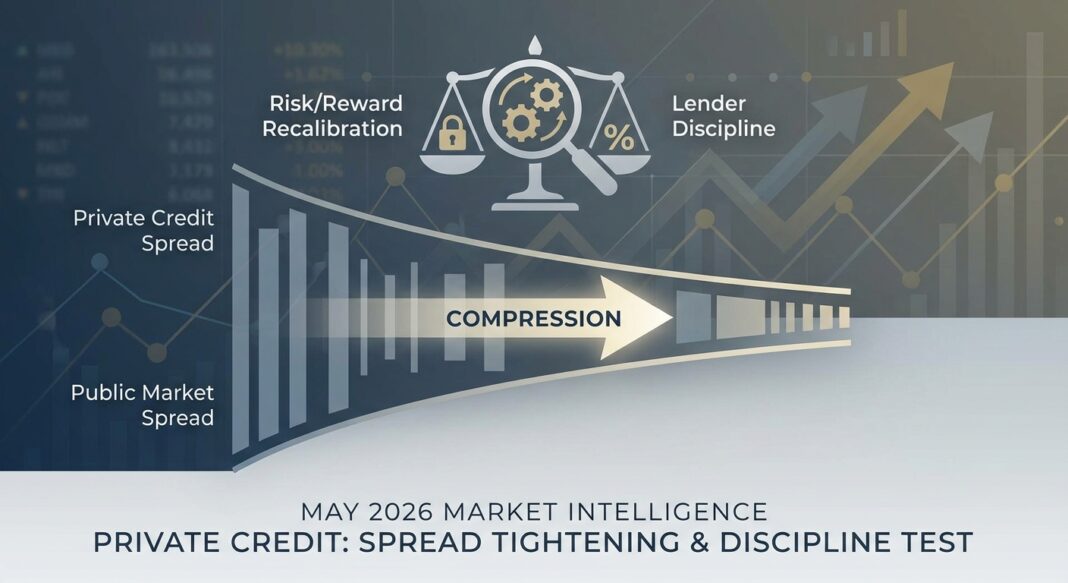
The Compression Cycle: Private Credit’s Risk/Reward Recalibrates at a Critical Inflection Point
The defining credit market story heading into summer 2026 is not a collapse in lending standards; it is a quiet, methodical compression of the premium that private credit has long commanded over public markets. Middle market direct lending spreads have tightened 50–75 basis points since Q4 2025, all-in yields are retreating from their post-2022 highs, and the illiquidity premium that once justified private credit’s structural advantage over broadly syndicated loans and high yield bonds has compressed to its narrowest level since 2021.
This is not a crisis signal; it is a late-mid-cycle recalibration, and it demands precision from both sides of the capital structure. For borrowers, windows of favorable pricing are open but closing. For institutional lenders and investors, the question is no longer whether private credit allocations are attractive in absolute terms, they remain so, but whether current spread levels adequately compensate for underwriting risk, covenant erosion, and the growing correlation between private and public credit in a risk-off scenario.
Against a backdrop of continued bank restraint in leveraged lending (confirmed by the Federal Reserve’s April 2026 SLOOS), private lenders are simultaneously absorbing larger deal sizes, absorbing more sector concentration, and facing a more contested competitive environment as the broadly syndicated loan (BSL) market rebounds in parallel. The credit cycle, in short, is entering a phase where manager selectivity and structural discipline will separate return outcomes far more than market beta.
Quantitative Market Snapshot: May 28, 2026
The table below presents key credit market metrics as of late May 2026, compared to Q4 2025, with sourced references for each data point.
| Metric | Current (May 2026) | Q4 2025 | Change | Source |
|---|---|---|---|---|
| Middle Market Direct Lending Spread | S+475–525 bps | S+525–575 bps | ▼ ~50–75 bps | Cliffwater CDLI |
| Middle Market All-In Yield (Direct Lending) | ~9.2–10.1% | ~10.5–11.2% | ▼ ~100–130 bps | Cliffwater CDLI |
| US HY Bond OAS (ICE BofA Index) | ~+320 bps | ~+380 bps | ▼ ~60 bps | FRED / ICE BofA |
| Broadly Syndicated Loan (BSL) Spread | S+275–325 bps | S+300–350 bps | ▼ ~25–30 bps | Pitchbook LCD |
| Private Credit Illiquidity Premium (vs. BSL) | ~175–225 bps | ~225–275 bps | ▼ ~50 bps | Pitchbook LCD |
| Middle Market Leverage Multiples (Sponsored) | 5.0–5.5x EBITDA | 4.75–5.25x EBITDA | ▲ ~0.25x | Preqin |
| BDC Portfolio Non-Accrual Rate | ~2.1% | ~1.8% | ▲ +30 bps | Cliffwater CDLI |
| US HY Trailing 12-Month Default Rate | ~3.4% | ~3.1% | ▲ +30 bps | S&P Global Ratings |
| US Private Credit AUM | ~$1.7T | ~$1.6T | ▲ ~6% | Preqin |
SOFR reference rate: approximately 4.30% as of late May 2026. Sources: Federal Reserve H.15. All spread and yield figures represent observed market ranges, not guaranteed rates. All-in yield calculations based on SOFR plus applicable spread.
Sector-Specific Lender Appetite: Divergence Is the Signal
The aggregate tightening of spreads masks a pronounced divergence at the sector level, and that divergence is the most operationally actionable intelligence available to institutional investors and operators right now.
🟢 High-Appetite Sectors
Technology & Software (ARR-Based Lending): The most competitive lending environment in the private credit market right now sits squarely in software and technology services. Recurring revenue lending, structured around annual recurring revenue (ARR) multiples rather than EBITDA, has expanded meaningfully in 2026, with spreads in this vertical compressing an estimated 25–40 bps year-to-date as lenders compete for exposure to high-retention SaaS businesses. Underwriting standards have evolved: lenders are increasingly accepting ARR coverage ratios of 0.8–1.0x on senior debt (vs. traditional EBITDA-based FCCR floors of 1.10–1.20x), reflecting confidence in contracted revenue visibility. Firms including Ares Management and Blue Owl Capital have highlighted software and technology as priority verticals in their Q1 2026 portfolio commentary.
Healthcare Services & Life Sciences: Healthcare services continues to attract strong lender appetite, particularly in physician practice management, behavioral health platforms, and specialty pharma distribution. However, a structural shift is underway: FCCR minimums in healthcare have tightened to a 1.20x floor (from 1.10x as recently as mid-2024), reflecting lender caution around reimbursement rate volatility and lingering labor cost pressures. This is a critical underwriting shift for operators in this space, borrowers who were previously credit-eligible may face renegotiation of covenant packages at refinancing.
Infrastructure-Adjacent Industrials: Energy transition infrastructure, data center construction lending, and industrial services supporting domestic manufacturing reshoring have emerged as consensus high-appetite sectors among upper middle market lenders. Deal volumes in this segment rose alongside increased deal flow in Q1 2026, per Preqin’s Q1 2026 data, with lenders attracted by long-dated contracted cash flows and tangible asset bases that support higher leverage multiples, often reaching 5.5–6.0x EBITDA for the strongest credits.
🔴 Constrained-Appetite Sectors
Office Commercial Real Estate: The structural lender retreat from office CRE, now in its third year, shows no meaningful reversal signal. Bank tightening in this vertical remains acute per the Fed’s April 2026 SLOOS, and private credit managers have largely declined to fill the void, treating this as a credit quality issue rather than a pricing opportunity.
Consumer Discretionary & Traditional Retail: Consumer-facing businesses with cyclical revenue profiles are encountering meaningfully tighter covenant structures: shorter amortization periods, lower leverage ceilings (typically capped at 4.0–4.5x EBITDA), and mandatory cash flow sweeps. Lender appetite in this sector is available but increasingly priced for risk rather than competitively.
Implications: What This Market Intelligence Demands of Operators and Investors
For Borrowers & Operators
The current environment offers a genuine, but time-limited, opportunity. All-in yields at 9.2–10.1% represent a meaningful improvement over the 10.5–11.2% levels seen in late 2025, and borrowers in favored sectors (technology, healthcare, infrastructure-adjacent industrials) should treat the next two to three quarters as a strategic execution window. Key priorities: lock in spread levels before potential rate resetting, stress-test FCCR projections against the tightening 1.20x floor now emerging across sectors, and proactively address debt-to-equity ratios ahead of refinancing conversations, lenders are placing increased emphasis on equity cushion (typically requiring minimum 35–40% equity contribution in sponsored transactions) as leverage multiples creep upward.
Operators in constrained sectors should not wait for credit conditions to re-open organically. Structural improvements to EBITDA margins, reduction of lease-adjusted leverage, and covenant-clean balance sheets are prerequisite to re-entering the credit market on competitive terms.
For Institutional Investors & Lenders
The compression of the illiquidity premium to approximately 175–225 bps over BSL rates warrants a systematic reassessment of return expectations across private credit portfolios. With the premium approaching its 2021 lows, institutional allocators must pressure-test whether current yield levels, even at 9.2–10.1% all-in, compensate for rising non-accrual rates (now 2.1% across BDC portfolios per Cliffwater), increasing leverage multiples, and a deteriorating public credit default backdrop (HY defaults at 3.4% LTM per S&P Global).
The forward-looking signal is one of selective discipline, not withdrawal. Managers with deep sector expertise in technology, healthcare, and infrastructure (and the sourcing relationships to access off-market transactions) are best positioned to protect spread premium. Vintage diversification and covenant negotiation rigor will be the primary differentiators in the 2026–2027 deployment cohort.
Key Market Insights: May 2026
- 🔵 Spread compression is structural, not cyclical: The 50–75 bps tightening in middle market spreads since Q4 2025 reflects an excess of deployed capital chasing a finite deal universe, not a fundamental improvement in borrower credit quality. Lenders who compress pricing without tightening structural protections are accumulating vintage risk.
- 🔵 The illiquidity premium is at a cycle low: At 175–225 bps over BSL, private credit’s premium over public markets is near its narrowest since 2021. Institutional allocators should benchmark current net IRR expectations against both historical premiums and rising non-accrual trends before adding exposure.
- 🔵 FCCR floors are moving, borrowers must act now: Healthcare FCCR minimums have shifted to 1.20x and similar tightening is spreading across industrials and business services. Operators with FCCR running at 1.10–1.15x should prioritize operational efficiency improvements before their next lender review cycle.
- 🔵 Sector selection is the alpha driver in 2026: Technology/software, healthcare services, and infrastructure-adjacent industrials are attracting meaningfully better pricing and terms than the broader market. Deal teams and operators in these verticals have negotiating leverage that counterparts in retail, consumer discretionary, and office CRE simply do not.
- 🔵 Bank restraint is durable, not temporary: The April 2026 SLOOS confirms continued net tightening in bank C&I lending standards for mid-market firms. This structural gap remains private credit’s most durable competitive advantage, but managers must price it correctly rather than compete it away through spread compression.
Forward Look: The Next 3–6 Months
The most probable scenario for H2 2026 is a bifurcated credit market: continued strong deal flow and competitive pricing in technology, healthcare, and infrastructure verticals, alongside a gradual repricing of risk in cyclical sectors where non-accrual trends are beginning to surface in BDC portfolios. If SOFR remains in the 4.1–4.4% range, consistent with current Federal Reserve guidance, all-in yields in middle market direct lending could compress further toward the 8.75–9.5% range by Q3 2026, intensifying the pressure on institutional investors to reassess target return assumptions and re-underwrite existing portfolio exposures.
The structural growth of US private credit AUM toward $1.7T and beyond, with major platforms including Apollo, Ares, and Blue Owl actively raising new capital, ensures that supply-side pressure on spreads is not abating. The strategic imperative for both operators and institutional investors is identical: position for precision over scale, covenant quality over yield maximization, and sector concentration in structurally advantaged verticals over undifferentiated market exposure.


