
When One Loan Replaces Many: The Unitranche Revolution
Imagine needing to close an acquisition in 45 days. The traditional path requires negotiating a senior secured term loan with a bank, layering in a mezzanine tranche with a separate fund, agreeing on an intercreditor agreement between the two lenders, and navigating two sets of covenants, two closing teams, and two post-close relationships. Now imagine replacing all of that with a single loan, a single lender, and a single credit agreement, closed in roughly the same time it takes a bank to finish its syndication process.
That is the core promise of the unitranche loan, and it has become the dominant financing structure in the U.S. middle market. What was once a niche tool used by a handful of direct lenders has grown into a structural pillar of private credit, reshaping how companies get capitalized, how sponsors structure acquisitions, and how institutional investors access private debt returns.
Understanding the unitranche (what it is, how it prices, where it fits in the capital stack, and what trade-offs it carries) is foundational knowledge for anyone evaluating private credit as an investor or considering private credit as a borrower.
What Is a Unitranche Loan?
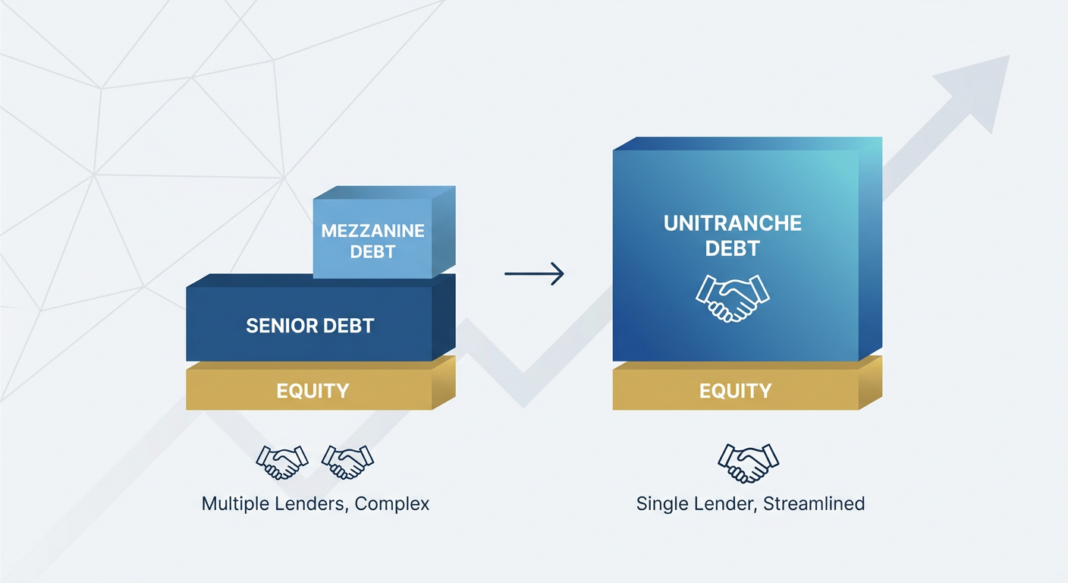
A unitranche loan is a single-tranche debt facility that combines what would otherwise be a senior secured term loan and a subordinated or mezzanine loan into one instrument, governed by one credit agreement, carrying one interest rate, and held by one lender (or a small club of direct lenders).
Traditionally, a leveraged buyout or growth financing required two separate debt layers. A senior secured lender: typically a bank, would provide first-priority capital at the lowest cost, protected by first lien collateral. A mezzanine or second-lien lender: typically a credit fund, would provide junior capital at a higher cost, accepting subordinate collateral claims and recovery risk in exchange for a yield premium. These two parties required a formal intercreditor agreement governing who gets paid first if the borrower defaults.
The unitranche collapses these layers. From the borrower’s perspective, there is one loan document, one interest rate, one covenant package, and one lender group to manage. Internally, some unitranche facilities divide the economics between a first-out (FO) and last-out (LO) tranche, governed by an Agreement Among Lenders (AAL): a private document invisible to the borrower. The FO lender receives lower interest and priority repayment; the LO lender receives higher interest and accepts subordination. The borrower pays one blended rate and never sees the internal waterfall.
The result is a structure that trades a modest yield premium, typically 50 to 100 basis points above a comparable traditional senior-plus-mezz stack, for dramatically simplified execution, faster closing, and fewer lender counterparties to manage over the life of the loan.
How It Works: A Concrete Example
Consider a hypothetical acquisition of a manufacturing services company with $20 million of EBITDA at a 5x purchase price, yielding a $100 million enterprise value. The sponsor will contribute 50% equity ($50 million) and borrow the remaining 50% ($50 million). Two paths are available:
Path A, Traditional Senior + Mezzanine Structure:
- Senior secured term loan: $35 million at approximately SOFR + 400 bps (roughly 7.5% all-in), 6-year term, springing financial covenant
- Mezzanine debt: $15 million at 12% cash + 2% PIK (14% all-in), 7-year term, 3-year non-call period
- Blended debt cost: ($35M × 7.5% + $15M × 14%) ÷ $50M = approximately 9.45%
- Time to close: 100–130 days; legal cost: $450,000–$650,000; two lender relationships to manage
Path B, Unitranche Structure:
- Single unitranche facility: $50 million at SOFR + 575 bps (approximately 10.0% all-in in the current rate environment), 6-year term, one maintenance covenant
- Blended debt cost: 10.0% on the full $50 million
- Time to close: 45–60 days; legal cost: $250,000–$350,000; one lender relationship to manage
The unitranche costs approximately 55 basis points more on a blended basis. In exchange, the operator closes two months faster, reduces legal fees by up to $200,000, and carries a single set of covenants. For a roll-up platform executing multiple add-on acquisitions per year, the speed and simplicity premium pays for itself quickly. According to CT Acquisitions (2026), unitranche blended pricing for a typical 5x leverage deal runs 9.5%–11% all-in, versus a traditional senior-plus-sub structure that prices only marginally cheaper at 9.0%–10.5%, with materially more execution complexity.
Current Market Reality: Where Unitranche Stands in 2026
The unitranche structure has moved from niche to dominant. According to CT Acquisitions (2026), the unitranche market grew from roughly $20 billion in annual issuance in 2015 to over $200 billion in 2025 as direct lenders displaced traditional bank syndication for sub-$1 billion EBITDA borrowers. The gravitational pull is structural, not cyclical, and four current data points explain why.
| Metric | Data Point | Source |
|---|---|---|
| North American Direct Lending AUM (YE 2025) | ~$644 billion (up from $93B in 2015) | Preqin via PIMCO, March 2026 |
| Unitranche Pricing, Upper Middle Market | SOFR + 425–475 bps (sponsored transactions) | Capstone Partners via ABF Journal, Aug 2025 |
| Unitranche Leverage (BDC Universe, Q2 2025) | 5.5x debt-to-EBITDA (vs. 5.4x prior year) | LSEG LPC via NEPC Q3 2025 Report |
| Bank C&I Lending Standards (Q1 2026) | Tighter for firms of all sizes; 4th consecutive quarter of net tightening | Federal Reserve April 2026 SLOOS |
| Private Credit Global AUM (Start of 2025) | $3 trillion (est. $5 trillion by 2029) | Morgan Stanley, 2025 |
The bank lending context is critical. According to the Federal Reserve’s April 2026 SLOOS, banks reported tighter C&I lending standards and higher premiums on riskier loans for firms of all sizes during Q1 2026: with banks citing a less favorable economic outlook, worsening industry-specific problems, and reduced risk tolerance as primary drivers. This ongoing tightening cycle has materially benefited direct lenders offering unitranche facilities, as middle-market borrowers who can no longer access bank financing at acceptable terms migrate toward private credit. Notably, the SLOOS also found that among banks that eased standards, more aggressive competition from nonbank lenders was cited as the primary reason, a direct acknowledgment of the unitranche market’s competitive pressure on traditional banks.
Meanwhile, according to ABF Journal (August 2025), unitranche financings now represent approximately 30% of sponsored middle-market transactions, with private credit controlling over 50% market share in sponsor-backed deals overall. Credit Crunch (January 2026) confirms that fourth-quarter 2025 direct lending spreads held steady at a median of S+475, unchanged from Q3, signaling that while competition is compressing spreads from peak levels, pricing has stabilized at levels still materially above pre-2022 benchmarks.
Decision Framework: Evaluating Unitranche
For Investors Evaluating Private Credit Exposure:
- Yield vs. complexity trade-off: Unitranche lenders earn a blended spread that compensates for holding both senior and junior risk in a single instrument. Investors consider whether the all-in yield (typically SOFR + 425–575 bps depending on deal size and credit quality) adequately compensates for the lack of structural subordination protection that a pure senior lender would have.
- Covenant quality matters more, not less: Because unitranche consolidates risk, covenant discipline is the primary downside protection mechanism. Investors examine whether deals include a maintenance financial covenant (tested quarterly regardless of borrower action) versus a springing covenant (only triggered when a revolver is drawn). Maintenance covenants give lenders early intervention rights, a meaningful structural protection in deteriorating credit environments.
- Manager size and hold capacity: Larger direct lenders (Ares, Blue Owl, Apollo, KKR, Blackstone) can hold $200M–$500M+ unitranche positions on balance sheet. Smaller managers may syndicate portions, reintroducing counterparty complexity. Investors evaluate whether a manager’s hold capacity aligns with deal size to ensure true single-lender dynamics.
- PIK toggle monitoring: According to the NEPC Q3 2025 Private Markets Report, PIK (payment-in-kind) usage across BDCs remained elevated relative to 2024, though declining from peak Q4 2024 levels. Elevated PIK usage in a portfolio is a signal that borrowers are deferring cash interest, a potential early stress indicator investors track in their manager due diligence.
For Operators Considering Unitranche Financing:
- Use unitranche when speed matters most: According to CT Acquisitions (2026), unitranche typically closes in 45–90 days versus 90–150 days for a traditional senior-plus-mezz syndication. For competitive acquisition processes, this speed differential can be determinative, especially on seller-mandated timelines.
- Model the true cost of complexity: Operators consider not just the spread differential but total transaction costs: two sets of legal fees, two sets of diligence, two sets of covenants to comply with, and two lender consents for every future amendment or add-on. The 50–100 bps unitranche premium often looks more attractive after accounting for $150,000–$300,000 in incremental legal and structuring costs on a traditional deal.
- Size dictates the optimal structure: According to CT Acquisitions (2026), the unitranche sweet spot is deals with enterprise values of $25M–$200M. Below that range, SBA or traditional bank senior debt wins on cost. Above $300M, the broadly syndicated loan (BSL) market generally offers tighter pricing. Operators in the middle-market core zone evaluate unitranche as the structurally efficient default.
- Understand the AAL before signing: While operators do not see the first-out/last-out split, the AAL governs what happens in a restructuring or amendment. Operators benefit from understanding that their single lender group may have internal economic disagreements, and ensuring their counsel reviews any provisions that affect amendment thresholds or acceleration rights.
Key Takeaways
- Unitranche is not a compromise; it is an innovation: It packages senior and subordinated risk into a single instrument that delivers execution certainty, relationship simplicity, and flexible covenants. The modest yield premium it commands over traditional structures reflects real structural value, not hidden risk.
- Bank tightening is a permanent tailwind: The Federal Reserve’s April 2026 SLOOS confirms that C&I lending standards tightened again in Q1 2026. Each incremental tightening cycle pushes middle-market borrowers who cannot meet bank criteria toward direct lenders, expanding the addressable market for unitranche capital.
- All-in yield, not spread alone, drives investor returns: Unitranche loans are floating-rate instruments. With SOFR hovering near 3.7% as of Q1 2026 and spreads holding at S+425–575 for middle-market credits, all-in yields of 8%–13% remain materially above pre-2022 benchmarks, even after 12–18 months of spread compression from peak levels.
- Covenants are the unitranche investor’s primary protection: Without structural subordination, investors rely on maintenance covenants, EBITDA cushions, and management access rights to detect and address credit deterioration early. The presence of a financial maintenance covenant (and the cushion to the test level) is among the most important structural terms to evaluate in a unitranche deal.
- Size your deal to the right market: Operators considering private financing evaluate whether their enterprise value falls in the $25M–$200M zone where unitranche lenders compete aggressively and pricing is most efficient. Outside that range, either bank debt (below) or the broadly syndicated loan market (above) may offer lower all-in costs worth the additional complexity.


