
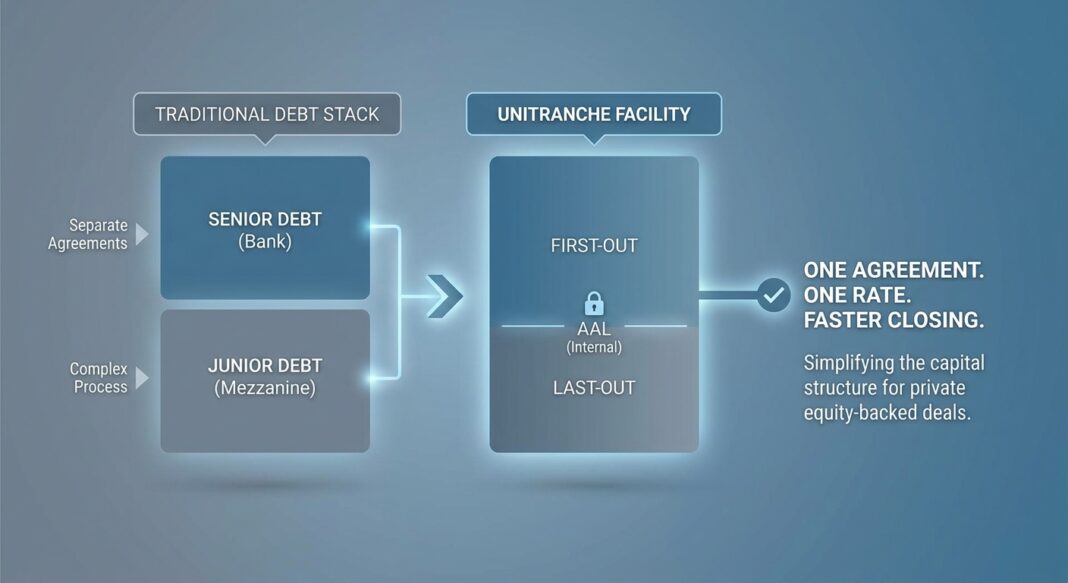
The Problem With Traditional Debt Stacks
When a private equity firm acquires a company, the traditional approach to financing involves multiple layers of debt: a senior secured revolving credit facility from a bank, a first-lien term loan, potentially a second-lien facility, and mezzanine debt sitting above equity. Each layer requires its own credit agreement, its own legal counsel, separate covenants, separate lender groups, and a governing intercreditor agreement that tells everyone where they stand in the payment queue.
That complexity takes time, sometimes months, and introduces real execution risk. In competitive auction processes, a sponsor who cannot commit capital quickly can lose a deal entirely. This is precisely the problem that the unitranche loan was designed to solve. Over the past decade, the unitranche has evolved from a niche middle-market tool into the dominant financing structure for private equity-backed buyouts in the United States, reshaping how private credit operates at scale.
What Is a Unitranche Loan?
A unitranche facility is a single credit agreement that combines what would ordinarily be separate senior and junior debt tranches into one blended instrument with one interest rate. As described by legal practitioners at Lucosky Brookman LLP, the structure offers borrowers a single set of loan documents, a blended interest rate, and greater efficiency in terms of lower overall financing costs and a simplified closing process.
From the borrower’s perspective, the transaction looks and feels like a single first-lien loan. Internally, however, private credit lenders often divide the facility into a First-Out (FO) tranche and a Last-Out (LO) tranche governed by a confidential Agreement Among Lenders (AAL). As explained by the American Bar Association’s Business Law Section (2025), the AAL, not an intercreditor agreement, dictates the economic and control rights of the various lender groups, with payments distributed according to AAL designations rather than lien priority.
The First-Out lender (often a bank providing the revolving credit facility) gets paid first in a stress scenario and accepts a lower yield. The Last-Out lender (typically the private credit fund) absorbs more risk and earns a higher spread. Together, they present a single blended rate to the borrower.
How It Works: A Concrete Example
Consider a private equity sponsor acquiring a company for $700 million: 14x EBITDA of $50 million, financing the deal with $300 million of equity and $400 million of debt. The sponsor approaches both a bank and a private credit firm.
- Bank-only path: The bank offers cheaper debt (roughly SOFR + 3.75% to 4.00%) but will likely only lend up to approximately $200 million (or about 4x EBITDA) leaving a $200 million gap the sponsor must fill elsewhere.
- Traditional two-tranche path: The sponsor fills the gap with a second-lien loan or mezzanine debt priced at a significantly higher rate. Two sets of documents, two lender groups, an intercreditor agreement, and weeks of negotiation follow.
- Unitranche path: The private credit firm (as Last-Out lender) teams with the bank (as First-Out lender) to offer the full $400 million as a single facility, for example, at SOFR + 5.25%. The borrower signs one credit agreement, pays one rate, and closes in weeks, not months.
The blended rate sits above what a pure senior bank loan would cost but below what a full second-lien stack would cost in aggregate: especially once legal, advisory, and management fees across multiple facilities are factored in. As Wall Street Prep notes, while the interest rate on unitranche term loans is higher than traditional term loans, the ease of access, structural flexibility, and shorter closing timelines counteract the higher pricing.
One real-world example illustrates the scale now involved: in early 2026, PitchBook/LCD (March 2026) reported that WWEX Group received a $4.815 billion unitranche loan supporting a Thoma Bravo buyout, priced at SOFR + 575 bps and led by Ares Capital with 33 lenders participating, a demonstration of how far the structure has scaled beyond the middle market.
Current Market Relevance
The unitranche is no longer a niche innovation; it is the structural backbone of the private credit market. Several current data points illustrate its dominance and the macro conditions reinforcing it:
| Metric | Data Point | Source |
|---|---|---|
| Private credit AUM (2025 est.) | ~$2.1 trillion | Private Equity Bro, Oct 2025 |
| Private credit AUM forecast (2029) | $2.64 trillion | Brookfield / Preqin, 2025 |
| Median new-issue unitranche spread (2025) | SOFR + 475 bps | PitchBook / S&P LCD, Jan 2026 |
| CDLI total return (full-year 2025) | 9.3% | Cliffwater / Morningstar, Mar 2026 |
| Bank C&I lending standards (Q1 2026) | Tighter for all firm sizes | Federal Reserve SLOOS, Apr 2026 |
| PC/MM CLO issuance (full-year 2025) | $43.1 billion (record) | PitchBook / S&P LCD, Jan 2026 |
Bank tightening is a critical tailwind for unitranche demand. According to the Federal Reserve’s April 2026 SLOOS, banks reported tighter standards for all categories of non-depository financial institution (NDFI) loans over the past year, with the most widely reported changes including higher premiums on riskier loans, stricter loan covenants, and shorter maximum maturities, conditions that push middle-market borrowers directly toward private credit alternatives.
Meanwhile, spreads are showing the first signs of meaningful widening after years of compression. PitchBook/LCD (March 2026) reported that for much of 2025, spreads plateaued at their lowest level since the decade began, but are now beginning to move wider as deal flow recovers, creating a more favorable entry point for lenders deploying capital into new unitranche facilities.
The Cliffwater Direct Lending Index (March 2026) reported that the CDLI delivered a 9.3% return for calendar year 2025, with interest income of 10.4% as the primary driver, underscoring the cash yield profile that makes direct lending and unitranche investing attractive to institutional allocators even as rate expectations shift.
Decision Framework
For Investors Evaluating Private Credit
- Understand your tranche position. Investors participating in Last-Out positions in a bifurcated unitranche carry more subordination risk than the blended rate suggests. Evaluate whether the yield premium adequately compensates for the payment waterfall structure.
- Assess the AAL’s control provisions. In a restructuring, First-Out lenders hold significant leverage. Investors should evaluate whether their fund’s AAL terms include meaningful consent rights and anti-priming protections.
- Examine borrower EBITDA quality. Unitranche loans often carry fewer maintenance covenants than traditional bank facilities. Scrutinize EBITDA add-backs carefully, as Private Equity Bro (Oct 2025) notes, market caps on pro forma cost savings add-backs clustered around 25–35% of EBITDA in 2024.
- Use the CDLI as a benchmark. Over 20 years, the Cliffwater Direct Lending Index has averaged 9.5% annual returns with only one negative year, providing a useful performance baseline for evaluating manager-level unitranche portfolios.
For Business Operators Seeking Capital
- Consider unitranche when speed matters. If your acquisition or refinancing timeline is compressed, a single-lender unitranche avoids multi-party intercreditor negotiations and can close significantly faster than a traditional bank-plus-mezz stack.
- Negotiate the flexibility features. Unitranche facilities commonly include delayed draw term loans (DDTLs) for add-on acquisitions, PIK toggle options for cash flow management, and limited mandatory amortization, all of which provide operational optionality that syndicated loans rarely offer.
- Model the true all-in cost. The headline spread on a unitranche appears higher than bank pricing. However, when legal fees, advisory costs, and the complexity premium of a multi-tranche structure are properly modeled, the effective cost differential often narrows materially.
Key Takeaways
- One document, one rate, one closing: The unitranche collapses a multi-tranche debt stack into a single credit agreement, eliminating the negotiation complexity and execution risk of coordinating senior and junior lenders through intercreditor agreements.
- The AAL runs the show internally: Behind the single facility, a confidential Agreement Among Lenders governs payment waterfalls, voting rights, and enforcement priority between First-Out and Last-Out lenders, creating a synthetic senior/junior structure invisible to the borrower.
- Bank tightening continues to drive demand: The Federal Reserve’s April 2026 SLOOS confirmed continued tightening of bank C&I lending standards, reinforcing the structural shift of middle-market borrowers toward private credit unitranche solutions.
- Scale has gone mega: Unitranche is no longer confined to the middle market: facilities exceeding $2 billion, arranged through clubs of direct lenders and BDCs, are now standard in the upper market, as evidenced by the $4.815 billion WWEX Group financing in early 2026.
- Spread dynamics are shifting: After years of compression that pushed median new-issue spreads to SOFR + 475 bps in 2025, the market entered 2026 with early evidence of widening, potentially improving risk-adjusted returns for investors deploying into new originations.


