
The Capital Gap That Kills Growth Deals
A founder-led software business with $8M in EBITDA has identified an accretive bolt-on acquisition. The target carries a $60M enterprise value. The company’s regional bank will extend a $20M senior facility secured against recurring revenue contracts, leaving a $15M to $20M gap between what the bank provides and what the deal requires. This is the exact moment most growth-stage acquisitions stall: not because the deal is bad, but because the operator cannot map which layer of the capital stack fills that gap, at what cost, and on what structural terms.
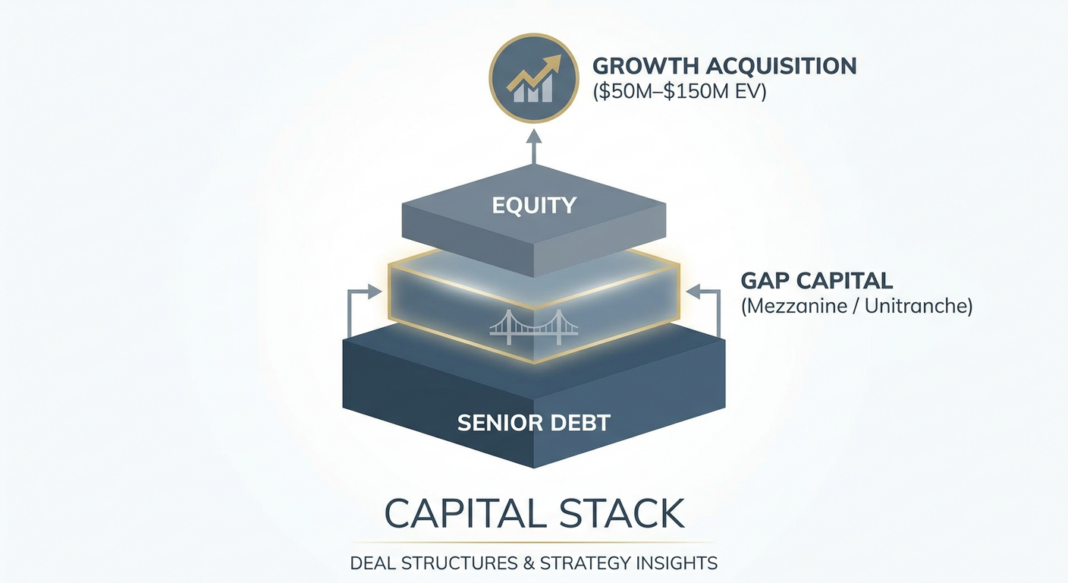
This gap (the space between traditional senior bank debt and equity) is where the modern capital stack has evolved most dramatically. Mezzanine financing, unitranche direct lending, and hybrid structures now dominate middle-market deal financing, offering operators tools to close the gap without excessive dilution. But navigating these options requires understanding how each instrument prices risk, what structural features each demands, and when one solution is superior to another.
This article maps the capital stack for growth-stage acquisition financing, walks through each layer’s mechanics and current market pricing, and delivers a tactical playbook for quantifying the gap, preparing materials, running the process, and negotiating the final structure.
The Cost of Capital Spectrum: From Bank Debt to Equity
Understanding where each instrument sits on the cost-of-capital continuum is the first act of capital stack discipline. For a growth-stage operator pursuing a $50M–$150M enterprise value transaction, the hierarchy runs as follows:
Layer 1: Senior Bank Debt / ABL (Lowest Cost, Highest Security)
Traditional bank revolvers and term loans remain the lowest-cost layer, typically priced at SOFR plus 200–350 basis points for strong middle-market credits. However, banks are constrained by regulatory capital requirements under Basel III, and service- and technology-related businesses that lack hard asset collateral are increasingly underserved by this channel. Banks will rarely extend leverage beyond 2.5x–3.0x EBITDA on a cash flow basis for sub-investment-grade credits.
Layer 2: Senior / Unitranche Direct Lending (Mid-Cost, Maximum Stretch)
This is where private credit dominates. Unitranche direct lending combines what would traditionally be separate senior and subordinated debt layers into one loan with one set of documents, one interest rate, and one lender relationship. The borrower signs one credit agreement with no intercreditor agreement to negotiate, the entire capital structure below equity collapses into a single instrument.
Current market pricing for unitranche facilities in the lower and core middle market sits at SOFR plus 500–700 basis points, with all-in yields running approximately 9.3%–11.3% before OID and fees. Upper middle market credits with stronger sponsorship and recurring revenue can access tighter spreads. According to Capstone Partners’ Q1 2026 Leveraged Finance report, 81% of direct lending LBOs carried spreads below 550 basis points in 2025, reflecting intense lender competition and record dry powder deployment pressure. Total leverage typically runs 4x–6x EBITDA in a single unitranche facility.
Key structural feature for growth operators: Delayed-draw term loans (DDTLs) of 0.5x–1.0x EBITDA are commonly included, available for 12–18 months post-close for add-on acquisitions, making unitranche a natural fit for buy-and-build strategies.
Layer 3: Mezzanine / Subordinated Debt (Higher Cost, Equity-Linked)
Mezzanine sits between senior debt and equity. It is subordinated in repayment priority, typically unsecured, and priced to reflect that risk premium. Mezzanine debt typically targets lender returns of 12%–20%, comprising a cash coupon of 8%–12%, PIK accretion of 2%–4%, and equity participation of 2%–8% through warrants or conversion rights. Maturities run 5–7 years, structured as bullet repayments.
The equity kicker is the defining structural feature. Warrants or options to purchase 1%–5% of the borrower’s equity allow the mezzanine provider to share in value creation. These give lenders potential equity upside and are a standard component of mezzanine deal structures, but they immediately complicate the cap table and require careful negotiation around strike price, vesting triggers, and exit mechanics.
Layer 4: Preferred Equity (Near-Equity Cost, Structural Flexibility)
Preferred equity carries no fixed repayment obligation but commands returns of 15%–20%+, with liquidation preferences and dividend rights that can constrain future financing flexibility. It is most appropriate when debt coverage ratios cannot support additional leverage or when a company is pre-profitability.
Layer 5: Common Equity (Highest Cost, Maximum Dilution)
Growth equity rounds typically demand 18%–25% ownership at entry. According to Carta’s State of Private Markets data, median dilution in 2025 sat at approximately 19.5% for seed rounds and 18% for Series A rounds: figures that reflect a market where capital has become more expensive and investors are demanding greater ownership for risk assumed. Each equity round compounds dilution, making debt-first structuring a priority for operators with serviceable cash flows.
Structure Breakdown: The $60M Acquisition Capital Stack in Practice
Return to our $8M EBITDA software operator pursuing a $60M acquisition. Here is how a practitioner structures the capital stack across two scenarios:
Scenario A: Unitranche Solution (One-Stop Direct Lending)
The operator sources a single $36M unitranche facility (4.5x EBITDA) from a direct lender, supplemented by $24M of equity from the business or a co-investor.
- Pricing: SOFR + 575 bps (approx. 8.75%–9.0% all-in at current SOFR ~3.25%)
- OID: 2% ($720K upfront cost on funded amount)
- Structure: 6-year term, single maintenance covenant (maximum total leverage ratio stepping down annually), 102/101/par prepayment schedule in years 1–3
- DDTL: $8M delayed-draw tranche for add-on acquisitions, available 18 months
- All-in cost: Approximately 9.3%–9.8% including OID amortization
- Closing timeline: 30–60 days from term sheet; no intercreditor negotiation required
Operator advantage: Simplicity, speed, single lender relationship, no dilution. The tradeoff is that maintenance covenants, quarterly leverage tests, will require cushion headroom in the financial model. Private credit lenders in the middle market have maintained firmer positions on covenant inclusion than their broadly syndicated counterparts.
Scenario B: Senior + Mezzanine Split (Layered Stack)
The operator uses $25M of senior bank debt at SOFR + 275 bps (approximately 5.5% all-in), layers $12M of mezzanine financing at a 13% blended rate (10% cash + 3% PIK), and provides $23M of equity.
- Mezzanine pricing: 10% cash coupon + 3% PIK + warrants covering 3% of fully diluted equity
- Mezzanine maturity: 6.5 years, bullet repayment
- Intercreditor agreement: Required between senior lender and mezz provider (adds 4–8 weeks and $150K–$300K in legal costs)
- Total blended cost of debt: ~8.5%–9.0% on the full debt stack
Operator tradeoff: Slightly lower blended cost vs. unitranche, but materially more complexity. Two separate lender negotiations, intercreditor documentation, and warrant dilution on the cap table. The mezzanine layer also introduces a PIK compounding risk: a $12M mezzanine note at 3% PIK grows to approximately $14.3M by year five if the PIK accrues fully, a balance sheet liability that must be addressed before any future equity raise or exit.
PIK Mechanics: What Operators Must Model
PIK interest functions by adding accrued interest to the outstanding loan principal rather than requiring cash payment. The primary purpose is to provide financial flexibility to growth companies that may be cash-constrained during an investment phase. But the compounding effect is material: at 3% PIK, a $12M note grows to approximately $13.9M in year five even with no drawdowns or additional accruals. At a full 11% PIK rate, a $50M note grows to approximately $84M by year five.
PIK is more prevalent today than in the low-rate era. Deals priced in 2024 and 2025 frequently cannot service full cash interest at high multiples, so the junior debt layer has been PIK more often, a structural feature that makes leverage multiples appear similar to 2021 levels even when cash coverage is materially weaker. Operators accepting PIK structures must model the compounding principal burden and its impact on exit proceeds, future refinancing capacity, and EBITDA multiples at sale.
Unitranche vs. Mezzanine vs. Senior/Sub Split: When Each Structure Wins
| Criteria | Unitranche | Senior + Mezzanine | Senior Only |
|---|---|---|---|
| Optimal deal size | $10M–$200M EV | $30M–$500M EV | Any, if leverage headroom allows |
| Closing speed | 30–60 days | 60–120 days | 60–90 days |
| Leverage capacity | Up to 5.5x–6.0x EBITDA | Up to 5.5x–6.5x EBITDA | 2.5x–3.5x EBITDA |
| All-in cost | ~9.5%–11.5% | ~8.5%–10% blended (but warrants add dilution cost) | ~5.5%–7.5% |
| Documentation complexity | Low, one agreement | High, intercreditor + two credit agreements | Moderate |
| Equity dilution | None (debt only) | Minimal cash dilution, but warrant coverage 1%–5% | None |
| Buy-and-build suitability | Excellent (DDTL flexibility) | Moderate (requires mezz lender consent for add-ons) | Limited leverage capacity |
| Covenant structure | Typically 1 maintenance covenant | Senior maintenance + mezz incurrence | Full maintenance package |
Decision framework: Unitranche wins when speed, simplicity, and a single lender relationship outweigh the marginal cost premium over a split stack. For a competitive auction process where a financing contingency could cost the deal, or for buy-and-build platforms where DDTL flexibility and lender consent mechanics matter, unitranche delivers superior execution certainty. The senior-plus-mezzanine structure makes sense when the borrower has time, the deal is large enough to justify legal complexity, and the operator wants to minimize total blended cash coupon while accepting modest warrant dilution.
Current Market Terms: What the Data Shows in 2025–2026
The private credit market heading into mid-2026 is defined by record capital availability, compressing spreads, and a deployment imbalance that continues to favor borrowers on pricing, though covenant packages remain more lender-protective in private credit than in the broadly syndicated market.
Five Key Data Points (All Sourced)
- Spread compression at historic lows. After peaking near 700 basis points in 2022, SOFR spreads on direct lending LBOs compressed to their lowest average levels ever in 2025. The percentage of direct lending LBOs carrying a spread below 550 basis points rose to 81% in 2025, according to PitchBook LCD (via Capstone Partners Q1 2026 Leveraged Finance Report). Total average borrowing costs are projected to decline to approximately 850 basis points (all-in) for 2026 and 2027 as SOFR drifts toward 3.25%.
- Record dry powder constrains lender discipline. U.S. direct lending funds held a record $146 billion in dry powder at year-end 2025, up from $141 billion at the end of 2024, per PitchBook LCD. This deployment pressure is a meaningful tailwind for borrower pricing leverage.
- OID standard at 2%–3%. Original issue discount on private credit deals averaged 2%–3% of funded principal in 2024–2025. On a $36M unitranche facility, a 2% OID means the borrower receives $35.3M but owes $36M at maturity, an effective annualized yield premium of approximately 33 basis points on a 6-year loan.
- PIK prevalence rising. In the direct lending market, PIK income as a share of total income averaged approximately 8.8% in Q3 2025, up from 4.2% pre-pandemic and 7.4% post-pandemic, according to Vanguard analysis of Keefe, Bruyette & Woods data. For mezzanine structures, partial PIK (e.g., 4% cash plus 6% PIK on a 10% total coupon) is the dominant form in subordinated credit deals.
- Covenant trends diverge by market segment. In the broadly syndicated loan (BSL) market, approximately 90% of new loans in 2024 remained covenant-lite. In private credit, most middle-market unitranche facilities retain at least one financial maintenance covenant, typically a maximum total leverage ratio, though larger-cap direct lending deals are increasingly accepting BSL-style documentation as competition intensifies.
The Gap Capital Playbook: Quantify, Prepare, Run, Negotiate
For operators and CFOs navigating a growth-stage acquisition, the process of securing gap capital follows a disciplined four-step sequence.
Step 1: Quantify the Gap
Start with the total uses of capital (enterprise value + transaction costs + working capital adjustment), subtract available equity (own balance sheet + co-investor commitment), and subtract what senior bank debt will provide. The residual is your gap. Map it against two questions: Can this gap be filled with leverage (debt service coverage above 1.5x–2.0x on a stress-case basis)? And does the all-in cost of filling it with debt produce a risk-adjusted return on the acquisition above your hurdle rate?
Use a simple debt sizing test: annual debt service (interest + mandatory amortization) should not exceed 35%–40% of EBITDA at closing leverage. For unitranche at 4.5x EBITDA and a 9.5% all-in rate, annual cash interest runs approximately 42.75% of EBITDA, tight, but manageable for a growing business with forward EBITDA expansion built into the model.
Step 2: Prepare Materials
Private credit lenders underwrite on four dimensions: (1) quality and durability of EBITDA, (2) defensibility of the business model and market position, (3) management capability to execute the acquisition and integration, and (4) exit path and refinancing flexibility at maturity. Your Confidential Information Memorandum (CIM) must address all four directly. Lenders will scrutinize EBITDA adjustments, average adjustments now exceed 25% of reported earnings in some market segments, creating skepticism that well-prepared materials must preemptively address with clear bridging schedules. Include a trailing 12-month adjusted EBITDA bridge, a detailed pro forma combining both businesses, a 3-year operating model under base and stress scenarios, and a clear articulation of the use of proceeds.
Step 3: Run a Competitive Process
Approach three to five direct lenders simultaneously. The unitranche market is dominated by large-scale platforms: Ares Capital, Blue Owl Capital, Antares Capital, Apollo Global Management’s direct lending arm, Golub Capital, and Monroe Capital are active across the $25M–$200M EV range. Obtain term sheets from at least two to three lenders before selecting a lead. Use competing terms sheets not just to drive pricing, but to benchmark structural features: DDTL availability, EBITDA definition, permitted add-on acquisition baskets, and dividend recapitalization allowances. Lender competition in 2026 remains a meaningful borrower tool: the market for debt financing remains highly competitive, giving borrowers continued leverage to set terms, particularly in the mid-market segment.
Step 4: Negotiate the Structure
The highest-value negotiation points for borrowers are rarely headline spread. They are the structural features that govern your flexibility over the loan’s life:
- Covenant headroom: Negotiate a 25%–30% cushion between your closing leverage multiple and the maintenance covenant trigger. A tight covenant at 5.0x total leverage when you close at 4.5x leaves almost no room for a quarter of underperformance.
- EBITDA definition: Push for broad add-backs for non-recurring items, run-rate synergies from acquisitions, and equity-based compensation. The definition of “Consolidated EBITDA” in the credit agreement will govern your covenant compliance for the life of the loan.
- DDTL sizing and availability period: For buy-and-build strategies, negotiate the largest possible DDTL tranche and the longest possible availability window, 18–24 months is achievable with a strong credit profile.
- Prepayment flexibility: Standard unitranche prepayment schedules in 2026 run 102/101/par over years 1–3. Push for 101/par or par call after year one if you anticipate a refinancing catalyst. The effective drag depends on whether you actually refinance, if you hold to maturity, prepayment fees never matter.
- Warrant strike price and coverage (if mezz): For mezzanine structures including warrant coverage, negotiate the strike price at or above current fair market value, cap total warrant coverage at 2%–3% of fully diluted equity, and insist on clearly defined exercise, expiration, and cashless exercise mechanics.
Key Takeaways
- Map the gap first, then select the instrument. The type of capital (unitranche vs. mezzanine vs. preferred) should follow from a rigorous quantification of the gap, debt service capacity, and cost of capital analysis, not from a default preference for one structure.
- Unitranche dominates growth-stage acquisition financing in 2026. With spreads compressed to SOFR plus 500–700 basis points, record lender dry powder, and DDTL flexibility for add-on acquisitions, unitranche offers unmatched speed and structural simplicity for operators in the $50M–$150M EV range.
- PIK interest compounds silently. A $12M mezzanine note at 11% PIK grows to approximately $20M by year five if fully accrued. Model this explicitly in your acquisition return analysis and stress-test exit proceeds against the compounding balance.
- Covenant structure is more valuable than headline pricing. In private credit, covenant headroom, EBITDA definition, and permitted basket sizes govern your operating flexibility for the loan’s full term. A lender offering 25 basis points less spread with tighter covenants may be more expensive in total economic terms than a modestly priced facility with generous structural protections.
- The process itself is a negotiation tool. Running three to five lenders competitively and obtaining multiple term sheets before selecting a lead is the single most effective lever for improving both pricing and structural terms. The market for debt financing in 2026 remains borrower-friendly, but only for operators who approach it with preparation, discipline, and competitive tension.
Sources
Data points, market statistics, and structural frameworks in this article are drawn from the following sources:
- Capstone Partners, Middle Market Leveraged Finance Update, Q1 2026
- PitchBook LCD, Direct Lending LBO Spread and Volume Data, 2025
- CTA Acquisitions, Unitranche Debt Acquisition Financing 2026
- Private Capital Global, Private Capital Debt Benchmarks for the New Rate Environment
- PipelineRoad, Unitranche Capital Raising Glossary
- ABF Journal, The Unitranche Evolution: How One-Stop Financing Is Streamlining Middle Market Capital Structures
- Vanguard, Private Credit’s Third Act: Reconnecting with Banks
- Carta, Mezzanine Debt: What It Is and When to Use It
- Not Very Private Equity, What Is PIK Financing?
- Cleary Gottlieb, Outlook for Private Credit in 2026
- Flow Capital, Financing Your Growth-Stage Company: Choosing Between Equity & Debt
- ABF Journal, Record Dry Powder Fuels Documentation Deterioration and PIK Proliferation
- Akin Gump, 2026 Perspectives in Private Equity: Evolution of Financing Sources
- EdgePoint, Leading with Dry Powder: Focused on Middle-Market M&A in 2026


