
The Core Underwriting Question Every Lender Must Answer
A $10 million EBITDA manufacturing business walks into a credit committee with five years of audited financials, a polished CIM, and a management team projecting 12% revenue growth. The proposed debt load: $45 million, or 4.5x leverage. On a base-case basis, debt service coverage looks acceptable. But here is the question every underwriter must be able to answer before a single dollar is committed: How much can EBITDA decline before this borrower cannot service its debt?
That question is the essence of cash flow stress testing in leveraged lending. The Federal Reserve, OCC, and FDIC’s Interagency Guidance on Leveraged Lending is explicit on this point: financial institutions must develop and implement guidelines for conducting periodic stress tests on loans originated to hold, as well as sensitivity analyses to quantify the potential impact of changing economic conditions on asset quality, earnings, liquidity, and capital. Stress testing is not optional. It is the foundation of sound leveraged credit underwriting.
The Analytical Framework: Three-Scenario Stress Testing
Institutional lenders structure cash flow stress tests around at least three distinct scenarios, each designed to test a different dimension of credit fragility. The sophistication of those tests should match the size, complexity, and risk profile of the portfolio, a standard set explicitly reinforced by interagency leveraged lending guidance.
Scenario Architecture
- Base Case: Management’s projections, adjusted and normalized by the underwriter. Revenue growth is held to industry consensus; margin assumptions are anchored to the trailing 36-month average. This is the scenario used for initial sizing, but never for credit approval in isolation.
- Downside Case: A moderate recession or sector-specific contraction. Revenues typically fall 10–20% from base; EBITDA margins compress as fixed costs remain sticky. This scenario tests whether a borrower can maintain covenant compliance and meet scheduled debt service without accessing revolving credit excessively.
- Severe / Stress Case: A scenario severe enough to trigger at least a one-notch credit rating downgrade. Fitch Ratings’ Corporate Rating Criteria describes this as a scenario where ratings-case projections are stress-tested against centrally defined macro downturns or sector-specific shocks: for example, a sustained raw material cost spike for industrials, or a rapid demand contraction for cyclical consumer businesses.
Example: $10M EBITDA Manufacturing Borrower
Starting from $10M EBITDA, $45M in total debt (4.5x leverage), and annual interest expense of $3.15M at a 7% blended rate with a 7-year amortization schedule requiring $2.5M in annual principal payments:
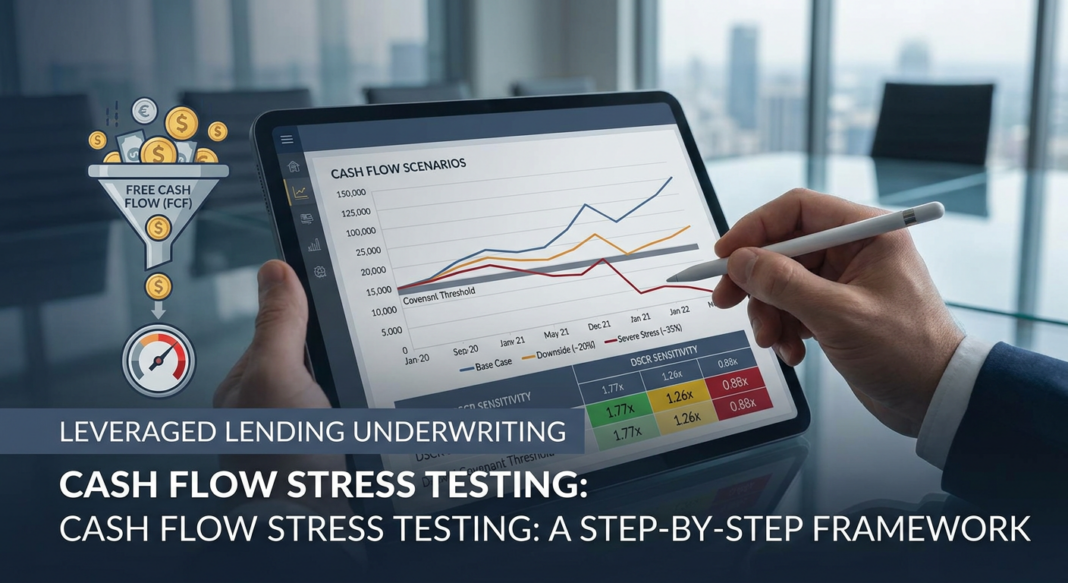
- Base Case EBITDA: $10.0M → DSCR of 1.77x (($10M – $1.5M capex) ÷ $5.65M total debt service)
- Downside Case EBITDA (–20%): $8.0M → DSCR of 1.15x, thin, but serviceable
- Severe Stress Case EBITDA (–35%): $6.5M → DSCR of 0.88x: covenant breach, liquidity draw, potential default trigger
The severe case exposes a fundamental structural risk: at 4.5x leverage, this borrower has limited cushion against a cyclical downturn that is well within historical norms for the manufacturing sector.
Walking Through the Calculations: What the Numbers Actually Tell You
The Debt Service Coverage Ratio (DSCR) is the primary covenant metric in leveraged lending. The formula is straightforward, Free Cash Flow divided by Total Debt Service, but the numerator requires disciplined construction:
Free Cash Flow = Adjusted EBITDA – Cash Taxes – Unfunded Capex – Changes in Working Capital
Each line item is a stress lever. Working capital is chronically underestimated in growth scenarios, a business expanding revenues 12% annually will typically consume 8–15% of incremental revenue in receivables and inventory build. Cash taxes deserve scrutiny when NOL carryforwards are masking near-term tax shields. Maintenance capex, as distinct from growth capex, must be isolated and held flat or escalated across all three scenarios.
The OCC’s Rating Credit Risk handbook reinforces that financial statement analysis (balance sheet, income statement, and sources-and-uses) must be used to assess a borrower’s ability to withstand an economic downturn, not simply to confirm current performance. Projections that look credible in a steady-state environment often conceal structural weaknesses that only become visible under scenario pressure.
Sensitivity Table: DSCR Under Revenue Shock
| Revenue Decline | EBITDA ($M) | FCF ($M) | DSCR | Assessment |
|---|---|---|---|---|
| 0% (Base) | $10.0M | $8.5M | 1.77x | ✅ Acceptable |
| –15% | $8.6M | $7.1M | 1.26x | ⚠️ Monitoring Required |
| –25% | $7.2M | $5.7M | 1.01x | 🔴 Covenant Threshold |
| –35% | $6.5M | $5.0M | 0.88x | 🔴 Technical Default |
What Institutional Lenders Require, And Where Deals Break Down
The Basel Committee on Banking Supervision’s Credit Risk Principles are clear that banks must take into account current and forward-looking market and macroeconomic factors when assessing individual credits, and must assess credit risk under stressful conditions. This is not a qualitative aspiration; it is a supervisory expectation with direct consequences for capital treatment and examination findings.
The most common structural failure in leveraged loan underwriting is not a flawed base case; it is an underpowered stress case. Underwriters frequently make three compounding errors:
- Anchoring the stress case to recent history: Using 2021–2024 performance as the floor for a downside scenario embeds survivorship bias. Cyclical industries regularly experience 30–40% EBITDA contractions during recessions.
- Treating management’s capex guidance as fixed: Growth capex is often presented as discretionary and therefore excluded from the stress case. In practice, deferred capex creates deferred liability, maintenance requirements compound, and asset quality deterioration accelerates at exactly the wrong point in the cycle.
- Ignoring working capital in stress scenarios: Revenue contractions drive receivables write-downs and inventory markdowns that destroy cash in the very period when debt service pressure peaks.
📊 Credit Performance Reference Points
- According to the Federal Reserve’s Leveraged Lending Guidance, transactions where total debt exceeds 6x EBITDA are flagged as meriting heightened supervisory scrutiny.
- Fitch’s Corporate Rating Criteria use a three-year forward forecast horizon combined with at least three years of historical data, representing approximately one full economic cycle, as the minimum analytical window for stress case construction.
- The BIS Counterparty Credit Risk Guidelines emphasize that sound due diligence processes must assess counterparties in both business-as-usual and stressed market conditions, not sequentially, but simultaneously during initial underwriting.
- The OCC Credit Risk Rating handbook identifies structural weaknesses (insufficient covenant protection, unsupported projections, inadequate collateral analysis) as independent grounds for special mention classification, irrespective of current payment performance.
Cash Flow Stress Testing: Underwriting Checklist
Before any leveraged loan reaches credit committee, underwriters should be able to affirm each of the following:
- EBITDA Normalization Completed: Have non-recurring items, owner add-backs, and pro forma synergies been independently verified and haircut to a defensible level? Is LTM EBITDA reflective of the ongoing business?
- Three Scenarios Documented: Base, Downside, and Severe cases are each built from independent revenue and margin assumptions, not simple percentage reductions applied to a single model.
- Maintenance Capex Isolated: Growth capex has been excluded from free cash flow in all stress scenarios. Maintenance capex is held constant or escalated for age of asset base.
- Working Capital Modeled Dynamically: Revenue contraction scenarios include working capital release or destruction consistent with the business model’s cash conversion cycle.
- Covenant Headroom Quantified: The DSCR and leverage covenant triggers have been mapped against each scenario. Breach points are explicitly identified and documented.
- Liquidity Sources Stress-Tested: Revolver availability under each scenario has been confirmed, including the impact of any borrowing base constraints or availability blocks tied to financial covenants.
- Industry Cycle History Reviewed: Peak-to-trough EBITDA contractions for the borrower’s sector have been researched and incorporated into the severe stress scenario floor.
- Management Track Record Assessed: As Fitch’s criteria note, financial performance over time is the most objective measure of management’s ability to execute, historical stress periods must be reviewed, not just trailing growth.
Key Takeaways for Leveraged Loan Underwriters
- 🔍 The base case is not the underwriting case. Loan sizing must be validated against a downside scenario that reflects plausible, not catastrophic, deterioration in business performance.
- 📐 DSCR construction is a discipline, not a formula. The quality of the numerator (how FCF is defined, what is included, and what is excluded) determines whether the ratio is a meaningful credit signal or a flattering artifact.
- ⚠️ Structural weaknesses are independent risk factors. Weak covenant packages, unsupported growth capex deferrals, and management projection bias are underwriting deficiencies regardless of how strong the current income statement looks.
- 🔄 Stress testing is a continuous obligation, not a point-in-time exercise. Interagency leveraged lending guidance requires periodic re-testing of the portfolio against updated economic conditions, not just at origination.
- 📊 Covenant breach points must be precisely mapped. Identifying the revenue decline percentage that triggers a covenant violation is as important as setting the covenant level, and both must be documented in the credit memorandum.


