
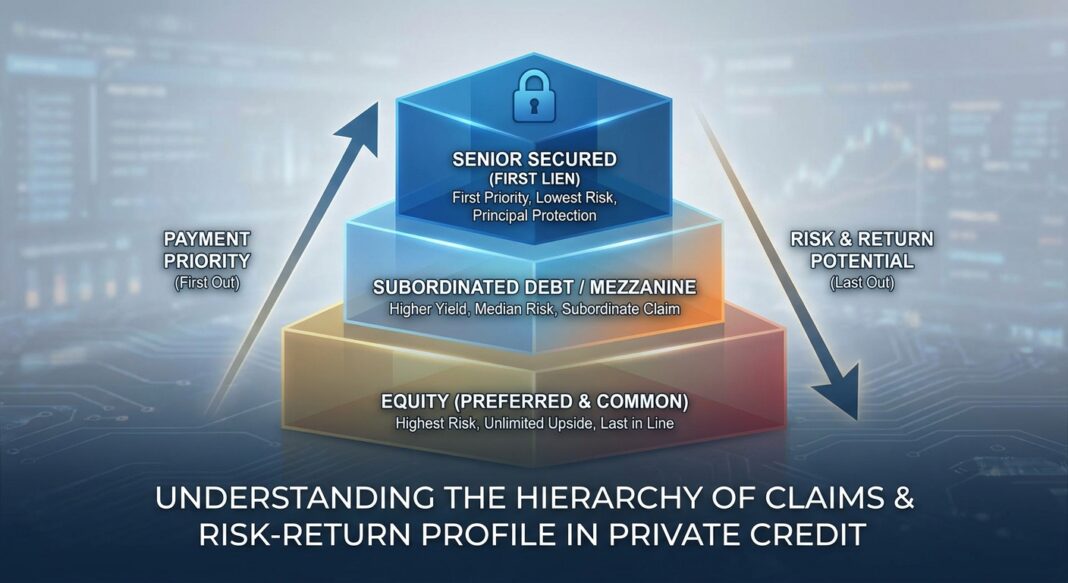
Where You Stand Determines What You Earn, and What You Risk
When a company borrows money, not all lenders are created equal. The capital stack: the hierarchy of claims on a company’s assets and cash flows, determines who gets repaid first when things go wrong, and who earns more in exchange for waiting longer. Understanding where a loan sits in that stack is arguably the single most important concept in private credit investing. It separates a senior secured direct lender from a mezzanine provider, even though both technically hold “private credit.”
For investors evaluating private credit funds, the capital stack position dictates risk, recovery, and return. For business owners and CFOs raising capital, it determines cost, dilution, and covenant intensity. Neither group can afford to treat private credit as a monolithic asset class, because it isn’t one.
The Concept: A Hierarchy of Claims
Think of the capital stack as a repayment waterfall. In a liquidation or restructuring, cash flows to the top first and trickles down from there. The layers, from most protected to least, typically look like this:
- Senior Secured Debt (First Lien): First in line. Backed by collateral: receivables, equipment, real property, or the enterprise itself. The lowest yield in the stack, but the strongest principal protection.
- Senior Secured Debt (Second Lien): Also secured, but subordinate to first-lien holders. Recovers only after first-lien claims are satisfied. Commands a higher spread in exchange.
- Mezzanine / Subordinated Debt: Unsecured or lightly secured. Often includes equity upside through warrants. Higher yield, higher risk, lower recovery in default.
- Preferred Equity: A hybrid instrument with fixed distributions but no collateral claim. Junior to all debt.
- Common Equity: Last in line. Absorbs all losses before anyone else. Unlimited upside, but the first to be wiped out.
As BIP Wealth explains it: senior secured debt is like standing at the front of the repayment line, everyone else waits behind you. Subordinated lenders earn more precisely because they are further back in that line.
How It Works: A Concrete Example
Consider a private equity firm acquiring a manufacturing business for $100 million. The deal is financed as follows:
- $50 million: Senior Secured Term Loan (First Lien), priced at SOFR + 550 bps
- $20 million: Mezzanine Debt, priced at a fixed 14% with warrants
- $30 million: Equity contributed by the PE sponsor
The company later faces stress. Its enterprise value drops to $65 million. Here is how recoveries flow:
- The first-lien lender holds a $50M claim and recovers $50M in full: a 100% recovery.
- The mezzanine lender holds a $20M claim. With only $15M remaining after the senior is paid, they recover $15M, a 75% recovery and a real loss.
- The equity sponsor recovers $0. Their $30M is entirely wiped out.
This scenario illustrates why senior secured lenders, the backbone of most direct lending funds, prioritize structural protection over yield maximization. The equity cushion below them (in this case, the $30M in sponsor equity, or 30% of the capital structure) must be eroded before the senior lender faces any principal loss. That buffer is not incidental; it is engineered deliberately into deal structures.
Current Market Relevance
The capital stack framework has never been more consequential than it is today, as private credit has become the dominant financing mechanism for middle-market companies.
According to PitchGrade (2026), global private credit AUM has surpassed $1.7 trillion as of Q1 2026, with the top five managers (Ares, Apollo, Blackstone, Blue Owl, and HPS) collectively overseeing more than $800 billion of that total. Senior secured direct lending represents the largest single strategy within that universe.
Pricing across the stack reflects risk positioning precisely. As noted by PitchGrade (2026), middle-market direct lending (senior secured) is currently pricing at SOFR + 500–650 bps, while large-cap direct lending trades at SOFR + 425–500 bps. Mezzanine and subordinated debt commands substantially wider spreads, often in the low-to-mid teens on an all-in basis, reflecting the subordinated position in the stack.
Regulatory pressure has structurally shifted who occupies the senior secured lending role. PitchGrade (2026) notes that Leveraged Lending Guidance from the OCC and Federal Reserve effectively prevents banks from underwriting loans with debt/EBITDA above 6.0x, pushing those deals entirely to private credit funds. Today, more than 75% of leveraged buyout financing in deals below $500M EBITDA is provided by private credit funds, not banks.
Blackstone (2026) reports that private credit now represents more than 25% of the U.S. below-investment-grade credit market, up from just 5% in the mid-2000s, a structural shift underscoring how central the asset class has become to corporate financing.
Meanwhile, default rates for senior secured direct lending have remained disciplined. According to Long Angle (2026), citing Proskauer’s Private Credit Default Index, default rates for direct lending have remained under 4% since 2021: a figure that reflects both the protective benefit of senior secured positioning and the underwriting standards of institutional managers.
| Metric | Value | Source |
|---|---|---|
| Global Private Credit AUM | $1.7T+ | PitchGrade, 2026 |
| Middle-Market Senior Secured Spread | SOFR + 500–650 bps | PitchGrade, 2026 |
| LBO Deals Below $500M EBITDA via Private Credit | 75%+ | PitchGrade, 2026 |
| Direct Lending Default Rate (Since 2021) | <4% | Long Angle / Proskauer, 2026 |
| Private Credit Share of U.S. Below-IG Credit Market | >25% | Blackstone, 2026 |
Decision Framework
For Investors Evaluating Private Credit Funds
Before allocating to any private credit strategy, investors consider where in the capital stack the fund primarily operates. A fund described simply as “private credit” could be a senior secured direct lender with sub-4% historical default rates, or a subordinated debt fund with equity-like risk and equity-like return targets. The questions to ask include: What is the fund’s average loan-to-value? What equity cushion sits below the loans? What is the average recovery rate in prior vintages? Senior positioning is not inherently superior, but the risk-return trade-off must be understood clearly before capital is committed.
For Business Owners and CFOs Raising Capital
Operators evaluate the capital stack from the cost and control perspective. Senior secured debt is the cheapest form of non-dilutive capital available to a private company, but it comes with the tightest covenants, collateral requirements, and lender oversight. Moving down the stack (mezzanine, preferred equity) costs more in yield or dilution, but typically provides more structural flexibility. Companies raising growth capital or financing an acquisition weigh the all-in cost of each layer against the operational constraints attached to it. The capital stack is not just a financing decision; it is a governance decision.
Key Takeaways
- Position determines protection: Senior secured lenders are first in line for repayment and last to absorb losses. Every layer below accepts more risk in exchange for more yield.
- Equity cushion is the margin of safety: In a well-structured deal, the equity and subordinated layers below a senior loan must be fully erased before the senior lender faces a loss. Larger equity cushions mean more protection.
- “Private credit” is not one thing: A senior secured direct lending fund and a mezzanine fund are both private credit, but they carry fundamentally different risk profiles. Stack position is the first question to answer.
- Banks have structurally retreated: Regulatory capital rules have made senior secured leveraged lending uneconomical for banks above 6.0x leverage, permanently expanding the role of private credit funds at this layer of the stack.
- Cost increases as you go down: Each layer of the capital stack compensates its holders for subordination. Operators raising capital understand this trade-off; investors allocating capital should demand clarity on which layer they are actually financing.


