
The Underwriting Challenge: What Happens When EBITDA Slips 15% After Close?
A middle-market manufacturer closes a $40M senior secured term loan in Q2 with trailing twelve-month (TTM) EBITDA of $10M, a 4.0x net leverage ratio, and a debt service coverage ratio (DSCR) of 1.8x. By Q4, a key customer representing 22% of revenue delays orders, raw material costs spike, and EBITDA compresses to $8.5M, pushing net leverage to 4.7x. The lender finds out at the next quarterly reporting date. Eighteen months later, the company files for restructuring.
The central failure was not the initial underwriting. It was the absence of a properly calibrated covenant structure that would have triggered lender action at the 4.25x threshold, not at 5.5x when the business was already impaired. Covenants are not legal formalities. They are the lender’s contractual early warning system, and designing them well is one of the highest-leverage skills in credit underwriting.
As the OCC’s Rating Credit Risk handbook notes, sound underwriting structures, including covenants, directly influence the probability and severity of future credit problems. When those protections erode under competitive pressure, credit risk rises even when performance appears stable.
The Framework: Financial Maintenance Covenants vs. Incurrence Tests
Credit agreements use two distinct covenant architectures, and understanding the difference is foundational to covenant design:
- Maintenance covenants require the borrower to satisfy a financial test every quarter, regardless of any action taken. A breach gives lenders the right to accelerate, waive, or renegotiate. These are standard in most direct lending and bank credit facilities.
- Incurrence covenants are tested only when the borrower takes a specific action: issuing debt, making an acquisition, or paying a dividend. These are common in broadly syndicated loans (BSLs) and high-yield bonds, where lender protections are structurally weaker.
For middle-market direct lenders, maintenance covenants are the preferred standard and typically include three core financial tests:
- Maximum Net Leverage Ratio: Total net debt ÷ TTM EBITDA. Example: not to exceed 5.0x, stepping down 0.25x per year.
- Minimum Debt Service Coverage Ratio (DSCR): TTM EBITDA ÷ Total Debt Service (cash interest + scheduled amortization). Example: not less than 1.20x at all times.
- Minimum Liquidity: Unrestricted cash plus revolver availability not less than $2.0M (or 10% of outstanding debt). This is often the earliest-tripping indicator of cash stress.
Example, Analyzing a $10M EBITDA Manufacturing Company: At close, net debt is $38M and EBITDA is $10M, yielding a 3.8x leverage ratio. The lender sets a maintenance covenant at 5.25x with a 0.25x annual step-down. Headroom at close is 147 basis points of EBITDA buffer, approximately $1.47M of EBITDA decline before a technical breach. Headroom analysis at close should always be quantified in dollar terms, not just ratio terms, because it contextualizes the business risk concretely.
The Analysis: Setting Headroom and Running Covenant Stress Tests
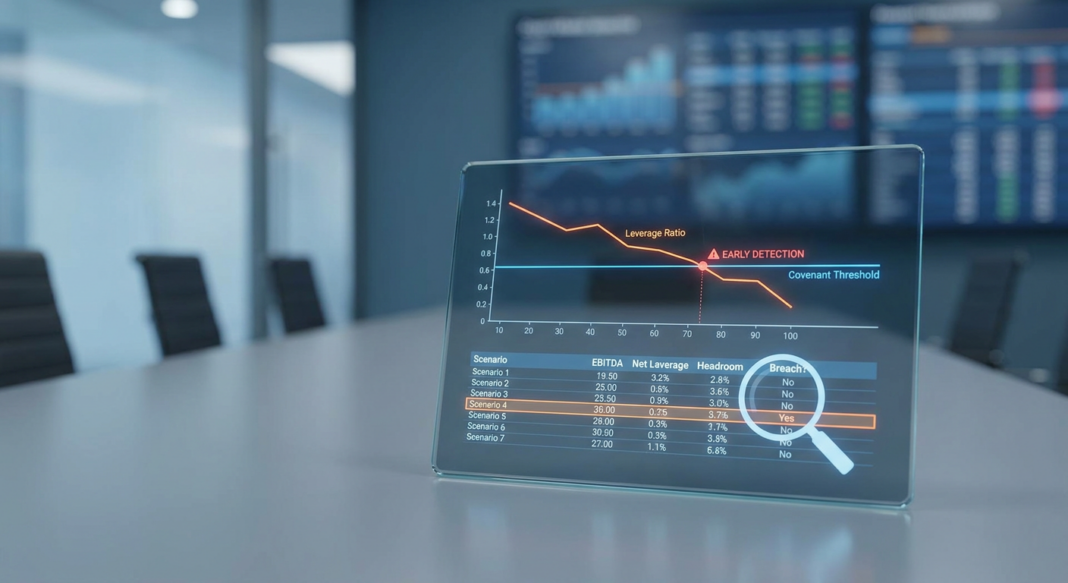
Covenant headroom (the buffer between current performance and the breach threshold) must be stress-tested before closing. The framework below walks through a three-scenario covenant stress test on the manufacturing example above:
| Scenario | EBITDA | Net Leverage | Covenant Threshold | Headroom | Breach? |
|---|---|---|---|---|---|
| Base Case | $10.0M | 3.80x | 5.25x | 1.45x | No |
| Revenue -10%, Margins -200bps | $8.1M | 4.69x | 5.25x | 0.56x | No |
| Revenue -15%, Margins -300bps | $7.2M | 5.28x | 5.25x | -0.03x | Yes |
This output answers the central underwriting question: how severe does the stress need to be before our contractual protections activate? In the scenario above, a 15% revenue decline with 300bps of margin compression, a plausible manufacturing downturn, triggers a technical default. That is a desirable outcome. It gives the lender a seat at the table while the business still has enterprise value to protect.
The DSCR test adds a parallel constraint. If annual debt service is $4.2M ($3.5M interest + $0.7M amortization), a 1.20x minimum DSCR requires at least $5.04M of EBITDA. In the severe stress scenario, EBITDA of $7.2M still clears the DSCR test at 1.71x: confirming that leverage deterioration, not cash flow, is the leading indicator here. Both tests serve different diagnostic functions and should always be run together.
Industry Standards: What Institutional Lenders Require
Experienced institutional credit managers (including direct lenders, BDCs, and insurance company private credit platforms) apply several standards that differentiate disciplined underwriting from covenant-lite structures:
- Headroom at origination: Most institutional frameworks require at least 20–30% cushion to the first maintenance covenant test at close. A covenant set at 5.0x for a 3.8x borrower implies 24% headroom, within acceptable range. Anything below 15% at close warrants escalated credit committee review.
- Step-down schedules: Leverage covenants should tighten 0.25x–0.50x annually, reflecting the lender’s expectation of deleveraging from operations and scheduled amortization. Flat covenants that never step down fail to incentivize paydown.
- EBITDA definition discipline: The most consequential negotiation in any credit agreement is often the EBITDA definition. Institutional lenders increasingly cap addbacks (particularly non-recurring and synergy-related adjustments) at 15–25% of unadjusted EBITDA. As noted by BIS/BCBS guidance on counterparty credit risk, ongoing due diligence must continuously reassess whether management’s reported figures reflect actual economic performance.
- Reporting cadence: Quarterly financial statements (within 45 days of quarter-end) and annual audited financials (within 120 days of fiscal year-end) are the institutional minimum. Monthly management accounts should be required for any borrower with leverage above 4.5x or in a cyclical industry.
- Cure mechanics: Equity cure rights, permitting sponsors to inject equity to remedy a covenant breach, should be limited to two to three times over the loan life, with cure amounts capped at the minimum needed to fix the breach, not to create additional cushion.
📊 Credit Performance Reference Points
- Covenant-lite loans have grown to represent the majority of broadly syndicated institutional loan volume in recent cycles, reducing early-warning capacity for lenders in public markets.
- Middle-market loans with maintenance covenants have historically provided lenders more time to intervene, often 2–4 quarters before a payment default, compared to covenant-lite structures where lenders typically only learn of distress at missed payment.
- The OCC’s credit risk rating guidance explicitly links structural weaknesses in covenant design to higher loss-given-default outcomes, noting that weakened underwriting protections affect probability and severity of future credit problems even when current performance appears stable.
- Per OSFI’s 2026 Capital Adequacy Requirements, due diligence analyses, including covenant adequacy reviews, must be completed at least annually for regulated institutions, with higher-frequency reviews required for deteriorating credits.
- Commercial mortgage lenders typically require DSCR minimums of 1.20x–1.30x depending on asset class, as documented in commercial mortgage underwriting frameworks, a benchmark that translates directly to corporate direct lending practice.
Covenant Underwriting Checklist: Pre-Close Diligence Points
Before any credit committee submission, the following covenant-specific diligence items must be completed and documented:
- Define EBITDA precisely. Document every addback category, apply a hard cap on non-recurring items (target: ≤20% of unadjusted EBITDA), and confirm the definition is consistent with QoE findings.
- Run the three-scenario covenant stress test. Base, moderate stress (revenue -10%), and severe stress (revenue -15% to -20%). Document breach points in dollar EBITDA terms.
- Confirm headroom ≥ 20% at close across all maintenance tests. Escalate to credit committee if any test shows less than 15% headroom.
- Negotiate step-down schedule. Ensure leverage covenant tightens at least 0.25x annually. Confirm it aligns with the base case deleveraging profile from the financial model.
- Review reporting obligations. Confirm quarterly financials within 45 days, annual audited financials within 120 days, compliance certificates with each delivery, and management calls at least semi-annually.
- Document cure right limitations. Cap equity cure events (2–3 maximum over loan life), cap cure amounts to minimum-necessary, and include a prohibition on consecutive cure periods.
- Identify leading indicators for monitoring. For each borrower, establish 2–3 operational KPIs (e.g., customer concentration, order backlog, inventory turns) that will be tracked alongside financial covenants as early-warning signals.
- Map covenant breach to remediation protocol. Before close, document the internal escalation path: who is notified at breach, what is the timeline for waiver or amendment negotiations, and what protections are preserved during the cure period.
Key Takeaways
- Covenants are early-warning instruments, not legal boilerplate. A properly calibrated maintenance covenant gives lenders contractual intervention rights while collateral value still exists, before default, not after.
- Headroom must be quantified in EBITDA dollars at close. Ratio-only headroom analysis obscures the actual dollar magnitude of deterioration a borrower can sustain before a breach. Always translate ratios into cash flow terms.
- EBITDA definition is where covenant strength is won or lost. Aggressive addback provisions structurally inflate reported EBITDA, create false headroom, and delay breach signals. Lenders should cap addbacks and document each adjustment with source evidence from QoE analysis.
- Stress testing must be systematic and scenario-specific. A single downside scenario is insufficient. Model revenue, margin, and leverage combinations independently to understand which variables drive the fastest covenant deterioration for each specific credit.
- Ongoing monitoring requires operational KPIs alongside financial tests. Financial covenant tests are lagging indicators. Customer concentration shifts, order book contractions, and working capital deterioration are leading signals that often precede EBITDA compression by one to two quarters, giving proactive lenders critical additional reaction time.


