
The Growth-Stage Gap Capital Playbook: How to Structure Mezzanine Financing When Senior Debt Runs Out and Equity Dilutes Too Much
A practitioner guide for CFOs, founders, and deal professionals navigating the most strategically complex layer of the capital stack.
The Growth-Stage Financing Challenge: Caught Between Two Bad Options
Here is the scenario that confronts hundreds of profitable growth-stage companies every year. A manufacturer, a software business, or a multi-unit services operator has proven its model. EBITDA is real, coverage ratios are solid, and management wants to execute a significant use-of-proceeds event: an acquisition, a geographic expansion, a recapitalization, or an ownership transition. The CFO runs the numbers and lands on a $20M to $50M capital need.
The bank says no, or rather, the bank says yes to the senior-secured portion that fits cleanly inside an asset base or 3.0x to 3.5x EBITDA, and no to the rest. The equity path is available, but at a meaningful cost: equity investors at this stage typically demand 15% to 30% ownership for minority checks, creating permanent dilution against a business that management believes is on the verge of its most valuable phase.
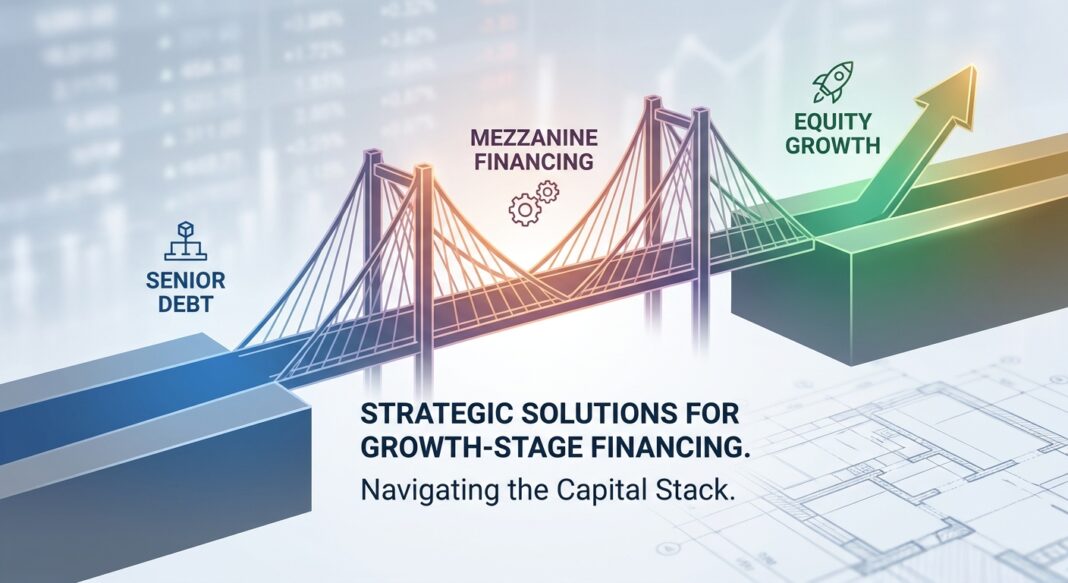
That is the gap. And filling it intelligently (without over-leveraging the business or surrendering unnecessary ownership) is precisely what mezzanine financing is engineered to do. Mezzanine debt is a hybrid form of capital that sits between senior debt and equity in the capital stack, functioning as a bridge that unlocks the proceeds of a transaction that would otherwise stall. Understanding how to structure it, price it, and negotiate it is one of the most important skills in growth-stage deal-making.
Mapping the Cost-of-Capital Spectrum: Banks to Equity
Before structuring any solution, operators and their advisors need to anchor on where each layer of capital sits on the risk-return spectrum. The capital stack is a strict hierarchy: senior debt sits at the top, subordinated debt in the middle, and equity at the bottom: in terms of repayment priority in a liquidation, and inversely in terms of cost and return expectation.
| Layer | Instrument | Indicative Cost (2026) | Leverage Capacity | Key Feature |
|---|---|---|---|---|
| Senior Secured | Bank term loan / ABL revolver | SOFR + 200–350 bps | 2.5x – 3.5x EBITDA | Lowest cost; requires maintenance covenants, amortization |
| Unitranche / Direct Lending | Single-facility private credit | SOFR + 425–725 bps | 4.5x – 6.0x EBITDA | One lender, one agreement; blended senior/sub pricing |
| Mezzanine | Subordinated note + equity kicker | 12% – 20% all-in (cash + PIK + warrants) | Fills gap above senior to 5.0x–6.5x EBITDA | PIK toggle; warrant coverage; bullet maturity |
| Preferred Equity | Structured preferred shares | 12% – 18% dividend + liquidation preference | Flexible; no fixed leverage ceiling | No fixed repayment; accrues on cap table; complex exits |
| Common Equity | Growth equity / private equity | 20%–30%+ ownership for minority checks | Unlimited | Permanent dilution; board control implications |
The insight that drives capital structure decisions is simple: every dollar of capital has a cost, and that cost rises as you move down the stack. The job of a CFO or capital advisor is to use the cheapest available layer first, fill the maximum amount of the need with it, and then layer up the stack only as far as the use-of-proceeds economics and debt service capacity require.
For a growth-stage company with $5M to $15M EBITDA executing a $20M to $50M transaction, the typical outcome is a senior facility covering 60–70% of the need and a mezzanine layer covering the remaining 30–40%. This is the gap that this article addresses.
Mezzanine Structure Breakdown: Every Component Explained
Mezzanine financing is not a single instrument; it is a package of features that can be combined in dozens of ways. Understanding each component is essential before negotiating any term sheet.
1. Cash Interest
The cash coupon is the base cost of the capital, paid regularly, typically quarterly. Current market rates for a performing growth-stage company run between 8% and 12% cash interest, depending on credit quality, leverage, and sector. This is the portion of cost that immediately affects free cash flow and debt service coverage.
2. Payment-in-Kind (PIK) Interest
PIK interest does not require a cash payment. Instead, the interest accrues and is added to the outstanding principal balance, compounding over the life of the facility. This is the defining cash-flow benefit of mezzanine financing: borrowers conserve near-term liquidity at the cost of increased principal obligations at maturity. A typical structure splits the coupon (for example, 10% cash-pay plus 3% PIK) to balance lender yield requirements against borrower cash flow.
PIK is particularly valuable during integration periods post-acquisition, capex cycles, or early-phase geographic expansions, when cash generation temporarily lags investment. The tradeoff is transparent: the lender gets a higher all-in IRR (via compounding), and the borrower gets protected liquidity in the near term.
3. Equity Kicker (Warrants)
The equity kicker is what transforms mezzanine from pure debt into a hybrid instrument. Warrants give the mezzanine lender the right to purchase a defined percentage of the company’s equity at a predetermined strike price, typically set at or near the company’s enterprise value at the time of the financing. Warrant coverage typically represents 3% to 8% of the total loan amount, expressed as a percentage of the borrower’s fully diluted equity.
The kicker serves two purposes. For lenders, it provides equity upside that boosts total returns toward a 15% to 20% IRR target. For borrowers, it reduces the cash coupon required, a company willing to grant warrants can often negotiate a lower cash-pay rate in exchange, improving near-term debt service economics.
4. Maturity and Amortization
Mezzanine facilities are almost universally structured as bullet repayments at a 5- to 7-year maturity, with no scheduled principal amortization. This is a critical structural advantage versus senior bank debt, which requires quarterly amortization. The bullet structure aligns naturally with an operator’s plan to refinance, sell, or recapitalize the business within an exit window, preserving cash flow for operations during the hold period.
5. Subordination and Intercreditor Dynamics
Mezzanine lenders sit junior to all senior secured lenders in the repayment waterfall. An intercreditor agreement governs the relationship between the senior lender and the mezzanine provider, defining standstill periods (typically 180 days), payment blockage rights, and enforcement rights. This complexity is the price borrowers pay for accessing the additional leverage capacity that mezzanine provides.
Worked Example: A $45M Acquisition Financing for a $75M EV Manufacturing Services Company
Consider a manufacturing services company with $8M EBITDA seeking to acquire a bolt-on for $45M enterprise value. The company’s senior lender is comfortable to 3.5x leverage, providing a $28M senior term loan. That leaves a $12M gap between the senior facility and the $45M need (with the remaining $5M funded from management’s equity rollover).
Indicative Mezzanine Term Sheet Summary
| Facility | $12,000,000 subordinated note |
| Coupon | 9.0% cash interest + 3.5% PIK = 12.5% total current yield |
| Maturity | 6 years (bullet) |
| Equity Kicker | Warrants representing 4.5% of fully diluted equity at a strike price equal to closing enterprise value |
| OID | 2.0% original issue discount (funded upfront) |
| Prepayment Premium | 103 / 102 / 101 / par (years 1 through 4+) |
| Covenants | Maximum total leverage: 5.5x EBITDA (quarterly tested); minimum fixed charge coverage: 1.10x |
| Reporting | Monthly management accounts; quarterly compliance certificates |
| Security | Second lien on all assets; pledge of equity |
| Governing Law | New York |
The all-in economics: Assuming a 5-year exit at a 7.0x EBITDA multiple on pro forma EBITDA of $11M (post-synergy), the lender’s IRR on this structure (including cash interest, PIK accretion, warrant value, and fees) approaches 16% to 18%, consistent with current market return targets for mezzanine funds. For the borrower, the alternative was issuing equity at a $60M post-money valuation to raise the same $12M, a full 20% ownership dilution versus a 4.5% warrant coverage.
How Mezzanine Compares to the Alternatives
Mezzanine vs. Unitranche
The unitranche has become the dominant structure in middle-market leveraged buyouts because it eliminates the complexity of separate senior and subordinated facilities. A single lender provides the entire debt package under one credit agreement, no intercreditor negotiation, no payment waterfall disputes. For upper middle market transactions, unitranche facilities are currently pricing at SOFR + 425–475 basis points, with core middle market credits adding 50–100 basis points to that range.
The unitranche is optimal when speed and execution certainty are paramount, particularly in competitive auction processes where a financing contingency could cost the deal. It is also cleaner for ongoing portfolio management, since add-on acquisitions and covenant modifications require only one lender’s consent. Its limitation is maximum leverage: unitranche lenders typically cap total leverage at 5.0x to 6.0x EBITDA. Companies needing to stretch beyond that threshold (or operating in sectors where a single lender cannot absorb the full exposure) may find a senior/mezzanine split more achievable.
Mezzanine vs. Growth Equity
Growth equity solves the access problem but at the highest cost on the capital spectrum. Equity investors in 2025–2026 typically demanded 15%–30% ownership for minority growth checks. Beyond the dilution math, equity investors bring governance implications: board seats, information rights, drag-along provisions, and liquidation preferences that can reset the payout waterfall at exit. For an operator confident in the business plan and focused on preserving exit proceeds for founders and existing shareholders, mezzanine’s limited dilution (warrants covering 3%–8% of equity versus 20%+ for a full equity raise) is a structurally superior choice.
Mezzanine vs. Second-Lien Debt
Second-lien term loans occupy a similar structural space but are typically syndicated or placed with institutional investors under a more standardized credit agreement. They generally do not include equity kickers, pricing closer to SOFR + 700–900 bps all-in for current cash-pay with no PIK component. For companies with sufficient scale to access the broadly syndicated market, second-lien debt can be cheaper than mezzanine on an all-in cost basis, but the absence of PIK optionality and the market volatility of syndicated instruments make it less suitable for private, relationship-driven growth transactions.
Current Market Terms: What the Data Shows in 2025–2026
Understanding where the market actually trades, not where it traded three years ago, is the difference between a well-advised borrower and one who leaves money on the table. Here are the key data points practitioners should anchor on:
- Unitranche all-in yields: Average all-in yields for new private credit deals ran 12% to 13% in the first half of 2024 for core and upper middle market transactions, with spreads in the SOFR + 550–725 bps range. For top-tier credits, step-downs of 50–100 bps at leverage milestones have become standard. (Private Equity Bro / LCD Data, 2025)
- OID compression: Average original issue discount on private credit deals was running at 2% to 3% of funded principal as of mid-2024. Borrowers with leverage and relationship capital can negotiate toward the low end of this range. (Private Equity Bro / LCD Data, 2025)
- Mezzanine all-in cost: Performing mezzanine for a growth-stage company currently yields lenders 12.5% to 14% in combined cash interest, PIK, and equity kicker economics, with higher-risk or pre-profitability structures pushing toward 18%–20%. (Carta Private Markets, 2025)
- Private credit AUM: Global private credit assets under management reached approximately $2.1 trillion in 2025, up from $1.5 trillion a year earlier, reflecting sustained demand from borrowers unable or unwilling to access syndicated markets. The market is projected to reach $2.8–$3.5 trillion by 2028. (McKinsey / Private Equity Bro, 2025)
- Covenant divergence, public vs. private: In the broadly syndicated loan market, approximately 90% of new loans in 2024 remained covenant-lite with incurrence-only structures. Private credit lenders, by contrast, have maintained firmer positions on maintenance covenants, particularly for mid-market transactions, most retaining at least one quarterly-tested financial covenant. (Private Capital Global, 2025)
- Venture debt market growth: The global venture debt market reached roughly $49 billion in 2025, with Deloitte projecting the asset class could grow to represent 20% of total venture funding by 2027, underscoring the mainstreaming of non-dilutive debt for growth-stage companies. (Flow Capital / Deloitte, 2025)
The clearest market trend: private credit and mezzanine providers are competing aggressively for quality credits, which has improved borrower leverage in negotiations: particularly on covenant headroom, PIK toggle flexibility, and warrant coverage percentages. Borrowers who run a proper process (see below) consistently outperform those who accept the first term sheet presented.
The Gap Capital Playbook: Four Steps to Executing a Mezzanine Raise
Step 1: Quantify the Gap Precisely
The fatal error in most gap capital processes is beginning outreach before the capital need is precisely defined. Start with a sources-and-uses table that identifies the total transaction value, the maximum senior debt capacity (underwritten conservatively at 3.0x to 3.5x EBITDA for bank debt, or up to 5.0x for a unitranche), the equity contribution available from management or existing investors, and the residual gap that mezzanine must fill.
Layer onto that a debt service capacity analysis: what is the maximum total annual cash interest payment that the business can sustain while maintaining a fixed charge coverage ratio above 1.1x? This defines the ceiling on the cash coupon and the floor for PIK structuring. Build three scenarios (base, downside, stress) to understand covenant headroom at each leverage test.
Step 2: Prepare the Materials
Mezzanine lenders underwrite cash flow first and collateral second. The information package should lead with the quality and predictability of EBITDA: not just headline numbers, but add-back analysis, customer concentration, contract duration, and retention metrics. Mezzanine providers will stress-test management projections aggressively; the credibility of assumptions matters more than their optimism.
Key documents: three years of audited financials, trailing twelve months management accounts, a detailed five-year projection model with clearly labeled assumptions, a customer list with concentration analysis, an enterprise value bridge showing how the lender’s collateral position is protected, and a management presentation that walks through the use-of-proceeds and the path to deleveraging within the mezzanine term.
Step 3: Run a Competitive Process
The mezzanine market in 2025–2026 is well-supplied with capital. Running a competitive process (approaching four to six providers simultaneously, setting a clear term sheet deadline, and communicating that multiple parties are engaged) is the single most effective way to improve pricing and structural terms. Key providers include dedicated mezzanine funds, business development companies (BDCs), family office credit desks, and the subordinated debt arms of private equity firms.
Do not assume that the first mezzanine quote reflects market. The gap between the best and worst bids in a well-run process commonly spans 150–250 basis points on all-in coupon, 1%–3% on warrant coverage, and material differences in covenant headroom, all of which have significant economic consequences over a six-year facility.
Step 4: Negotiate the Structure
Once term sheets are received, negotiation should focus on five specific points, in order of economic importance:
- PIK toggle flexibility: Negotiate the right to elect PIK at the borrower’s option, not just lender-triggered, and eliminate or minimize any step-up margin for PIK periods. The less punitive the PIK election, the more valuable the cash flow protection.
- Warrant coverage and strike price: The strike price matters as much as the coverage percentage. A warrant struck at closing enterprise value on a company about to grow significantly is far more dilutive than a warrant struck at a premium to closing value. Negotiate a meaningful premium to the closing EV as the strike price, and cap coverage at the low end of market range.
- Covenant headroom: Push for maximum leverage covenant set at a minimum 20–25% cushion to projected peak leverage, with EBITDA definitions that include standard addbacks. A covenant breach does not automatically mean default, but it gives lenders negotiating leverage; protect yourself with sufficient headroom.
- Prepayment optionality: Declining call premiums over three to four years are standard. Negotiate for a clean make-whole only in year one, then rapidly declining call protection, critical for preserving the option to refinance if market conditions improve.
- PIK-to-default risk: Ensure covenants are calibrated to avoid the structural trap of compounding PIK pushing the borrower through a leverage covenant, a pattern sometimes called “PIKing into default.” Build explicit equity cure provisions into the credit agreement as a backstop.
Key Takeaways
- Mezzanine is not expensive capital; it is correctly priced capital. Compared to the permanent dilution of a full equity raise, warrant coverage of 3%–8% against total equity is a structural bargain for an operator with a credible growth plan and a clear exit path.
- PIK interest is a liquidity tool, not a warning sign. Used deliberately during capital deployment and integration phases, PIK elections preserve free cash flow for operations while satisfying lender yield requirements, but compounding must be modeled rigorously to avoid covenant creep.
- The covenant structure is as important as the price. In the private credit market, most mid-market mezzanine facilities retain at least one quarterly-tested maintenance covenant. Negotiating the EBITDA definition, the headroom cushion, and the cure provisions is as value-generative as negotiating the coupon.
- The private credit market has $2.1 trillion in AUM and is competing for quality credits. Borrowers who run a structured, competitive process consistently outperform those who accept the first term sheet: market competition has moved structurally in borrowers’ favor on pricing, flexibility, and covenant terms.
- Match the structure to the use-of-proceeds, not the other way around. Acquisition capital, working capital, and recapitalization proceeds have different cash flow timing profiles, different risk dynamics, and different optimal structures. A mezzanine facility for an acquisition with a six-month integration period demands more PIK flexibility than one used for an immediately accretive bolt-on.


