
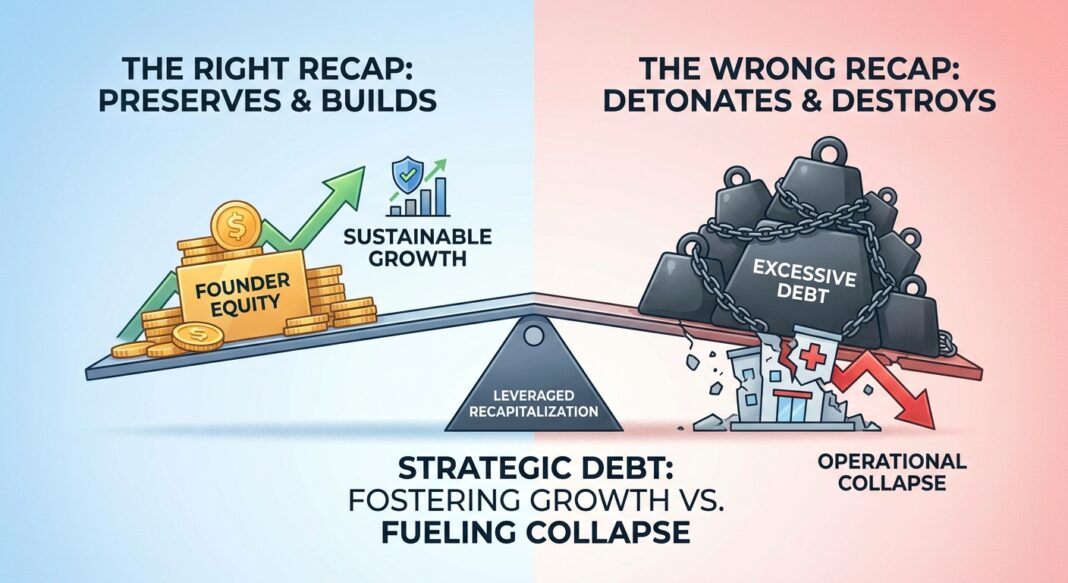
Two companies. Two recapitalizations. Both used new debt to put cash in owners’ pockets. One left its founder wealthier, still in control, and building. The other left patients stranded, workers jobless, and creditors holding the bag. The difference wasn’t the tool; it was whose interests the debt was designed to serve.
The Story: A Tale of Two Recaps
Picture a founder who has spent fifteen years building a niche industrial services company. Call her Clara. Her firm generates $8 million in EBITDA on $50 million in revenue: predictable, recurring, with long-term contracts and a loyal customer base. Ninety percent of her net worth sits in that single illiquid asset. She isn’t ready to sell. She isn’t ready to hand the keys to a private equity sponsor with a five-year exit clock. But she is ready to take some chips off the table, fund her children’s education, diversify into real estate, and stop lying awake at night worrying that one bad year could wipe out everything she built.
Her advisor introduces her to the concept of a leveraged recapitalization: borrowing against the cash-generating power of her own business to distribute capital to herself, without selling a single share. The company takes on debt. She takes out cash. She retains full ownership. The business keeps running under her leadership.
Now contrast that with Steward Health Care. In 2016, Cerberus Capital Management, then Steward’s private equity owner, orchestrated a sale-leaseback of Steward’s hospital real estate to Medical Properties Trust (MPT), generating a large cash payout funneled to its investors. According to reporting by the Boston Globe and congressional investigators, Cerberus extracted approximately $800 million from Steward through various mechanisms (including dividend recapitalizations, management fees, and related-party transactions) before exiting its position in 2020. What remained was a hospital system buried under $6.6 billion in long-term rent obligations to MPT and a debt structure it could never service while also delivering patient care.
In May 2024, Steward filed for Chapter 11 bankruptcy with over $9 billion in liabilities: the largest hospital bankruptcy in decades. Five hospitals have since permanently closed. Approximately 2,400 workers lost their jobs. Communities lost emergency rooms.
Same financial instrument. Radically different outcomes. The question every founder, operator, and capital partner must ask is not whether to recapitalize, it’s for whom, at what leverage, and in whose hands the resulting debt burden rests.
The Decision: What the Options Actually Look Like
When a founder-operator like Clara reaches an inflection point, the menu of options typically looks like this:
- Sell the business outright. Full liquidity, but total loss of control, culture risk, and often a tax event on the entire gain at once.
- Raise growth equity / bring in a VC or PE sponsor. Dilution of ownership, sometimes significant, and the introduction of governance rights, board seats, and a fixed exit timeline that may not align with the founder’s vision.
- Do a founder-controlled leveraged recapitalization. The company borrows, typically 3x to 4.5x EBITDA in the current middle-market environment, and distributes the proceeds to the owner as a dividend or recapitalization payment. The founder retains 100% of equity and operational control.
For Clara’s company at 4x EBITDA leverage on $8M EBITDA, the math looks like this:
| Item | Amount |
|---|---|
| Company EBITDA | $8,000,000 |
| Leverage multiple applied | 4.0x |
| Total new debt raised | $32,000,000 |
| Transaction fees / costs (~2%) | ($640,000) |
| Net cash to founder | ~$31,360,000 |
| Annual debt service (est. ~SOFR + 400bps ≈ 8.3%) | ~$2,650,000 |
| EBITDA after debt service coverage (est.) | ~$5,350,000 |
| Founder equity retained | 100% |
Clara walks away with roughly $31 million in personal liquidity, diversifying the wealth that was previously 90% concentrated in one illiquid asset, while retaining full ownership of a business she expects to grow. If she grows EBITDA to $12 million over five years, her equity value at exit would be worth approximately $60–72 million at a 5–6x EBITDA multiple, on top of the $31 million she already received.
This is the founder-controlled leveraged recap done right: moderate leverage, strong underlying cash flow coverage, and capital structured entirely around the long-term health of the business: not a sponsor’s IRR clock.
Steward’s recap was structurally different in one devastating way: the debt burden fell entirely on the operating hospitals: institutions that run on thin margins, require ongoing capital investment in staff and equipment, and serve communities that depend on them for survival. The cash flowed out. The debt stayed in. The obligation to service it never went away.
The Outcome: Numbers That Tell the Story
The market backdrop today makes the contrast even more instructive. Dividend recapitalization volumes in the leveraged loan market reached approximately $81 billion in 2024, near an all-time record, before continuing at pace through 2025. Capital is widely available. Spreads for single-B issuers reached their lowest levels in at least seven years in early 2025. The borrower-friendly environment is real.
But that same environment has also enabled transactions that look less like financial discipline and more like financial extraction. One publicly documented example: Blackstone-backed fintech provider IntraFi’s leverage rose to more than 9 times EBITDA after it funded a nearly $1.5 billion dividend with debt in 2024, with Moody’s estimating it may take nearly two years for leverage to fall below 7x. That’s a business, however strong, carrying a debt load that leaves almost no room for a bad quarter, a competitive disruption, or a macro shock.
When PE sponsors use the recap as a liquidity tool primarily to return capital to their own LPs under pressure, the alignment breaks down. As Moody’s analysts noted in early 2026, “because this behavior often coincides with challenging exit environments, it suggests sponsors are prioritizing investor distributions over long-term credit health.”
Clara’s outcome looks different. With $31M in personal liquidity, moderate leverage at 4x, and full operational control, she has both the financial cushion and the strategic freedom to invest in the business: hire, acquire, expand. Her debt service is comfortably covered. Her lender, a direct lender providing a covenant-lite term loan, has aligned itself with her cash flow profile, not a PE fund’s exit calendar. That distinction is everything.
This is precisely why refinancing and recapitalization transactions drove 61.9% of total institutional loan volume in 2025: founder-led businesses and operators are discovering that strategic leverage, used on their own terms, is one of the most powerful financial tools available to them.
The Lessons: A Framework for Founders Facing This Decision
The Steward story is not a story about recapitalization being inherently dangerous. It is a story about misaligned incentives amplified by excessive leverage applied to a cash-constrained operating environment. The hospitals couldn’t absorb the debt because healthcare margins are razor-thin and patient care requires constant reinvestment. The PE sponsor could exit with profits intact precisely because the debt stayed on the operating entity’s balance sheet, not the sponsor’s.
The founder-controlled recap, done prudently, inverts this dynamic. The founder IS the operator. The debt burden falls on the business they intend to run for the next decade. There is no asymmetric extraction at play. Alignment is structural.
The Four-Question Framework
Before pursuing a leveraged recapitalization, founders and operators should pressure-test the decision against four critical questions:
- Can the business comfortably service the debt? A minimum 2x EBITDA-to-debt-service coverage ratio provides meaningful cushion. Leverage above 5x EBITDA in cyclical or margin-thin businesses introduces fragility that can become existential in a downturn.
- Who bears the risk if cash flows disappoint? In a founder-controlled recap, the answer is the founder-operator, the person with the most information about the business and the strongest incentive to protect it. In a PE-driven recap, the risk is often offloaded to the operating company while the sponsor has already booked a return.
- Is the capital staying in or going out? Debt raised to fund growth (acquisitions, capex, geographic expansion) creates assets against which the leverage is justified. Debt raised purely to pay a dividend extracts value without creating any new asset-side capacity to repay.
- What is the lender’s alignment? A direct lender or private credit provider offering flexible covenants, long-duration capital, and bespoke terms is a fundamentally different partner than a broadly syndicated loan structure optimized for liquidity and rapid repayment. The former is built for the business; the latter is built for the market.
The current environment, with dry powder in U.S. direct lending funds hitting a record $146 billion at year-end 2025: means capital is available, competition among lenders is fierce, and terms are favorable for quality borrowers. That’s an opportunity. But opportunity without discipline has a well-documented track record. Steward Health Care is one chapter of it.
Clara’s story can be yours. The difference between liquidity and collapse comes down to one question: Is this debt serving the business, or is the business serving the debt?
Key Insights
- The tool is neutral; the incentive is not. A leveraged recapitalization is neither inherently good nor bad. What determines the outcome is whether the debt burden is sized for the business’s actual cash flows and whether the operator who bears the risk is the same party who benefits from the liquidity.
- Founder-controlled recaps preserve alignment in ways PE-driven ones cannot. When the founder remains the operator and the sole equity holder, there is no misaligned exit clock, no LP pressure, and no asymmetric risk transfer. The debt disciplines the same person it enriches.
- Coverage ratio is the sanity check. Businesses with 2x+ EBITDA-to-debt-service coverage at moderate leverage (3–4.5x EBITDA) have historically managed recapitalizations without operational disruption. Businesses at 7–9x leverage with thin operating margins have very little margin for error.
- The market is wide open, and that is both the opportunity and the warning. With $81 billion in dividend recap volume recorded in 2024 and spreads near multi-year lows, founders have access to favorable debt capital. But the same environment has enabled reckless extraction at overleveraged companies. Discipline, not access, is the differentiator.
- Private credit is becoming the preferred partner for founder-led recaps. Direct lenders offer speed, customization, and flexible covenant structures that traditional syndicated markets cannot match, making them ideally suited for founders who want bespoke capital without surrendering governance to a financial sponsor.


