
The Underwriting Question Every Lender Must Answer First
Before a term sheet is signed, a single question should anchor every leveraged credit decision: Under what conditions does this borrower stop being able to service its debt, and how far are we from that point today? That is the core discipline of cash flow stress testing, and it is where rigorous underwriting separates performing portfolios from troubled ones.
In leveraged lending, where debt multiples are high and covenant protections can be thin, stress testing is not a post-closing formality. It is a pre-commitment underwriting tool. According to the OCC’s Credit Risk Rating guidance, sound underwriting requires that structural protections, including repayment coordination with cash flow, be assessed before credit is extended, not after performance deteriorates. Structural weaknesses identified at origination, the OCC warns, directly affect the probability and severity of future problems.
This article walks through a practitioner’s framework for stress testing cash flows on a middle market leveraged credit, including base case construction, scenario design, key metrics, and the red flags that should slow or stop a deal.
The Analytical Framework: Three Layers of Cash Flow Stress
Effective stress testing is not a single sensitivity toggle on a model. It is a three-layer analytical process that moves from base case validation, through downside scenario construction, to recovery or exit analysis. Each layer answers a different underwriting question.
Layer 1: Base Case Validation
The base case is not management’s forecast. It is the lender’s independent projection, anchored in trailing-twelve-month (TTM) audited financials, normalized for non-recurring items, and adjusted for known forward changes in revenue, cost structure, or capex. As Fitch’s Corporate Rating Criteria makes clear, financial projections must be grounded in the issuer’s current and historical operating and financial performance, combined with at least three years of operating history, a timeframe that captures one typical economic cycle.
The base case establishes three critical anchors:
- Normalized EBITDA: adjusted for owner compensation, one-time charges, and run-rate synergies with appropriate haircuts
- Maintenance Capex: distinguished from growth capex; maintenance capex is a real cash obligation and must be deducted to reach true Free Cash Flow (FCF)
- Working Capital Seasonality: cash traps from seasonal inventory or receivables cycles that can distort annual FCF
Layer 2: Downside Scenario Construction
This is the stress test proper. Lenders should construct at minimum two downside scenarios: a moderate stress (e.g., revenue decline of 10–15%, margin compression of 150–200 bps) and a severe stress (revenue decline of 20–25%, margin compression of 300+ bps). Fitch’s COMFORT model applies a similar logic, a stress case is defined as a scenario that may cause the rating to be downgraded by at least one notch, and scenarios are developed based on potential risks the issuer may encounter through the cycle. Industry-specific assumptions should drive the revenue haircut: cyclical manufacturers face demand shocks; healthcare services businesses face reimbursement rate pressure; software businesses face churn and renewal risk.
Layer 3: Recovery and Exit Analysis
If the severe stress scenario triggers a covenant breach or debt service shortfall, the underwriter must assess collateral coverage and recovery value. As the CFA Institute’s Credit Analysis Models framework describes, the three inputs to credit risk modeling are expected exposure to default, loss given default (LGD), and probability of default, and these must be assessed in concert, not in isolation.
Walking the Numbers: A $10M EBITDA Manufacturing Credit
Consider a $10M EBITDA manufacturing company seeking a $35M senior secured term loan, a 3.5x leverage multiple at close. On the surface, this appears within conventional middle market parameters. Stress testing quickly reveals the risk texture beneath that headline number.
Base Case Debt Service Coverage Ratio (DSCR)
Assume the following:
- Normalized EBITDA: $10.0M
- Maintenance Capex: $1.5M
- Cash Interest (7.5% on $35M): $2.625M
- Required Amortization (5% annually): $1.75M
- Total Annual Debt Service: $4.375M
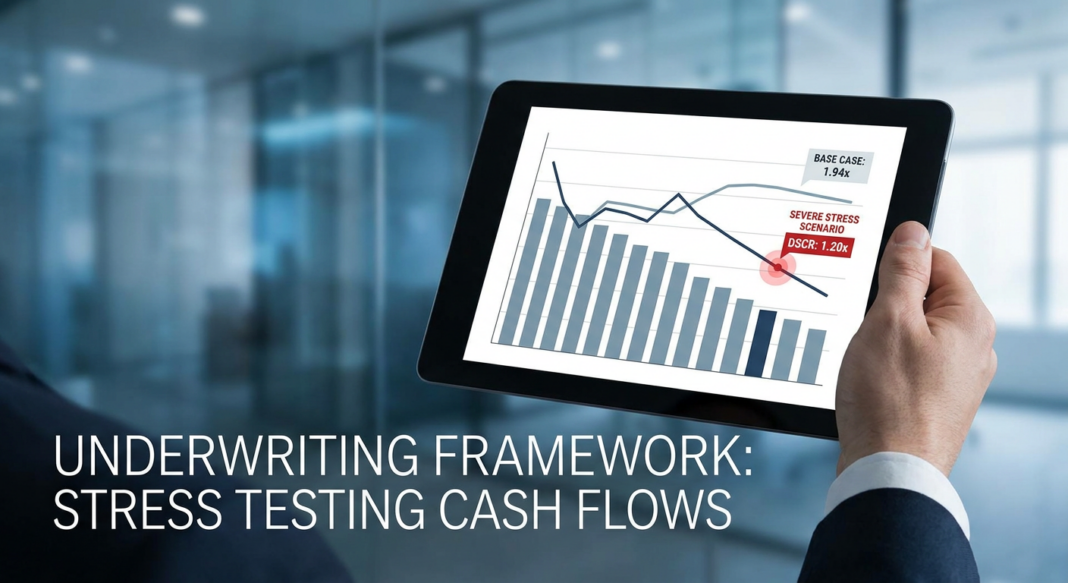
Base Case DSCR = ($10.0M − $1.5M) ÷ $4.375M = 1.94x
A DSCR of 1.94x provides reasonable headroom. Now apply a moderate stress: revenue down 12%, operating leverage drives EBITDA down 18% to $8.2M.
Moderate Stress DSCR = ($8.2M − $1.5M) ÷ $4.375M = 1.53x
Still serviceable. Apply the severe stress: EBITDA falls 28% to $7.2M, a scenario consistent with a demand contraction common in industrial manufacturing downturns.
Severe Stress DSCR = ($7.2M − $1.5M) ÷ $4.375M = 1.30x
At 1.30x, the borrower is still technically covering debt service, but covenant headroom is thin. If a leverage maintenance covenant is set at 4.5x total debt/EBITDA, the stressed leverage ratio moves to $35M ÷ $7.2M = 4.86x: a covenant breach. This is precisely the moment underwriters must ask: is the covenant set correctly, and what is the enforcement mechanism?
What Institutional Lenders Require: Standards and Red Flags
Institutional credit underwriting, informed by frameworks from rating agencies and regulatory bodies, converges on several non-negotiable standards for leveraged cash flow analysis. Moody’s RiskFrontier methodology emphasizes that portfolio-level credit risk management requires quantifying each exposure’s marginal contribution to portfolio loss, meaning individual deal stress tests must also be evaluated in the context of sector and name concentration.
What Experienced Lenders Look For
- DSCR floor of 1.20x in the severe stress scenario, deals that breach this threshold under realistic assumptions carry disproportionate workout risk
- Leverage covenant with 15–20% headroom to the closing leverage multiple, covenants set too loosely provide no early warning signal
- Fixed charge coverage ratio (FCCR) of at least 1.10x inclusive of rent, capex, and tax obligations in a stress scenario
- Liquidity runway of 12+ months at stressed cash burn, the borrower must be able to weather a demand trough without a liquidity event
Common Red Flags in Cash Flow Stress Testing
- Heavy EBITDA addback reliance: When pro forma EBITDA adjustments exceed 15–20% of reported EBITDA, the base case itself may be overstated, making every stress scenario more severe than modeled
- Maintenance capex understatement: Management-provided capex figures often reflect growth investment only. Lenders must independently benchmark maintenance capex against industry depreciation norms
- Single-customer revenue concentration: A customer representing more than 20% of revenue introduces binary stress risk, the loss of that relationship can immediately flip a performing credit to distress
- Interest rate sensitivity in floating-rate debt: A 200 bps rate increase on a $35M floating-rate loan adds $700K in annual debt service, stress scenarios must model rate risk alongside revenue risk
- Ignoring working capital drag in stress: Distressed borrowers often face accelerated payables demands from suppliers simultaneously with declining receivables collections, a double squeeze that can destroy liquidity faster than the income statement suggests
📊 Credit Performance Reference Data
- According to CFA Institute, the term structure of credit spreads tends to widen and steepen materially during periods of weak economic activity, directly increasing refinancing risk for stressed borrowers
- Fitch’s Corporate Rating Criteria weights cash flow measures of earnings, coverage, and leverage substantially more heavily than equity-based ratios such as debt-to-equity, citing book values as a weaker measure of debt service capacity
- The OCC’s Credit Risk handbook identifies capital depletion through loan losses as the proximate cause of most institutional failures, underscoring that stress test discipline is a solvency-level concern, not merely a portfolio management courtesy
- Moody’s RiskFrontier documentation identifies reverse stress testing (identifying which borrowers and sectors contribute most to large portfolio losses) as a core step in credit capital planning
Cash Flow Stress Testing Underwriting Checklist
Use this diligence framework before final credit approval on any leveraged credit:
- Obtain three full years of audited financials plus TTM management accounts, do not rely on CIM-presented figures without independent reconciliation
- Reconstruct EBITDA from scratch: challenge every addback; require documentation for each non-recurring adjustment exceeding $100K
- Separate maintenance capex from growth capex: request the borrower’s fixed asset schedule and benchmark to industry depreciation rates
- Build your own debt service schedule: model amortization, PIK accruals (if any), revolver utilization, and interest at both current and stressed rates (+200 bps minimum)
- Run three scenarios: base, moderate stress (−15% EBITDA), and severe stress (−25% to −30% EBITDA), document assumptions for each
- Calculate DSCR, FCCR, and leverage at each scenario: flag any scenario where DSCR falls below 1.20x or leverage breaches covenant thresholds
- Map liquidity runway: model monthly cash burn at severe stress; confirm availability under the revolving credit facility is unimpaired in a stress scenario
- Assess collateral coverage at stressed enterprise value: apply a distressed EBITDA multiple (typically 4.0–5.0x for manufacturing) and confirm first-lien recovery adequacy
- Identify concentration risks: customer, geography, product line, and supplier, and layer binary stress scenarios on top of financial stress
- Confirm covenant structure aligns with stress output: leverage and FCCR covenants should trigger early warning at 15–20% EBITDA deterioration, not at the point of default
Key Takeaways for Credit Underwriters
- 🔍 The base case is not the borrower’s forecast; it is your independent reconstruction of normalized, sustainable cash flow, anchored in audited history and explicit assumptions about forward performance drivers.
- 📉 A DSCR above 1.20x in a severe stress scenario is the minimum threshold for underwriting comfort in leveraged middle market credits, anything tighter demands structural protections such as cash sweeps or tighter amortization.
- ⚠️ EBITDA addbacks above 15–20% of reported EBITDA are a material red flag: overstated base case earnings systematically compress the apparent distance to covenant breach and default.
- 📊 Maintenance capex and working capital seasonality are the two most frequently understated cash drains in sponsor-prepared CIMs; independent verification of both is non-negotiable.
- 🏦 Stress testing is a portfolio-level discipline, not just a deal-level one: as Moody’s RiskFrontier methodology demonstrates, each new credit’s marginal contribution to sector concentration and correlated loss must be evaluated alongside its standalone cash flow performance.


