
The Repayment Line: Private Credit’s Most Important Concept
When a company borrows money from multiple sources, not all lenders stand in the same place when it comes time to get paid back. Some lenders are first in line. Others wait. Some may never get paid at all if the business runs into serious trouble. This ordering (who gets paid first, and who absorbs losses first) is called the capital stack, and understanding where you sit within it is the single most important factor in evaluating any private credit investment or financing decision.
The capital stack isn’t just an academic framework. As BIP Wealth puts it, before evaluating any fund, any headline, or any investment opportunity, the foundational question is simply: where in the line am I standing?
What the Capital Stack Actually Is
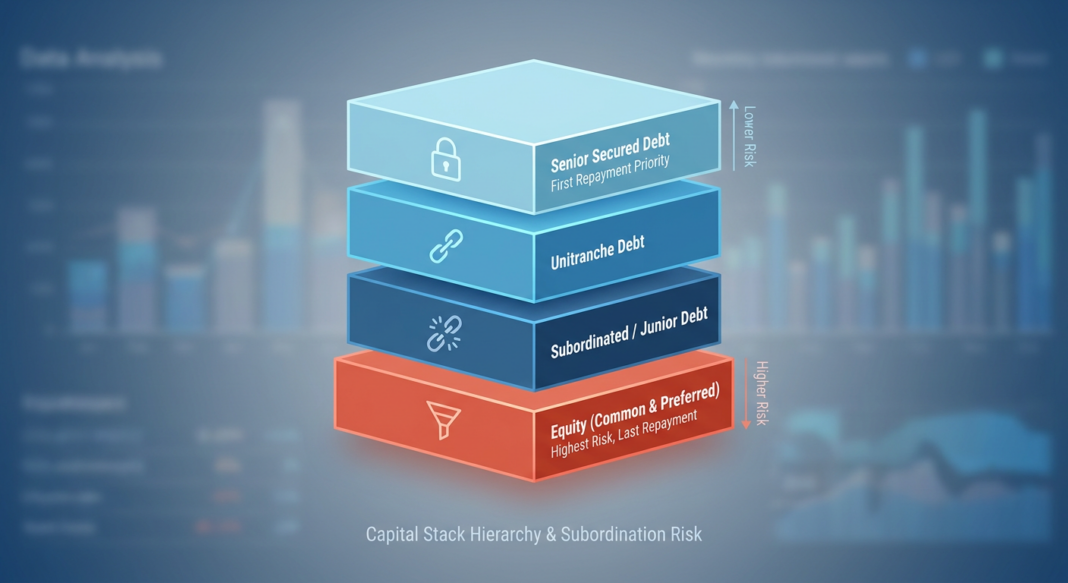
The capital stack is the hierarchy of all financial claims on a company’s assets and cash flows, arranged by priority of repayment. Think of it as a literal stack of claimants. Those at the top get paid first and bear the least risk. Those at the bottom absorb losses first and get paid last, but in exchange, they may earn higher returns if the business thrives.
Working from top to bottom, the capital stack typically looks like this:
- Working Capital Facilities (revolving credit lines, trade payables), highest priority, typically short-term
- Senior Secured Debt: first long-term lender in line, backed by collateral such as receivables, equipment, or real property
- Unitranche Debt: a blended structure combining senior and subordinated debt into a single instrument, common in middle-market buyouts
- Subordinated / Junior Debt: sits behind senior lenders; accepts more risk in exchange for a higher coupon
- Mezzanine Debt: hybrid capital bridging debt and equity, often carrying warrants or equity conversion features
- Preferred Equity: ahead of common equity but behind all debt in a liquidation
- Common Equity: residual claim on assets after every creditor has been satisfied; highest risk, highest potential upside
The label “private credit” alone tells you very little about actual risk. A senior secured direct lending fund and a subordinated mezzanine fund are both technically private credit, but they occupy dramatically different positions in the repayment hierarchy, as highlighted in the Meketa Private Credit Primer (2024).
A Concrete Example: The $20M Middle-Market Buyout
Consider a private equity firm acquiring a manufacturing business for $20 million. The deal is financed as follows:
- $12M Senior Secured Term Loan: provided by a direct lender, secured by the company’s equipment and receivables, carrying a floating rate of SOFR + 550 bps (approximately 10.8% as of mid-2026)
- $4M Mezzanine Loan: unsecured, carrying a 14% coupon plus equity warrants representing a 5% ownership stake
- $4M Equity: contributed by the private equity sponsor, representing a 20% equity cushion against the total purchase price
Now imagine the business deteriorates and is ultimately sold for only $13 million in a distressed scenario. Here is what happens:
- The senior secured lender recovers its full $12M: fully covered by the sale proceeds.
- The remaining $1M goes to the mezzanine lender, who recovers only 25 cents on the dollar against a $4M loan. A significant loss.
- The equity sponsor recovers nothing. Their $4M is entirely wiped out.
This example illustrates subordination in action. The senior secured lender’s position above everyone else in the stack provided substantial downside protection, even when the deal went badly wrong. The mezzanine lender accepted subordination risk for a higher coupon, and that risk materialized. The equity holder absorbed the first and deepest loss, as always.
Current Market Relevance
Understanding capital stack position is especially critical in today’s private credit environment, where deal volume, spreads, and risk appetite are all shifting.
- According to the Long Angle Private Credit Investment Guide 2026, direct lending default rates have remained under 4% since 2021, citing the Proskauer Private Credit Default Index, a figure that reflects the structural protection senior secured positions provide during periods of stress.
- Private credit now accounts for approximately 20% of the total leveraged credit market, up from a fraction of that share a decade ago, according to Long Angle (2026), driven by banks retreating from leveraged lending under regulatory pressure.
- Senior secured debt attracted nearly half of all capital raised by private debt funds in recent years, per Gridline’s capital structure analysis, reflecting institutional investor preference for the top of the stack in an uncertain macro environment.
- The Briarcliffe Field Guide to Private Credit (January 2026) identifies 26 distinct private credit strategies across its Four Pillars framework, underscoring how dramatically risk and return profiles vary by stack position, even within the same asset class label.
| Layer | Typical Risk | Indicative Return Range | Source |
|---|---|---|---|
| Senior Secured Direct Lending | Low–Moderate | 9%–12% (floating) | Long Angle, 2026 |
| Unitranche | Moderate | 10%–13% | Gridline |
| Mezzanine / Subordinated | High | 13%–18%+ | Briarcliffe, Jan 2026 |
| Common Equity | Highest | 20%+ (target IRR) | Meketa, 2024 |
Decision Framework: Investors and Operators
For investors evaluating private credit funds: Stack position should be the first filter, not the last. A fund advertising double-digit returns may be achieving those returns by sitting in subordinated or mezzanine positions, which is a valid strategy, but it carries materially different risk than senior secured lending. Investors consider asking: Is the fund senior secured or subordinated? Is the debt backed by specific collateral? What is the average loan-to-value ratio across the portfolio? What recovery assumptions underpin the strategy in a stress scenario?
For business owners and operators seeking capital: Where a lender sits in your capital stack directly determines how much flexibility and risk that lender will tolerate, and what it will cost you. Senior secured lenders typically impose tighter covenants and require collateral, but they offer lower interest rates. Mezzanine lenders accept less security but charge more and may take equity warrants. Operators evaluate whether the incremental cost of subordinated capital is justified by the growth or acquisition it enables, and whether equity dilution via mezzanine warrants is preferable to issuing new shares outright.
Key Takeaways
- Position defines risk, not just the label. “Private credit” describes an asset class, not a risk level. Senior secured and subordinated debt are fundamentally different instruments despite sharing the same category name.
- Collateral is the senior lender’s safety net. Senior secured debt backed by hard assets (equipment, receivables, real property) gives lenders a priority claim even in liquidation scenarios, materially reducing loss severity.
- Higher yield always reflects higher stack risk. When a private credit fund offers materially higher returns than its peers, that premium almost certainly reflects a lower position in the capital stack, and correspondingly less protection in a downturn.
- Equity cushion matters as much as position. A 20% equity contribution below the debt layers means losses would have to exceed 20% of enterprise value before any lender takes a principal hit. Thinner equity cushions compress that buffer significantly.
- The same deal can look very different by layer. In the $20M example above, the senior lender made a full recovery on a deal that produced a near-total loss for the mezzanine lender. Capital stack position determined the outcome, not the underlying business quality.


