
The Growth-Stage Financing Gap: Where Strategy Meets Structure
The most consequential financing inflection point in any company’s lifecycle is not the seed round, and it is not the IPO. It is the moment a growth-stage business (one with demonstrated unit economics, repeatable revenue, and a credible expansion plan) exhausts the capacity of its existing capital structure before it can self-fund its next phase.
At this stage, the company has typically moved past the burn-heavy early years. It has product-market fit, a functioning go-to-market engine, and a revenue base that institutions can underwrite. But it is not yet generating the free cash flow a traditional bank lender demands before extending meaningful credit. And a full equity round (at current valuations, with dilution running 20–30% of ownership per institutional round) may destroy more value than it creates.
This is the gap. And closing it correctly determines whether a company reaches its next inflection point on its own terms, or concedes control, economics, or optionality to fill a hole that a better-structured instrument could have bridged. The discipline of navigating this gap begins with one question: what is the capital actually for?
Step 1: Map the Use-of-Proceeds Before Touching the Stack
Capital structure decisions that skip the use-of-proceeds analysis inevitably produce mismatches: equity raised to fund working capital, short-term revolvers used to finance multi-year product builds, or mezzanine drawn down against assets that will not generate returns within the instrument’s term. Each mismatch carries a compounding cost.
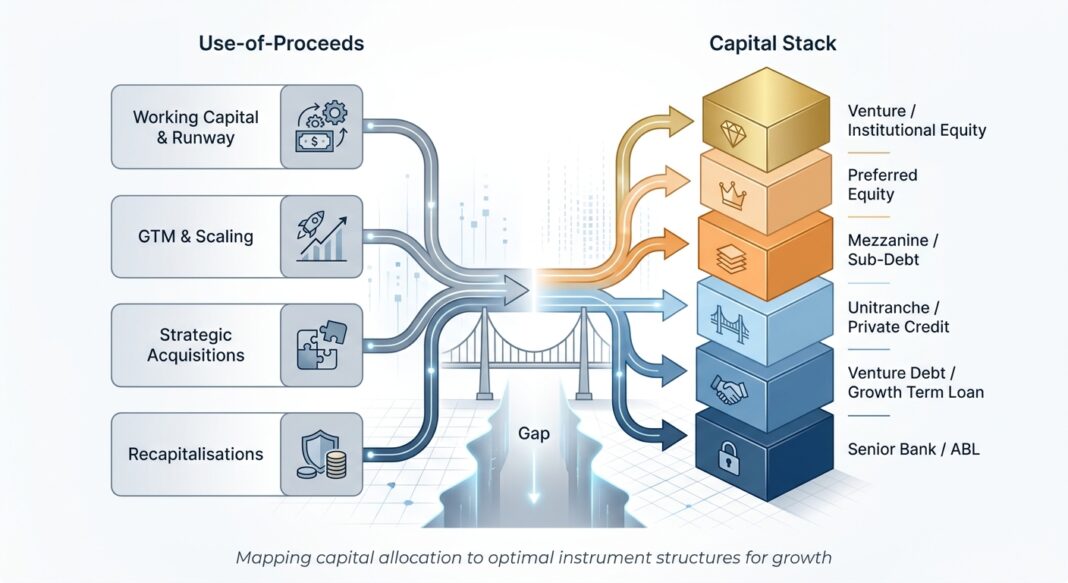
The correct starting point is a precise categorisation of how every dollar of new capital will be deployed. At the growth stage, use-of-proceeds typically falls into one of four buckets, each with a distinct risk profile and therefore a distinct optimal funding source:
- Working capital & runway extension: Bridging receivables cycles, funding seasonal inventory, or extending cash runway by six to twelve months while a larger process is run. Best matched to revolving credit facilities, asset-based lending (ABL) against receivables, or revenue-based financing where cash flows are predictable and recurring.
- Go-to-market & headcount scaling: Hiring sales and marketing teams with defined payback periods, expanding into adjacent geographies, or accelerating customer acquisition against a proven funnel. This is the natural home of venture debt and growth-term loans: instruments that are minimally dilutive, sized to two to four times monthly recurring revenue, and structured with twelve to thirty-six month terms that align with the payback horizon of the investment.
- Strategic acquisitions or capability builds: Acquiring a complementary business, a technology asset, or a customer base. Here the capital requirement is larger, the asset base is broader, and the instrument set expands to include unitranche facilities, acquisition credit facilities, and in some cases a mezzanine tranche sitting behind a senior secured layer. The key structural question is whether the acquired business generates standalone cash flow that services the additional debt, or whether the combined entity must be underwritten on a blended basis.
- Recapitalisations & ownership transitions: Founder liquidity events, management buyouts, or restructuring a cap table ahead of an institutional equity round. These are typically addressed through preferred equity, subordinated debt with equity kickers, or structured secondary transactions, instruments that balance the seller’s need for certainty of proceeds against the buyer’s or incoming investor’s need for downside protection.
As the framework documented by practitioners working across 500+ startup funding structures makes clear, the fundamental principle is to match capital behaviour to operational reality: equity is for uncertainty, debt is for predictable returns. Raising equity to cover working capital is a value-destructive mismatch. Raising debt against a moonshot is a solvency risk. The use-of-proceeds map forces that discipline before term sheets are in play. [re-cap.com]
Step 2: Map the Cost of Capital Spectrum
Once the use-of-proceeds is defined, the capital stack offers a clear spectrum from cheapest to most expensive, with access constraints tightening as cost falls:
| Instrument | Typical All-In Cost | Dilution | Key Access Gate |
|---|---|---|---|
| Senior Bank / ABL | 7–11% all-in | None | EBITDA positivity or hard asset coverage |
| Venture Debt / Growth Term Loan | 10–15% + warrants (0.5–1.5% coverage) | Minimal | Revenue traction ($5M+ ARR), 10–50%+ YoY growth |
| Unitranche / Private Credit | 12–18% all-in | None to minimal | Predictable EBITDA or recurring revenue; leverage 3–5x |
| Mezzanine / Sub-Debt with Equity Kicker | 15–22% (cash + PIK + warrants) | Low to moderate | Established business; used behind senior tranche |
| Preferred Equity / Growth PE | 20–30%+ IRR target | Significant | Proven unit economics; performance-based valuation |
| Venture / Institutional Equity | 25–40%+ cost of equity | 20–30% per round | Growth narrative; investor thesis alignment |
The practitioner’s discipline is to draw as much capital as possible from the left side of this table (reserving equity for genuine uncertainty and upside-sharing) while ensuring that the fixed-cost obligations created by debt instruments are serviceable under a realistic downside scenario. As one framework for growth advisors notes, “the math is straightforward: model the cost of debt (interest, amortisation, warrants, risk) versus the cost of equity dilution, the right answer depends on the specific situation.” [flowcap.com]
Step 3: The Gap Capital Playbook, Quantify, Prepare, Execute
Phase 1: Quantify the Gap with Precision
A gap capital process that begins with a round-number ask, “we need $15 million”, is already weakened. Institutional lenders and investors will reverse-engineer the number anyway. Present it first, with rigour. The quantification document should include: a quarter-by-quarter cash deployment model showing exactly how capital is allocated (headcount by role, channel spend by quarter, product investment by workstream); sensitivity analysis across at least three scenarios (base, upside, downside); and a clear articulation of the milestone or inflection point the capital is designed to reach: whether that is profitability, a next financing event, or a strategic exit. [angelinvestorsnetwork.com]
Phase 2: Build the Lender / Investor Package
At the growth stage, institutional debt providers underwrite on operating metrics, not just vision. The materials package must include: audited or reviewed financials for the prior two to three years; a detailed unit economics summary (customer acquisition cost, payback period, net revenue retention by cohort); a 24-month financial model with monthly granularity in year one; and a clear articulation of the asset or cash flow coverage available to the lender. Capital stack architecture (including all existing instruments, conversion terms, and governance rights) must be disclosed cleanly and early. Opacity on cap table complexity is one of the fastest ways to lose lender confidence before a term sheet is issued. [moonshotnx.com]
Phase 3: Run a Structured, Competitive Process
Even for a $10–20 million debt raise, running a minimum of three to five parallel conversations creates negotiating leverage that a bilateral process cannot replicate. Sequence the outreach: begin with lenders whose mandates most closely match the company’s profile (ARR-based lenders for SaaS, ABL providers for businesses with tangible receivables, unitranche funds for acquisition-driven structures). Stagger the timeline so that term sheets arrive within a two-week window, enabling a genuine comparison rather than a sequential accept-or-reject dynamic. The goal is not to create artificial tension; it is to generate real optionality.
Step 4: Negotiating the Structure, Key Deal Points
Once term sheets are in hand, the negotiation typically concentrates on five structural variables:
- Covenant design: Push for incurrence-based covenants over maintenance covenants wherever possible. A maintenance covenant (tested quarterly against an EBITDA or leverage threshold) creates a technical default risk precisely when a growth-stage business is investing ahead of revenue. Incurrence covenants only test at the moment of a specific action (an acquisition, a dividend, an additional draw), which is structurally more forgiving of the revenue variability inherent in scaling businesses.
- PIK vs. cash pay: For instruments in the mezzanine or subordinated layer, negotiate the ability to PIK (pay-in-kind, accruing rather than paying cash interest) during the first twelve to eighteen months of deployment, when capital is being actively invested and cash generation is still ramping.
- Warrant coverage and strike price: On venture debt and growth term loans, warrant coverage is often non-negotiable in principle but highly negotiable in quantum. The market standard runs from 0.5% to 1.5% of the loan amount; well-prepared borrowers with multiple term sheets routinely compress this to the lower end of the range.
- Prepayment flexibility: Negotiate soft call protection rather than hard lockouts. A structure that allows prepayment at 103/102/101 over the first three years is materially more valuable than one with a no-call period, particularly if the company expects to refinance following an equity event or EBITDA inflection.
- Milestone-linked tranching: Where the lender requires it, structure delayed-draw tranches tied to specific, objectively measurable milestones rather than lender discretion. This preserves access to committed capital without surrendering control over the timing of its deployment.
The foundational discipline throughout this process, as capital structure practitioners consistently emphasise, is to design for downside scenarios, not the pitch deck. Accept terms that are workable if growth comes in at 30% of plan, not only terms that work if the model’s base case is delivered precisely. [re-cap.com]
Key Takeaways
- Use-of-proceeds defines instrument choice: Working capital, GTM scaling, acquisitions, and recaps each have distinct optimal funding sources. Never let instrument availability drive the use-of-proceeds decision.
- Exhaust the left side of the cost spectrum first: Every percentage of equity preserved at the growth stage compounds through to the exit. Use non-dilutive instruments (ABL, venture debt, unitranche) as far as the cash flow or asset base can support.
- Quantify the gap with quarterly granularity: A round-number capital ask without a deployment model signals to lenders that the borrower has not stress-tested their own plan. Precision in the ask accelerates underwriting and strengthens negotiating position.
- Design covenants for the downside scenario: Incurrence-based packages, PIK optionality, and milestone-linked tranches are not borrower-friendly luxuries; they are structural features that prevent technical defaults from triggering at exactly the wrong moment in the growth cycle.
- Run a competitive, parallel process: Even at smaller deal sizes, multiple simultaneous conversations are the single most reliable mechanism for improving pricing, loosening covenants, and reducing warrant coverage. Bilateral processes leave measurable economics on the table.


