
When One Loan Does the Work of Many
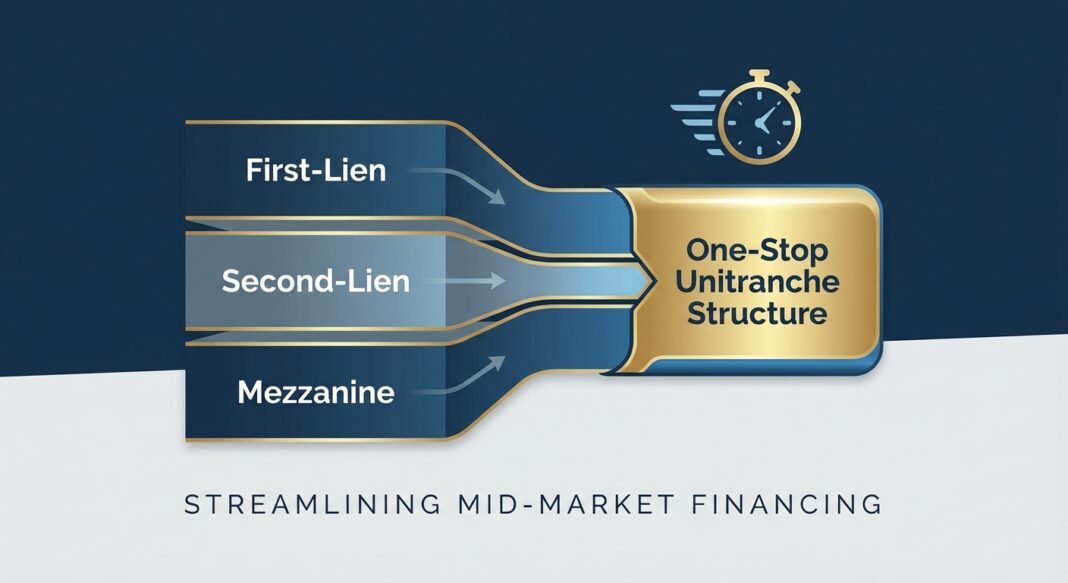
Picture a mid-market company raising $400 million for a leveraged buyout. The traditional path requires negotiating a first-lien term loan with a bank, a second-lien facility with a credit fund, and sometimes a mezzanine tranche layered on top. Each layer carries its own credit agreement, its own covenant package, its own legal counsel, and its own closing timeline. The result: weeks of parallel negotiations, stacks of documentation, and real execution risk on a time-sensitive deal.
Enter the unitranche loan: private credit’s signature innovation and, by most measures, the dominant debt structure in sponsor-led mid-market transactions today. A unitranche collapses that complexity into a single facility, a single interest payment, and a single set of covenants, all while preserving the economic layering that investors in different risk positions require.
Understanding how unitranche loans actually work, what is visible to the borrower versus what happens behind the scenes, is essential knowledge for both business owners evaluating financing options and investors allocating capital to private credit strategies.
What a Unitranche Loan Actually Is
Unitranche debt is a hybrid loan structure that combines first-lien and second-lien (or senior and subordinated) debt into a single credit facility, governed by one credit agreement and carrying a single blended interest rate. As Global Legal Insights (2026) explains, the structure simplifies the capital stack, reduces documentation and administrative costs, and streamlines negotiations between borrower and lender.
There are two core varieties. The stretch unitranche functions like a traditional Term Loan B but extends leverage higher than a conventional senior loan, think financing a buyout at 6.0x EBITDA through a single first-lien instrument where a bank might only stretch to 4.0x–4.5x. The bifurcated unitranche goes further: it slices the single loan into a first-out (FO) tranche and a last-out (LO) tranche governed by a confidential Agreement Among Lenders (AAL). The borrower sees only one loan. Behind the scenes, lenders have contractually divided up the economics, payment priority, and remedies in a default.
As Wall Street Prep notes, the first-out portion receives priority of payment when triggering events occur, while the last-out lender earns a higher yield in exchange for subordinated recovery risk. The AAL establishes the waterfall payment schedule, governs the allocation of fees and interest, and critically, keeps its terms confidential from the borrower.
How It Works: A Concrete Example
Consider a private equity sponsor acquiring a company valued at $700 million, representing a 14x multiple on $50 million of EBITDA. The deal requires $400 million in debt financing alongside $300 million of equity.
In a traditional structure, the sponsor might approach a bank for a $200 million first-lien term loan at approximately SOFR + 3.75%–4.00% (roughly 4x EBITDA), then layer a $100 million second-lien facility at SOFR + 7.50%–8.50% on top, and potentially a $100 million mezzanine tranche at 12%–14%. Each tranche requires separate counsel, separate credit agreements, and separate intercreditor negotiations, a process that can take 60–90 days from launch to close.
In a unitranche structure, a private credit fund (or a club of direct lenders) provides the full $400 million in a single facility at a blended rate, historically SOFR + 5.00%–6.00% for upper middle-market transactions. As Accredited Insight (November 2025) illustrates, behind the scenes the fund might structure a first-out position for a bank partner (lower rate, higher priority) and retain a last-out position (higher rate, subordinated recovery), the two lenders governed by an AAL that the borrower never sees. The last-out portion, per the AAL, earns a higher interest rate than the first-out portion, while the first-out lender receives priority on principal, interest, and any amounts due in a default scenario.
The borrower’s gain is structural simplicity: one set of documents, one set of covenants, one payment, and, critically, deal closings in weeks rather than months, since there is no public syndication process to navigate. According to Private Equity Bro (October 2025), sponsors frequently justify 50–100 basis points of additional spread over syndicated alternatives when unitranche financing closes 30–45 days faster, eliminating the execution risk that can break a purchase agreement.
Current Market Relevance
Unitranche has moved well beyond its middle-market roots. Global Legal Insights (2026) reports that 2024 saw unitranche loan activity for large-cap borrowers reach $210 billion: more than double the $94 billion recorded in 2023, as the structure scaled into jumbo transactions exceeding $1 billion. A landmark example: PitchBook (May 2025) reported that Apollo and Blackstone led a group of lenders providing a $4 billion unitranche loan at SOFR + 475 bps, illustrating how the structure now competes directly with large syndicated transactions.
The macroeconomic backdrop continues to favor private credit’s value proposition. The Federal Reserve’s January 2026 SLOOS confirmed that banks reported, on balance, tighter lending standards for commercial and industrial loans to firms of all sizes through the fourth quarter of 2025, a consistent theme across every Fed survey going back through 2024. Banks cited a less favorable economic outlook, reduced risk tolerance, and concerns about legislative and regulatory changes as key drivers of tightening.
According to CNBC (March 2026), banks’ share of buyout financings above $1 billion fell to just 39% in 2023 from roughly 80% in the prior five years, a vacuum that unitranche lenders filled decisively. That share has partially recovered to just over 50% in 2025 as banks re-enter, but private credit retains structural advantages in speed, certainty, and flexibility.
The overall market is enormous and still growing. The Federal Reserve (May 2025) estimated the U.S. private credit asset class at $1.34 trillion and nearly $2 trillion globally as of mid-2024, having grown roughly five times since 2009. Preqin, cited by S&P Global Market Intelligence (2025), estimates private credit AUM will nearly double to $4.5 trillion by 2030 from approximately $2.28 trillion in 2025.
| Metric | Value | Source |
|---|---|---|
| Large-cap unitranche activity (2024) | $210 billion (up from $94B in 2023) | Global Legal Insights, 2026 |
| Largest single unitranche (2025) | $4 billion at SOFR + 475 bps (Apollo & Blackstone) | PitchBook, May 2025 |
| U.S. private credit AUM (mid-2024) | $1.34 trillion (nearly $2T globally) | Federal Reserve, May 2025 |
| C&I lending standards (Q4 2025) | Tighter for firms of all sizes (net balance) | Fed SLOOS, January 2026 |
| Bank share of buyouts >$1B (2023 trough) | 39% (vs. ~80% five years prior) | CNBC, March 2026 |
| Private credit AUM forecast (2030) | ~$4.5 trillion (from ~$2.28T in 2025) | S&P Global / Preqin, 2025 |
Decision Framework: Investors and Operators
For Investors Evaluating Unitranche Exposure:
- Understand your position in the AAL. If a fund discloses last-out exposure, recognize that recovery in a distressed scenario is subordinated to first-out lenders despite the loan appearing as a single first-lien instrument. First-out and last-out positions carry meaningfully different risk profiles.
- Evaluate covenant quality. The single-document structure can obscure covenant erosion. Per Private Equity Bro (2025), EBITDA add-backs in 2024 clustered around 25–35% of reported EBITDA, a metric investors consider carefully as it directly affects leverage calculations and covenant headroom.
- Assess liquidity structure. As PIMCO (March 2026) notes, semi-liquid vehicles invest in illiquid long-term loans: liquidity is conditional, not guaranteed, particularly during periods of market stress.
- Review bankruptcy risk of the AAL. The enforceability of AAL provisions in bankruptcy remains an evolving area of law, as Lucosky Brookman (2023) highlights, classification of first-out versus last-out claims in Chapter 11 proceedings has not been definitively settled by courts.
For Business Operators Evaluating Unitranche Financing:
- Quantify the speed premium honestly. Unitranche typically costs 50–100 bps more than an equivalent syndicated transaction. Operators consider whether deal certainty, speed of execution, and avoidance of syndication flex risk justifies that premium for their specific transaction timeline.
- Leverage the single-lender relationship. Private credit’s bilateral structure, one lender (or a small club) versus a dispersed syndicate, means amendments, waivers, and restructurings can be negotiated directly. This is a tangible operational advantage when business conditions change.
- Scrutinize PIK toggle provisions. Unitranche agreements often include payment-in-kind (PIK) options that allow borrowers to defer cash interest and add it to principal. While this provides near-term cash flow relief, it compounds the debt balance and increases the total cost of financing over time.
Key Takeaways
- One loan, two risk layers: In a bifurcated unitranche, the borrower sees a single first-lien facility while lenders have privately divided the loan into first-out (lower yield, priority recovery) and last-out (higher yield, subordinated recovery) positions via an Agreement Among Lenders.
- Speed is the premium: The absence of a public syndication process allows unitranche deals to close in weeks rather than months, a structural advantage that sponsors and borrowers frequently value above the cost differential versus syndicated alternatives.
- The market has scaled dramatically: Large-cap unitranche volume more than doubled from $94 billion in 2023 to $210 billion in 2024, with individual deals now reaching $4 billion, a scale that would have been unthinkable a decade ago when unitranche was exclusively a middle-market product.
- Bank tightening is a structural tailwind: Persistent C&I lending tightening documented across every Federal Reserve SLOOS from 2024 through early 2026 continues to redirect borrowers toward private credit solutions, reinforcing unitranche’s structural role in the leveraged finance ecosystem.
- Investors must look through the single-loan appearance: The simplicity of unitranche for borrowers creates complexity for investors. Evaluating a fund’s AAL position, covenant quality, EBITDA add-back policies, and liquidity terms is essential due diligence that goes well beyond a headline yield figure.


