
The Most Important Question in Private Credit
Before evaluating a yield, a spread, or a fund manager’s track record, every participant in private credit markets (whether an institutional investor or a business owner seeking capital) needs to answer one foundational question: where in the repayment line does this obligation sit? That question is answered by understanding the capital stack.
The capital stack is not an abstract concept. It is the single structural mechanism that determines who gets paid first when a company generates cash, and who absorbs losses first when a company runs into trouble. Mastering it is the prerequisite for understanding how private credit works.
What the Capital Stack Is and How It Works
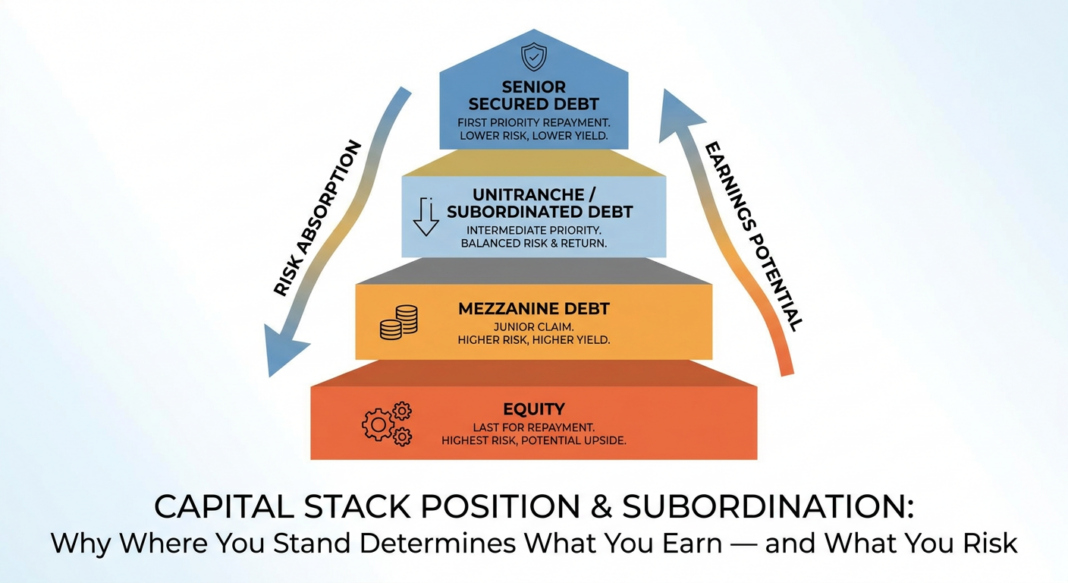
The capital stack is the ordered hierarchy of all financial claims on a company’s assets and cash flows. Each layer, or “tranche,” carries a defined priority of repayment and a corresponding level of risk. According to Gridline’s Alternative Investment Blog, the stack runs from top to bottom across five primary layers: senior secured debt, unitranche debt, subordinated debt, mezzanine debt, and equity.
The logic is straightforward: the higher your position in the stack, the lower your risk and the lower your expected return. The lower your position, the higher your risk, but also the higher your potential return. This inverse relationship between position and risk is the engine that drives pricing across all of private credit.
Critically, as BIP Wealth explains, the layers at the top (senior secured debt and working capital obligations) are backed by tangible collateral: cash, receivables, equipment, and real property. The layers at the bottom (preferred and common equity) absorb losses first and receive distributions last. Subordination is the legal mechanism that enforces this hierarchy: junior creditors formally agree that senior creditors must be made whole before they receive anything in a default or liquidation scenario.
A Concrete Example: The Same Company, Four Different Risk Profiles
Consider a hypothetical middle-market manufacturer, Acme Industrial LLC, with an enterprise value of $100 million and the following capital structure:
- Senior Secured Loan: $50 million at SOFR + 450 bps (floating rate, first lien on all assets)
- Unitranche Facility: $15 million at a blended fixed rate of approximately 11% (combines senior and junior risk in one instrument)
- Mezzanine Note: $10 million at 14% cash interest plus equity warrants
- Equity: $25 million contributed by the private equity sponsor
If Acme’s enterprise value drops by 30% to $70 million in a stress scenario, the outcomes diverge sharply by position:
- The senior secured lender is owed $50 million. With $70 million in recovery value, they are made whole. Loss: $0.
- The unitranche facility ($15 million) is next in line. The remaining $20 million of value more than covers their claim. Loss: $0.
- The mezzanine note ($10 million) has only $5 million of remaining enterprise value available. Loss: approximately $5 million, a 50% impairment.
- The equity sponsor loses their entire $25 million contribution. Loss: 100%.
This is the mechanics of subordination in action. Notice that the senior secured lender, accepting the lowest yield, carried the least risk. The equity holder, expecting the highest upside, absorbed every dollar of loss first. The mezzanine investor earned a higher coupon than the senior lender precisely because they accepted this intermediate loss exposure.
Current Market Relevance: Where Institutional Capital Is Positioning
Understanding capital stack position is not merely theoretical in today’s market; it directly reflects where sophisticated capital is concentrating and why.
The private credit market has grown substantially, with PitchBook documenting the steady expansion of direct lending, predominantly senior secured credit, as banks have pulled back from middle-market lending following post-GFC regulatory changes. This structural shift means that private credit funds now occupy the space banks once held, primarily at the top of the capital stack.
According to Gridline, in 2021 nearly half of all capital raised by private debt funds was directed to senior debt strategies, a clear signal of where institutional investors sought the balance of yield and downside protection. That preference for senior positioning has remained a consistent theme as credit conditions evolved through subsequent rate cycles.
Long Angle’s 2026 Private Credit Guide notes that private credit now accounts for roughly 20% of the broader leveraged credit market, gaining share steadily from banks and syndicated loan markets. Importantly, the guide observes that direct lending default rates have remained under 4% since 2021 according to the Proskauer Private Credit Default Index, a figure that reflects both the structural protection of senior positioning and the collateral backing it carries.
Meanwhile, Meketa’s Institutional Private Credit Primer highlights that the asset class continues to attract institutional allocators specifically because of its capital stack seniority combined with the floating-rate income profile, a combination that performed defensively during the 2022–2024 rate environment.
Decision Framework: Investors and Operators
For Investors Evaluating Private Credit Funds
The phrase “I invest in private credit” carries far less information than the question “where in the capital stack does my capital sit?” A senior secured direct lending fund and a mezzanine fund are both private credit, but they carry fundamentally different risk profiles, recovery expectations, and return targets. Investors consider evaluating:
- Lien position: Is the fund first lien, second lien, or subordinated? First lien holders have priority claim on collateral.
- Loan-to-value (LTV): How much equity cushion sits below the debt? A 50% LTV means assets can lose half their value before the lender faces impairment.
- Collateral quality: Is the debt backed by hard assets, cash flows, or intangibles? Hard asset collateral offers more reliable recovery in liquidation.
- Sponsor equity contribution: Private equity sponsors with meaningful equity at stake have strong incentives to support the business, protecting lenders above them in the stack.
For Business Operators Structuring Capital
Operators choosing between financing sources are, at their core, deciding how much of their capital stack to “sell” and at what cost. Senior secured debt is the cheapest capital precisely because lenders bear the least risk, but it comes with tighter covenants and collateral requirements. Mezzanine and subordinated debt allows operators to access more capital without immediate equity dilution, but at meaningfully higher rates. Operators typically evaluate:
- How much total debt can the business’s cash flows service at each cost level?
- What is the blended cost of a multi-tranche capital structure versus a single unitranche facility?
- Which covenants at each stack level create operational constraints that matter to the business plan?
Key Takeaways
- Position determines risk: The higher a lender sits in the capital stack, the lower their loss exposure in a default, and the lower their yield. This inverse relationship is the foundational pricing logic of all private credit.
- Subordination is a legal mechanism: Junior creditors formally agree to wait behind senior creditors. In a stress scenario, this hierarchy is enforced, not negotiated.
- “Private credit” is not one risk profile: Senior secured direct lending and mezzanine debt are both private credit but occupy entirely different risk-return positions. Investors evaluate stack position before evaluating yield.
- Equity cushion is the senior lender’s buffer: The equity contributed by sponsors absorbs losses before debt is impaired. A deeper equity cushion means greater structural protection for lenders above it.
- Operators trade cost for control: Each layer of the capital stack carries a cost-covenant tradeoff. Senior debt is cheapest but most restrictive; equity is most expensive in dilution terms but carries no repayment obligation.


