
The Growth-Stage Acquisition Gap: When Senior Debt Runs Out of Road
A growth-stage company (typically one generating between $5M and $20M in EBITDA, executing a bolt-on or platform acquisition) faces a structurally predictable capital problem: the senior bank will stretch to roughly 3.0x–3.5x EBITDA, the equity check is already committed, and there is still a meaningful dollar gap sitting in the middle of the capital stack with no natural home.
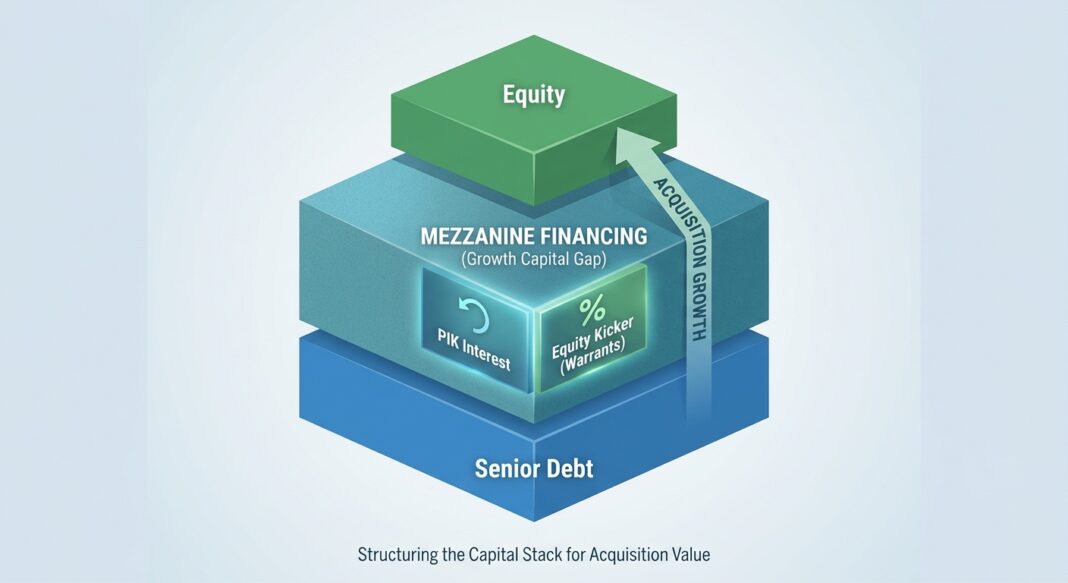
This is the mezzanine moment. Mezzanine debt is a hybrid form of capital that combines features of both debt financing and equity financing, acting as a funding bridge that fills the gap between the amount a traditional bank will lend and the firm’s existing equity base. For operators who have maximised senior capacity and want to avoid the dilution cost of a full equity raise, mezzanine is often the most efficient path forward.
The challenge is that mezzanine is also the most structurally complex layer in the capital stack. It carries PIK interest mechanics, equity kicker economics, subordination dynamics, and intercreditor negotiations that all interact simultaneously. Getting the structure right (and understanding the true all-in cost) is what separates operators who use mezzanine strategically from those who discover its real price at exit.
This article breaks down the full mechanics of growth-stage mezzanine for acquisitions: how to structure it, how to compare it against alternatives, how current market terms are shifting, and how to negotiate the key deal points before signing a term sheet.
Structure Breakdown: Components, Mechanics, and a Worked Example
The Three Layers of Mezzanine Economics
Mezzanine financing is not a single instrument; it is an aggregation of three distinct economic components that must be modelled together to understand true cost.
1. Cash-Pay Interest
Mezzanine loans often include two types of interest payments. Current cash interest is a straightforward, periodic cash payment, much like the interest on a standard loan, typically paid monthly or quarterly, which can impact the company’s operating budget. Typical interest rates range from 10% to 15% annually in 2025, reflecting the risk premium.
2. Payment-in-Kind (PIK) Interest
With PIK interest, the borrower does not pay cash right away. Instead, the interest amount is added to the total loan balance, causing the principal to grow over time. Borrowers favour PIK mechanics primarily to conserve cash during integration periods, capex cycles, or market downturns. The compounding effect is the critical risk to model: PIK does not feel expensive until you see it capitalised year after year. Bullet repayment looks simple until you see how much principal has grown by exit.
A common structure pairs cash and PIK: mezzanine loans often mix both types, a loan might have 12% cash interest plus 2% PIK interest, giving a total yield of 14%.
3. The Equity Kicker (Warrants)
An equity kicker is a feature commonly associated with mezzanine financing, serving as a sweetener that allows lenders to participate in the company’s success, typically in the form of warrants or options. These equity components commonly come in the form of warrants or options to buy between 1% and 5% of the borrower’s equity. Warrant coverage is typically sized as a percentage of the loan principal, and the strike price is set at current enterprise value, making the kicker substantially more valuable if the company exits at a premium.
The true complexity comes from the warrants. These equity kickers can complicate the capital structure, add layers to future financing rounds, and create challenging negotiations in a potential exit scenario.
Worked Example: A $50M Acquisition by a $30M EBITDA Manufacturing Company
Consider a manufacturing platform generating $8M EBITDA seeking to acquire a complementary business at a $50M enterprise value (6.25x EBITDA). The combined pro forma entity is projected at $14M EBITDA post-integration.
| Capital Layer | Amount | % of Structure | Indicative Pricing | Notes |
|---|---|---|---|---|
| Senior Secured Bank (TL + Revolver) | $28M | 56% | SOFR + 275–325 bps | ~3.5x pro forma EBITDA; asset-secured; quarterly maintenance covenant |
| Mezzanine (Subordinated Debt) | $12M | 24% | 12% cash + 2% PIK; warrants for 3% equity | 5-year bullet; unsecured; subordinated via intercreditor agreement |
| Equity (Sponsor + Management) | $10M | 20% | Target IRR 25%+ | Common equity; last money out |
| Total | $50M | 100% | Blended cost ~9–10% | Total leverage ~5.0x pro forma EBITDA |
At exit after 5 years, assuming a modest 7x EBITDA multiple on $18M EBITDA, the warrant holder converts a 3% stake worth roughly $3.8M against a $12M loan funded five years earlier, materially enhancing the mezzanine lender’s IRR beyond the stated interest rate. This is exactly the structure where the mezzanine lender earns a 15% current return (combining cash and PIK interest compounding into principal) plus potential equity upside through warrants if the company is sold or goes public.
Structural Term Sheet: Key Mezzanine Parameters
- Amount: $10M–$100M (core middle market range)
- Interest Rate: 12%–16% all-in (cash + PIK split); market average for 2025 typically ranges from 12% to 16%
- Maturity: Mezzanine loans typically mature in 5 to 7 years, often aligning with expected exit timelines
- Amortisation: Repayment is usually structured as a single bullet payment at maturity
- Warrant Coverage: commonly between 10% and 25% of the loan amount, convertible to 2%–5% equity
- Call Protection: Origination fees and prepayment penalties are common. Call protection often discourages early repayment, with declining premiums over the first few years of the loan
- Covenants: Incurrence-based with a limited maintenance overlay; leverage and minimum coverage ratios
How It Compares: Mezzanine vs. the Alternatives
Choosing mezzanine over its alternatives is a function of four variables: the size of the capital gap, the borrower’s cash flow profile, dilution tolerance, and timeline to exit. The following framework maps each option across these dimensions.
Mezzanine vs. Second-Lien / Unitranche
The traditional leveraged finance structure requires a borrower to negotiate with multiple creditor groups: a senior lender or syndicate, a mezzanine provider, and potentially a second-lien lender. Each layer has its own documents, covenants, pricing, and enforcement rights. The intercreditor agreement between these parties is among the most complex and contentious documents in any financing.
Unitranche eliminates this layering entirely: a single-facility debt structure that combines what would traditionally be separate senior and subordinated debt layers into one loan with one set of documents, one interest rate, and one lender relationship. Unitranche facilities typically price at SOFR + 425–475 basis points for sponsored upper middle market transactions, with core middle market credits commanding 50–100 basis points higher according to Capstone Partners’ Winter 2025 Leveraged Finance Report. This makes unitranche competitively priced against a blended senior/mezz stack, but it concentrates all decision-making in a single lender, which has covenant and amendment implications.
Mezzanine vs. Growth Equity
The primary trade-off is dilution vs. cash flow obligation. Entrepreneurs and business owners view mezzanine capital as a way to achieve growth while maintaining control over the company’s direction and culture, which might be compromised with an influx of new equity investors. While more expensive than traditional bank loans, mezzanine funding is cheaper than equity and less dilutive to business owners. The key test: if projected EBITDA growth post-acquisition is sufficient to service the debt load and repay at bullet maturity, mezzanine preserves substantially more equity value than issuing growth equity at a suppressed current valuation.
Decision Matrix
| Scenario | Preferred Structure | Rationale |
|---|---|---|
| Strong FCF; dilution-sensitive; clear exit in 4–6 years | Senior + Mezzanine | Minimises equity give-up; services debt from cash flow |
| Speed-critical; single lender preferred; $25M–$150M EV | Unitranche | Closes 30–45 days faster; one set of documents |
| Uncertain cash flow; pre-EBITDA growth phase | Growth Equity / Preferred | No fixed debt service obligation during scaling |
| Asset-heavy; receivables or inventory base available | ABL + Mezzanine | ABL maximises senior capacity; mezz fills residual gap |
Current Market Terms: What the Data Shows in 2025–2026
The mezzanine and private credit markets have shifted materially over the past 18 months. Borrowers with strong sponsors and defensible cash flows are finding incrementally better terms, but the covenant environment and pricing landscape are bifurcating sharply by deal size.
Five Market Data Points
1. Pricing Compression Accelerating in Direct Lending
According to LCD, 33.5% of BDC portfolio holdings as of Q2 2025 priced below S+500, up from 17% a year ago, while investments priced at S+600 or higher fell to 24% from 44% last June. The shift marks a stark contrast to market pricing just two years ago, when average direct lending spreads hovered around 675 bps. For mezzanine borrowers, this competitive pressure is a negotiating tailwind.
2. Covenant Bifurcation by Deal Size
Maintenance covenants continue to be more prevalent in the lower and core mid-market (EBITDA under $100M), while covenant-lite structures are more common for larger borrowers (EBITDA over $100M) that operate in defensive industries. For growth-stage borrowers in the $5M–$30M EBITDA range, maintenance covenants, quarterly tests of leverage or fixed charge coverage, have returned to many PE-backed deals financed by non-bank lenders. This requires enhanced focus on realistic covenant cushions and headroom in financial models.
3. Leverage Standards Resetting to 5.0x
Market data confirms that most transactions now clear around 5.0x EBITDA leverage, representing a notable retreat from the 6.0x+ levels prevalent during 2018–2019. Bain & Company reports that debt-to-EBITDA ratios for U.S. LBOs averaged approximately 4.9x in 2024, remaining well below pre-pandemic peaks. Mezzanine effectively allows borrowers to push total leverage to this threshold while keeping senior debt within bank appetite.
4. PIK Income Rising Across the BDC Universe
According to PitchBook, PIK interest income for the top 15 BDCs topped $1 billion in March 2025, reflecting a 20% year-over-year increase. Payment-in-kind options, which allow borrowers to add interest owed onto the loan’s principal in lieu of making cash payments, have become a sought-after differentiator in private financing. Once the domain of distressed borrowers, healthy companies have utilised PIK toggles in recent years to prioritise growth initiatives while sustaining their leverage levels amid elevated interest rates.
5. Mezzanine All-In Cost Range for Performing Companies
Mezzanine debt is more expensive than senior debt, with a typical loan for a performing company expected to yield 12.5–14% for the lender. Mezzanine deals typically range $10M–$100M as subordinated debt with 10–15% interest rates, with warrant coverage delivering incremental equity upside for the lender on top of the stated rate. Borrowers should model the full IRR impact of warrants across low, base, and high exit scenarios before accepting a term sheet.
The Gap Capital Playbook: Four Steps to Executing a Mezzanine Raise
Mezzanine is not a reactive instrument; it works best when the borrower has quantified the gap precisely, packaged the credit story correctly, and run a targeted process. Here is the practitioner framework.
Step 1: Quantify the Need
Start with the acquisition price, subtract senior debt capacity (typically 3.0x–3.5x pro forma EBITDA from a bank), subtract available equity, and define the precise dollar gap. Include integration costs, transaction fees, and a liquidity reserve, do not undersize the mezzanine and return to market six months later. Mezzanine debt providers evaluate historical and projected cash flow, growth potential, and ability to service both existing senior debt and the new mezzanine layer. Expect lenders to review EBITDA, coverage ratios, and management track record.
Step 2: Prepare the Credit Package
A mezzanine process requires a Confidential Information Memorandum, three years of audited financials, a 5-year integrated financial model showing debt service coverage across scenarios, and a clear use-of-proceeds narrative. The model must show: (a) pro forma leverage at close, (b) debt paydown trajectory, (c) minimum fixed charge coverage under a downside case, and (d) enterprise value at exit with warrant dilution calculated explicitly. Exit value should be shown across low, base, and high cases, based on exit equity assumptions. Implied dilution should be calculated so the cost is not abstract.
Step 3: Run the Process, Target Fund Type Carefully
Not all mezzanine capital is the same. BDCs, insurance-affiliated sub-debt funds, family office credit vehicles, and dedicated mezzanine funds each have different pricing expectations, warrant appetite, and covenant requirements. Most deals have 3–5 year terms with minimal amortisation until maturity. Profitability requirements mean lenders need positive EBITDA or a clear path to profitability within 12 months. Run at least three parallel conversations to create competitive tension, which is the primary mechanism for tightening warrant coverage and improving PIK/cash split terms.
Step 4: Negotiate the Intercreditor Before the Term Sheet Closes
The intercreditor agreement between the senior bank and mezzanine lender governs standstill periods, enforcement rights, and payment blockages. If senior covenants are breached, mezzanine payments can be blocked entirely until the senior default is cured, creating uncertainty for both the borrower and the mezzanine lender. Negotiate the standstill period (typically 90–180 days) and ensure the mezzanine lender retains cure rights before the intercreditor is signed. Operators frequently underestimate how much negotiating leverage they hold on this document prior to execution.
Structuring Guidance: Where Borrowers Have Leverage and Where They Do Not
For Operators: Five Negotiation Priorities
- PIK vs. Cash Split: Push to maximise PIK allocation in early years when integration is absorbing cash. Effective PIK structures include carefully tailored triggers. Performance-based triggers might require a minimum liquidity threshold before permitting cash-pay toggling. Alternatively, time-based triggers may allow PIK for an initial period, with a step-down to partial cash-pay thereafter.
- Warrant Coverage Percentage: Warrants are the highest-leverage negotiating point. A 25-basis-point reduction in warrant coverage is structurally more valuable than a 100-basis-point cut in the stated interest rate at a high-growth exit multiple. Balance warrant coverage (commonly between 10% and 25% of the loan amount) to keep dilution controlled.
- Call Protection: Negotiate declining prepayment premiums after year two. If the acquisition thesis plays out ahead of schedule and a full exit or refinancing becomes possible, punitive call protection destroys value. The agreement should clarify whether make-whole or call protection applies to both the debt and the warrant value, and how capitalised PIK is factored into any premium calculation.
- Covenant Headroom: Typical financial maintenance covenants now include total leverage ratios with 30% or higher cushions to model. Insist on 30%–35% headroom above the base case model, not the lender’s stressed case, and negotiate EBITDA add-backs for integration costs and non-recurring items from day one.
- Information Rights vs. Board Rights: Lenders expect monthly and quarterly financials, compliance certificates, budget-to-actuals, and sometimes board observer rights. Resist observer rights where possible; offer expanded financial reporting as a substitute. Observer rights create governance friction that becomes costly at the next financing round.
For Lenders and Investors: What to Scrutinise in the Structure
- EBITDA Definition Quality: EBITDA definitions padded with add-backs and forecasts give borrowers ample performance leeway. Insist on a clean EBITDA definition with disciplined, time-limited add-backs.
- PIK Compounding Risk: There is a nuanced risk profile: compounding can elevate loss severity if performance underwhelms, and covenants must be calibrated to avoid PIKing into default.
- Intercreditor Enforceability: Ensure the payment blockage and standstill mechanics are clearly documented. The intercreditor is where mezzanine recovery in a distress scenario is won or lost.
Key Takeaways
- Mezzanine fills a structural gap that neither banks nor equity can efficiently occupy. For growth-stage acquisitions where senior capacity is exhausted and dilution is prohibitive, subordinated debt with a PIK/cash blend is the purpose-built solution.
- The true all-in cost is the sum of three components: cash interest, PIK compounding, and equity kicker value at exit. Model all three across exit scenarios before accepting a term sheet, the stated rate alone is consistently misleading.
- Warrant coverage, not the headline interest rate, is the highest-leverage negotiation point for borrowers at high-growth businesses where exit multiples will make warrants deeply in-the-money.
- The covenant and pricing environment in 2025–2026 is bifurcated by deal size. Middle-market borrowers (EBITDA under $100M) continue to face maintenance covenant requirements; larger credits are approaching covenant-lite. Smaller borrowers should negotiate for 30%–35% headroom cushions from day one.
- Run the process competitively and negotiate the intercreditor early. Parallel conversations with multiple mezzanine providers are the primary mechanism for tightening warrant coverage and improving PIK terms, and the intercreditor agreement between senior and mezzanine lenders must be settled before closing, not after.


