
The Most Important Question in Private Credit
When evaluating any private credit investment or borrowing arrangement, one question cuts through the complexity faster than any other: where in the repayment line do you stand? That question is the essence of capital stack analysis, and understanding it is foundational to every decision made in private credit markets, whether you are allocating institutional capital or financing a business.
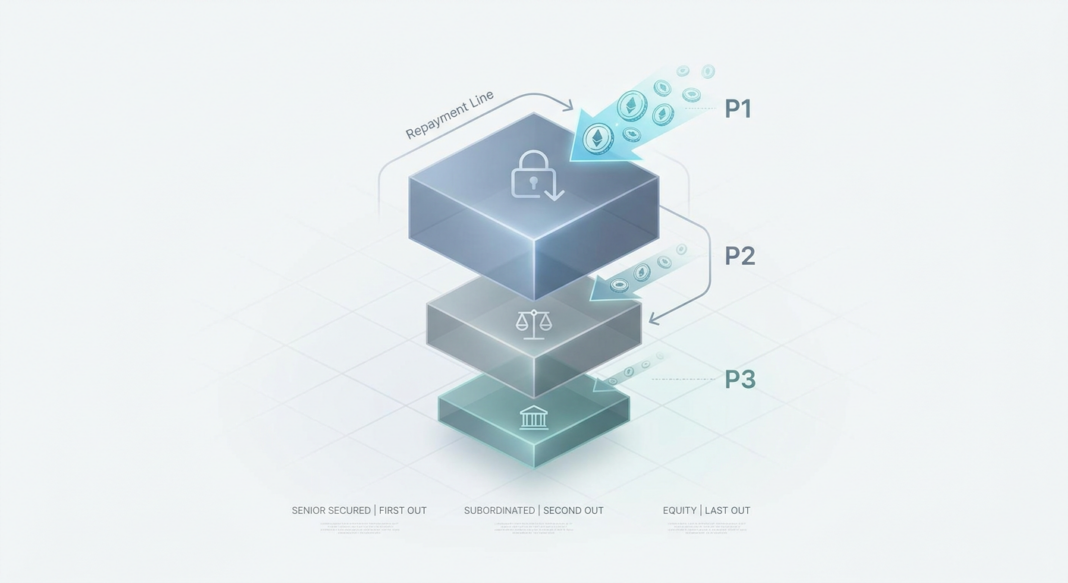
The capital stack is not a metaphor. It is a legally binding hierarchy that determines the sequence in which creditors and owners receive payments: both during normal operations and, critically, in a default or liquidation scenario. Every layer of financing a company carries sits somewhere in that stack, and that position defines the risk, the return expectation, and the structural protections available to the party occupying it.
How the Capital Stack Works
Think of the capital stack as a building. The higher your floor, the safer your position. The ground floor, equity, absorbs every loss first, because it has no contractual right to repayment. The top floors, senior secured debt, collect first, backed by collateral claims on real assets. Everything in between represents a negotiated trade-off between risk and yield.
According to Gridline’s private credit capital structure guide, the stack from top to bottom typically comprises: senior secured debt, unitranche debt, subordinated (junior) debt, mezzanine debt, and equity. Each descending layer accepts greater loss exposure in exchange for a higher return expectation.
As BIP Wealth’s capital stack primer explains, senior secured lenders hold priority claims on tangible assets (cash, receivables, equipment, real property) and stand at the front of the repayment line ahead of all long-term creditors. Subordinated lenders sit further back; they may earn a higher coupon precisely because they accept the risk of being wiped out if asset values fall short in a liquidation.
PitchBook’s private debt guide reinforces this point: because debt investors are senior in the capital stack relative to equity holders, they get paid first in any workout or restructuring, making private credit structurally lower-risk than private equity for equivalent underlying businesses, though return expectations reflect that difference.
A Concrete Example with Numbers
Consider a middle-market manufacturing company acquired in a leveraged buyout at an enterprise value of $100 million. The acquisition is financed as follows:
- Senior Secured Term Loan: $50 million (50% of enterprise value), top of stack, first lien on all assets
- Mezzanine Debt: $20 million (20% of enterprise value): subordinated, unsecured, higher coupon
- Equity (Sponsor Capital): $30 million (30% of enterprise value), bottom of stack, absorbs first losses
Now suppose the business underperforms and is sold in a distressed process for $60 million: a 40% decline from purchase price. Here is how recoveries flow through the stack:
- Senior Secured Lender: Recovers $50 million in full, 100% recovery rate
- Mezzanine Lender: Recovers the remaining $10 million, 50% recovery rate
- Equity Sponsor: Recovers nothing, complete loss of $30 million
This illustrates the core mechanic of subordination: the equity cushion of $30 million had to be entirely erased before the mezzanine lender suffered any loss. And mezzanine had to absorb its loss before the senior lender felt any pain. Position in the stack is not just theoretical; it has direct, quantifiable consequences when stress materialises.
Current Market Relevance
Understanding stack position is especially pertinent in the current private credit environment, where the asset class has grown substantially and now commands a meaningful share of leveraged lending activity.
According to Long Angle’s 2026 Private Credit Investment Guide, private credit now represents approximately 20% of leveraged credit market share in the United States, a significant shift driven largely by banks pulling back from middle-market lending following post-GFC regulatory constraints. Importantly, the guide notes that leveraged credit as a share of nominal U.S. GDP has remained broadly stable, suggesting private credit is capturing existing demand rather than inflating systemic leverage.
Senior secured direct lending has attracted the largest share of institutional allocation within the private credit universe. As noted by Gridline, in recent years nearly half of all capital raised by private debt funds has targeted senior debt strategies, a reflection of institutional preference for top-of-stack positioning during periods of macroeconomic uncertainty.
On credit quality, Long Angle cites Proskauer’s Private Credit Default Index, which shows direct lending default rates have remained below 4% since 2021: a figure that reflects both the structural protections of senior secured positioning and the influence of private equity sponsor oversight on borrower discipline.
The Meketa Private Credit Primer notes that private credit has evolved considerably since the Global Financial Crisis, transitioning from a niche strategy to a core allocation for institutional investors seeking yield, downside protection, and portfolio diversification, with capital stack seniority remaining the primary risk-management lever across strategies.
Decision Framework
For Investors Evaluating Private Credit Funds
- Identify stack position first. As BIP Wealth notes, a senior secured direct lending fund and a subordinated debt fund are both “private credit”, but they occupy fundamentally different risk positions. The label alone tells you nothing; the stack position tells you everything.
- Quantify the equity cushion beneath you. The larger the equity buffer below your position, the greater the implied loss that must occur before your principal is impaired. Evaluate loan-to-value ratios and attachment points relative to enterprise value.
- Understand collateral quality. Senior secured claims backed by tangible, liquid assets (receivables, equipment) provide stronger protection than those relying solely on enterprise cash flows.
- Price the illiquidity premium deliberately. Private credit positions typically carry six-to-ten-year capital lockups. That illiquidity should be compensated by a meaningful spread over comparable public market instruments, and your stack position determines the appropriate benchmark for that comparison.
For Business Owners and Operators Seeking Capital
- Match your capital need to the right layer. Senior secured debt is the lowest-cost debt option but requires collateral and covenant compliance. Mezzanine provides flexibility but at a meaningfully higher cost of capital. Equity avoids repayment obligations entirely but dilutes ownership permanently.
- Understand what lenders see in your stack. A private credit lender evaluating your business will immediately assess how much equity sits below their proposed loan, because that equity is their first line of defence. The more equity in your capital structure, the more attractive your credit profile becomes to senior lenders.
- Use subordinated capital strategically, not reactively. Mezzanine and junior debt can bridge financing gaps when senior capacity is exhausted, but operators should model the full cost (including higher coupons and potential warrant coverage) before accepting subordinated terms.
Key Takeaways
- Stack position is the single most important risk variable in private credit. It determines recovery sequencing, loss absorption order, and yield expectations, before any individual deal characteristics are even considered.
- Senior secured debt protects through priority and collateral. First-lien lenders hold contractual claims on assets and stand at the front of the repayment line, making this the most capital-efficient risk position in the debt universe for institutional allocators.
- Subordination means accepting more risk for more yield. Each layer below senior secured requires compensation for the additional loss exposure accepted, but that loss exposure is real, not theoretical, as illustrated by liquidation math.
- The equity cushion is a private credit investor’s primary buffer. The larger the equity layer beneath a debt position, the more enterprise value must erode before principal is impaired, making sponsor equity contribution a critical underwriting variable.
- “Private credit” is not a monolithic risk category. Investors and operators should always determine the specific stack position of any financing arrangement before drawing conclusions about risk, return, or appropriateness for their objectives.


