
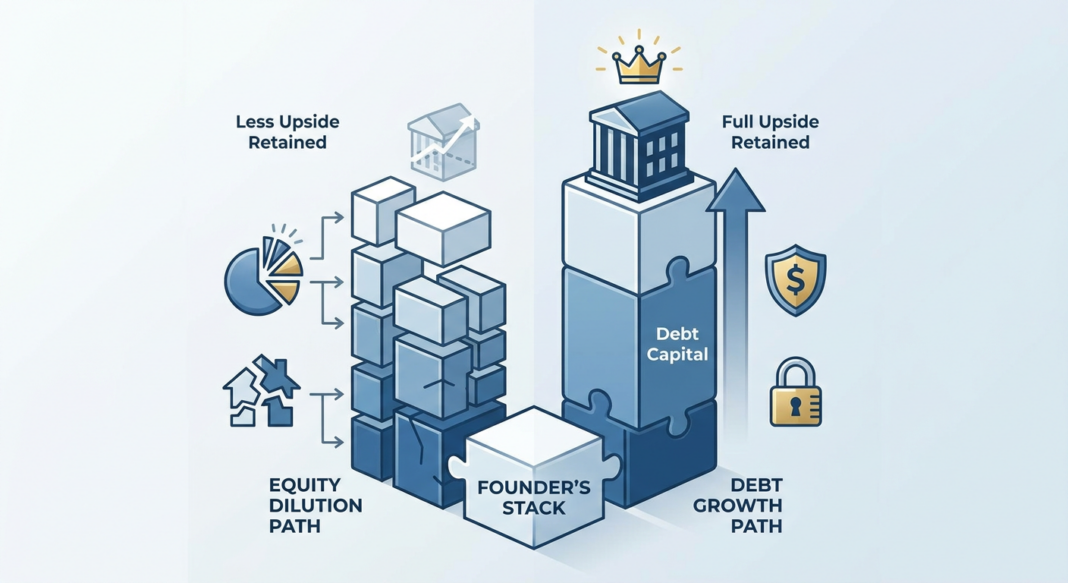
The Founder’s Stack: How One Late-Stage Company Used $3.1B in Venture Debt to Grow Without Giving Away the House
A real-world capital structure story (and a hypothetical contrast) that reveals why the smartest founders in 2024 and 2025 chose debt over dilution at the most critical moment of their growth.
The Story: A $7 Billion Company That Chose Leverage Over Dilution
By late 2024, Cohesity (the Santa Clara-based AI-powered data security and management platform founded by Mohit Aron) had already closed a landmark Series G equity round exceeding $1 billion, pushing its valuation to $7 billion. The company had serious momentum: recurring revenue, deep enterprise relationships, and a market tailored precisely for the AI and ransomware-defense spending wave. But the company’s ambitions weren’t finished. It needed more capital: capital for international expansion, talent, product development, and to close its transformative combination with Veritas Technologies’ data protection business.
The obvious path for a company at this stage is another equity round. Dilute further, pull in more VC money, and ride the narrative. But Cohesity’s leadership made a different call. In December 2024, the company closed a $3.1 billion debt financing: one of the largest venture debt deals in the technology sector’s history: using debt, not equity, to fund its next chapter.
The reasoning was clean: the business generated predictable, recurring revenue from enterprise customers. The cash flows could support debt service. And critically, the founders and early investors did not have to surrender another slice of ownership at a moment when the exit clock was still ticking and the upside was very much intact. This wasn’t rescue financing. It was a deliberate, sophisticated capital structure decision made from a position of strength.
“We’re seeing a real departure from the old notion that debt is a sign of distress, this year’s data shows it’s increasingly a sign of discipline.”, David Spreng, Founder & CEO, Runway Growth Capital
Source: Runway Growth Capital / PitchBook, 2024–2025 Venture Debt Review (August 2025)
The Decision: What Were the Options on the Table?
Consider what an equity alternative would have looked like for a company at Cohesity’s stage. By 2025, median dilution sits at approximately 19.5% for seed rounds and 18% for Series A rounds, according to Carta data. By the time a company has completed a Series A with an option pool, founders and early stakeholders typically retain around 50% ownership, and dilution compounds with every subsequent round. For a company that had already completed a Series F and a Series G, any further equity raise would squeeze existing ownership into an ever-smaller slice of the cap table.
The debt path preserved all of that. The structure, a senior secured term facility underwritten against Cohesity’s enterprise-grade recurring revenue, meant no new shareholders, no new board seats demanded, no new liquidation preferences stacked on top of existing ones. Ownership percentages remained untouched.
The hypothetical contrast (clearly labeled as illustrative): Imagine two SaaS founders (call them Founder A and Founder B) each running a $12M ARR data security company in 2022 with an identical $80M valuation. Founder A raises a $20M Series B at a 20% dilution to fund a new product line and international sales team, then a subsequent $30M Series C two years later at another 18% dilution. By the time a $150M acquisition offer arrives in 2025, Founder A owns roughly 38% of the company, down from 65% at founding. Founder B, by contrast, takes on $25M in venture debt at 11% interest against strong ARR, services $2.75M annually, hits the same growth milestones, and retains 65% ownership at exit. The same $150M outcome yields approximately $57M to Founder A versus $97.5M to Founder B. Same company. Same market. Radically different personal outcomes, determined entirely by the financing choice.
The Outcome: What the Numbers Actually Reveal
For Cohesity, the $3.1 billion debt round wasn’t just a financial instrument; it was a strategic signal. The company used the financing to power its combination with Veritas Technologies’ data protection business, a move that created, in the company’s own framing, a new leader in AI-powered data security and management. The deal closed in September 2025, with Cohesity absorbing one of the largest enterprise data protection assets in the industry, without surrendering equity to do it.
The broader market data validates this approach. According to the Runway Growth Capital and PitchBook 2024–2025 Venture Debt Review, total venture debt deal value reached a record $53 billion in 2024: even as deal count dropped to its lowest level in a decade. Fewer deals, but far larger ones. Nearly 60% of all venture debt financings in 2024 occurred at the late or venture-growth stage. These aren’t distressed companies reaching for a lifeline. These are mature, well-capitalized businesses making a deliberate capital allocation choice.
The cautionary contrast is equally instructive. The PE-driven software take-privates of 2022–2025 tell the opposite story. Coupa Software, taken private by Thoma Bravo for roughly $8 billion with a debt-to-equity ratio approaching 65:35, saw significant post-acquisition layoffs reportedly reaching 30% of its workforce. Citrix, taken private by Vista Equity Partners and Evergreen Coast Capital for $16.5 billion carrying approximately $15 billion in debt, left banks absorbing over $600 million in losses trying to syndicate the loans. These are not stories of too much leverage per se; they are stories of leverage misapplied to businesses where cash flow assumptions proved wrong, and where the debt served the fund’s return model, not the company’s operational reality.
Late-stage tech valuations remain roughly 40% below their 2021 peaks, making equity more expensive in dilution terms than at any point in the recent boom cycle. In that environment, the math strongly favors debt for companies with proven revenue and a clear path to cash flow.
The Lessons: A Framework for the Founder Facing This Decision Today
What separates Cohesity’s debt story from the overleveraged PE cautionary tales isn’t the presence of debt, it’s the alignment between the company’s cash flow reality and the debt structure chosen. The principles are worth extracting clearly.
1. Debt Rewards Businesses That Have Already Won the Unit Economics Battle
Venture debt works best when a company has proven revenue (generally $2–3M ARR minimum, according to FlowCap’s 2025 analysis) a clear growth plan, and the ability to service interest payments. It is not a substitute for product-market fit. It amplifies companies that already have it.
2. Dilution Is Permanent; Interest Is Temporary
A 20% dilution round taken today permanently reduces founder upside at every future exit, at every future valuation step-up, and at every secondary sale. Interest paid on a $25M facility over four years represents a fixed, finite cost that disappears when the loan is repaid. The asymmetry between the two costs is dramatic and frequently underappreciated.
3. The VC Clock Runs Against Founders: Even When the Numbers Look Good
Italian VC exit data from 2022–2024 revealed that in 47% of small- and mid-cap transactions, founders received less than 15% of total deal value, despite having built the company. The structural explanation is simple: liquidation preferences, participating preferred, and anti-dilution clauses accumulate with every round. Debt carries none of these mechanisms. A lender gets repaid. It does not take a pro-rata share of your exit waterfall.
4. The Market Has Changed, And Lenders Are Responding
In previous rate cycles, founders cited interest rates as their top concern when evaluating debt. Today, according to the PitchBook / Runway data, founders prioritize flexibility, speed, and control over headline rates. Lenders have responded accordingly, offering more borrower-friendly covenants and tailored repayment structures. The stigma is also fading: 61% of survey respondents in the 2024–2025 Venture Debt Review said they no longer view venture debt as “rescue financing.”
5. The Decision Framework: Three Questions Before You Sign Any Term Sheet
- Can the business service interest from operating cash flow or near-term revenue growth? If yes, debt is likely the better path. If no, equity is necessary.
- What is the expected time to exit, and what does dilution cost you in dollar terms at that exit? Model it explicitly. The number is always larger than founders intuitively expect.
- Is the capital being raised for growth or survival? Debt for growth, funded by cash-generating operations, is leverage used as intended. Debt used to extend runway on a burning company is a different instrument entirely, and a far riskier one.
Key Insights
- Debt is increasingly a growth tool, not a distress signal. The record $53 billion in venture debt deal value in 2024 was concentrated in mature, late-stage companies using debt to scale, not to survive. The stigma around debt is structurally obsolete for companies with proven cash flows.
- Dilution compounds invisibly, until the exit waterfall makes it visible. Research on Italian VC exits found founders received less than 15% of deal value in nearly half of small- and mid-cap transactions. Structural dilution from stacked liquidation preferences is the hidden cost of equity that most founder narratives ignore.
- The Cohesity model (equity to prove the business, debt to scale it) is the new template. Sophisticated late-stage companies are “stacking” financings: using equity rounds to establish valuation and credibility, then debt to fund the heavy capital requirements of expansion without incremental ownership cost.
- PE leverage becomes dangerous when it serves the fund’s IRR model, not the company’s cash flow reality. The Coupa and Citrix cautionary tales are not arguments against leverage; they are arguments against leverage misaligned with operational fundamentals. The debt-to-equity ratio must be anchored to actual, serviceable cash flows.
- Today’s borrower-friendly lending environment favors founders who understand how to use it. With U.S. direct lending dry powder at a record $146 billion at end-2025 and lender competition compressing SOFR spreads, the supply of patient, flexible debt capital is at an all-time high. Founders who understand the instrument have structural negotiating leverage that did not exist five years ago.


