
Why Middle-Market Borrowers Are Choosing One Lender Over Many
Picture a traditional leveraged buyout from a decade ago. A private equity sponsor would spend weeks coordinating a senior bank syndicate, then separately negotiating a mezzanine tranche with a different lender group: each with its own legal team, its own covenant package, and its own ideas about control rights. The result was a capital structure that worked, but rarely quickly, and almost never simply.
Today, a growing share of middle-market borrowers are funding their transactions through a single instrument called the unitranche loan: a structure that has gone from a niche post-crisis innovation to the dominant debt product in U.S. middle-market finance. According to Global Legal Insights (January 2026), unitranche loans have become the flagship product of the private credit market, with large-cap unitranche activity reaching $210 billion in 2024, more than double the $94 billion recorded in 2023.
For investors evaluating private credit funds and for business owners considering their financing options, understanding how unitranche structures work (including their pricing, protections, and trade-offs) is essential literacy in today’s capital markets.
What Is a Unitranche Loan?
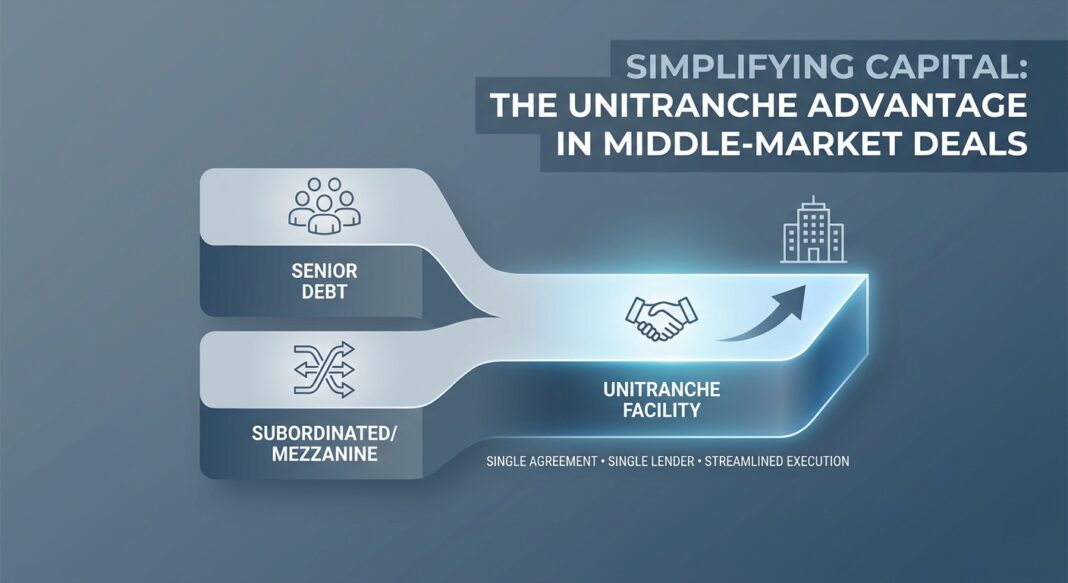
A unitranche facility is a debt structure that combines what would traditionally be separate senior and subordinated debt layers into a single loan with one credit agreement, one interest rate, and one primary lender relationship. As described by Global Legal Insights, the structure simplifies the capital stack, reduces documentation and administrative costs, and streamlines negotiations, all from the borrower’s perspective.
Behind the scenes, however, considerable sophistication can exist. When two or more lenders participate, they often privately divide the facility into a “first-out” and a “last-out” tranche through a confidential document known as an Agreement Among Lenders (AAL). As explained by Mary Taylor & Associates (April 2026), the AAL determines how interest, repayments, enforcement rights, and recoveries are shared among lenders with different risk appetites. The borrower is not typically a party to the AAL and interacts only with the single blended facility.
The result, as Mary Taylor & Associates summarizes, is “simplicity from the borrower’s perspective, coupled with sophisticated risk allocation among lenders behind the scenes.”
There are two primary unitranche variants investors and operators should understand:
- Straight Stretch Unitranche: A single lender provides the full credit facility, stretching to higher leverage levels than a traditional senior-only bank loan would allow.
- Bifurcated Unitranche: Two or more lenders co-fund the facility, splitting it internally into first-out (lower risk, lower return) and last-out (higher risk, higher return) positions, governed by the AAL.
How It Works: A Concrete Example
Consider a private equity sponsor acquiring a software business with $10 million in EBITDA for a purchase price of $60 million (6x EBITDA). The deal requires $40 million of debt and $20 million of equity. Under a traditional structure, the sponsor might layer a $30 million senior bank loan at SOFR + 300 bps on top of a $10 million mezzanine facility at a fixed 13%–15%: requiring separate documentation, separate counsel fees, and an intercreditor agreement governing the two lenders’ competing rights.
Under a unitranche structure, a single private credit lender (or a bifurcated pair of lenders behind one agreement) provides the full $40 million in a single facility. According to Capstone Partners’ Middle Market Leveraged Finance Report (Q4 2025), unitranche facilities for sponsored upper-middle-market transactions currently price around SOFR + 425–475 basis points, with core middle-market credits (like this $10M EBITDA company) typically 50–100 bps higher. With three-month SOFR projected near approximately 3.25% through 2027, an all-in rate on this deal would fall in the 8.5%–9.0% range, a single blended rate that replaces the complexity of the senior/mezz stack.
For the borrower, the advantages compound quickly. According to Private Equity Bro (October 2025), unitranche execution can close 30 to 45 days faster than a syndicated alternative, a meaningful advantage in competitive auction processes where a financing delay can cost a sponsor the deal entirely. The borrower also faces only one set of covenants, one administrative agent, and one counterparty for amendment requests, add-on acquisitions, and dividend recapitalizations.
The lender, in turn, earns a blended return that is higher than pure senior pricing while controlling the entire first-lien credit position, and typically retaining meaningful covenant protections.
Current Market Relevance
The unitranche structure has moved from middle-market niche to mainstream capital markets fixture over the past five years, and 2025–2026 market data reinforces this trajectory on multiple dimensions.
Private credit has scaled dramatically. According to Morgan Stanley, the size of private credit reached approximately $3 trillion at the start of 2025, up from roughly $2 trillion in 2020, and is estimated to grow to $5 trillion by 2029. Within North America specifically, PIMCO (March 2026, citing Preqin) reports that direct lending AUM grew roughly sevenfold over the past decade to approximately $644 billion by year-end 2025.
Bank tightening is driving borrowers toward private credit alternatives. The Federal Reserve’s April 2026 SLOOS reported that banks continued to tighten standards for commercial and industrial loans to firms of all sizes in Q1 2026, the latest installment of a multi-year tightening cycle that has narrowed traditional bank access for many middle-market operators.
Spreads have compressed but remain attractive. After peaking near 700 basis points in 2022, SOFR spreads on direct lending deals compressed significantly, with Capstone Partners noting that 81% of direct lending LBOs carried a spread below 550 bps in 2025, the lowest average levels ever recorded. Total average borrowing costs are projected near approximately 850 bps for 2026 and 2027.
Unitranche retains stronger covenant protections than the syndicated market. According to Private Capital Global (September 2025), while approximately 90% of broadly syndicated loans in 2024 remained covenant-lite, private credit lenders have maintained firmer positions on covenant inclusion, particularly for mid-market transactions. Most middle-market unitranche facilities retain at least one financial maintenance covenant, typically a quarterly leverage or fixed charge coverage test.
Default rates are rising modestly but remain contained. The Proskauer Private Credit Default Index (Q1 2026) tracked 697 loans representing $189.2 billion in original principal and recorded a default rate of 2.73%, up from 2.46% in Q4 2025, but described by Proskauer’s private credit group as tracking below broadly syndicated loan market levels.
Investor satisfaction remains high. According to IQ-EQ (February 2026, citing Preqin’s November 2025 survey), 81% of LP respondents plan to hold or increase their commitment to private credit throughout 2026, with 91% of LPs stating the asset class met or exceeded their expectations.
| Metric | Data Point | Source |
|---|---|---|
| Private Credit Global AUM (start of 2025) | ~$3 trillion | Morgan Stanley |
| N. American Direct Lending AUM (year-end 2025) | ~$644 billion | PIMCO / Preqin (March 2026) |
| Upper Mid-Market Unitranche Spread (2025) | SOFR + 425–475 bps | Capstone Partners (Q4 2025) |
| Private Credit Default Rate (Q1 2026) | 2.73% | Proskauer Default Index (Q1 2026) |
| LBOs with Spread Below 550 bps (2025) | 81% of direct lending deals | Capstone Partners / PitchBook LCD (Q4 2025) |
| BSL Market Covenant-Lite Share (2024) | ~90% of new syndicated loans | Private Capital Global (September 2025) |
Decision Framework: Investors & Operators
For Investors Evaluating Private Credit Funds:
Investors considering allocation to a direct lending or private credit fund consider several factors specific to unitranche-focused strategies. First, covenant quality matters: a fund that maintains maintenance covenants on its unitranche portfolio provides lenders with early-warning signals if a borrower’s performance deteriorates, allowing for proactive engagement rather than waiting for a payment default. As noted by PipelineRoad (March 2026), maintenance covenants “give the lender an early seat at the table if the borrower’s financial performance deteriorates.”
Second, investors evaluate first-out vs. last-out positioning in bifurcated structures. First-out lenders carry lower credit risk and receive priority in recoveries; last-out lenders bear more risk in exchange for higher yield. Understanding which position a fund primarily occupies informs both expected return and loss-given-default assumptions.
Third, investors weigh the illiquidity premium. According to T. Rowe Price / OHA (2025), private credit new issue spreads have consistently run 1.5% to 3.4% wider than broadly syndicated loan spreads since 2019, a persistent premium reflecting both illiquidity and complexity.
For Business Owners and Operators Evaluating Unitranche Financing:
Unitranche financing is typically most relevant for businesses with EBITDA between $5 million and $50 million that are involved in an acquisition, management buyout, or leveraged recapitalization. Operators consider unitranche when speed and certainty of close are critical, particularly in competitive processes. The simplified documentation reduces legal costs and time to close relative to layered structures. However, operators also recognize the trade-off: unitranche all-in rates are higher than pure senior bank debt, and the maintenance covenant obligations require ongoing financial discipline. Operators evaluate whether their projected free cash flow supports interest coverage ratios typically expected to exceed 2.0x, with stronger deals achieving 2.5x–3.0x, according to Private Capital Global.
Key Takeaways
- Unitranche combines senior and subordinated debt into one instrument: giving borrowers a single lender, single rate, and single covenant package, while lenders privately allocate risk via an Agreement Among Lenders (AAL).
- The speed premium is real and measurable: unitranche execution can close 30–45 days faster than a syndicated alternative, a decisive advantage in competitive M&A processes where timing can determine whether a deal closes.
- Unitranche retains stronger investor protections than the syndicated market, while ~90% of broadly syndicated loans were covenant-lite in 2024, most middle-market unitranche facilities maintain at least one financial maintenance covenant, giving lenders an earlier intervention right.
- Current pricing reflects a more competitive but still attractive environment: upper-middle-market unitranche spreads of SOFR + 425–475 bps (implying ~8.5%–9.0% all-in) represent material compression from 2022 peaks, driven by a record private credit capital base competing to deploy.
- Bifurcated structures add complexity investors must evaluate: when assessing a private credit fund’s portfolio, understanding whether positions are first-out or last-out within a unitranche is essential to accurately mapping risk and recovery exposure.


