
The Story: A Term Sheet Signed at the Edge of the World
It was March 2020. The world had just locked down. Conference rooms sat empty, corporate travel budgets evaporated overnight, and any lender with a shred of caution was pulling term sheets off the table. It was, objectively, the worst time to be a B2B video collaboration analytics company looking for growth capital.
And yet, that is exactly when Austin-based Vyopta: a SaaS platform helping enterprises manage complex, multi-vendor video collaboration environments, signed a financing term sheet with Vistara Growth. The deal closed in May 2020, on its original terms, without renegotiation, even as the broader lending market seized up.
CEO and co-founder Alfredo Ramirez didn’t take a dilutive equity round. He didn’t hand a VC firm a board seat. He took non-dilutive term debt (structured as a long-duration, non-amortizing growth loan) and used it to execute. Four years later, in June 2024, HP acquired Vyopta as a strategic addition to its Workforce Experience platform. The founders, early investors at Elsewhere Partners, and the entire Vyopta team walked into that acquisition with a cap table that had not been materially diluted over the final four years of the company’s independent life. Every percentage point of ownership they hadn’t surrendered to a late-stage VC was a percentage point they took to the HP closing table.
That outcome didn’t happen by accident. It was the direct result of a deliberate, leverage-first capital strategy made at the most uncertain moment imaginable.
The Decision: Growth Capital Without the Equity Tax
In early 2020, Vyopta faced a structural problem familiar to any scaling SaaS business: the company’s existing bank relationship couldn’t stretch far enough to fund the growth ambitions the team had mapped out. The natural next move in the venture playbook would have been a new equity round: bring in a growth-stage VC, price the round, accept dilution, add board complexity, and align the cap table with a new set of incentives that may or may not match those of the founders and existing investors.
But there was a critical wrinkle. Most banks and venture debt funds willing to engage at that moment required a condition that effectively negated the point of debt: they wanted fresh equity capital from investors as a prerequisite. In the venture debt world, this is standard practice, lenders underwrite against the implied backstop of equity support, not against the underlying business fundamentals. The message to Vyopta was essentially: go raise equity first, then we’ll talk about lending you money on top of it.
Vistara’s approach was different. Their “growth debt” model underwrites directly against business fundamentals (revenue quality, customer concentration, market position, management track record) rather than requiring equity support as a condition of lending. They provided Vyopta a long-duration, non-amortizing term loan: a structure explicitly designed to give the company runway to invest in growth rather than to service debt from day one.
A year into the arrangement, when Vyopta decided it wanted to invest more aggressively into product and go-to-market than originally budgeted, Vistara extended additional capital, again without requiring investors to contribute equity first. The alignment was clean. The cap table stayed clean.
The Outcome: A Simple Cap Table Is a Strategic Asset
The path from that 2020 term sheet to HP’s 2024 acquisition was not, as Vistara’s own post-acquisition commentary noted, a straight line from bottom-left to top-right. Vyopta navigated a genuine existential market shift: enterprise video collaboration hardware collapsed almost overnight as the workforce moved home, legacy providers lost ground to Zoom and Microsoft Teams, and the company had to rebuild its product positioning for a multi-vendor, hybrid-work world it hadn’t originally been designed to serve.
The non-amortizing debt structure was critical here. A traditional amortizing loan would have forced cash out of the business during exactly the period when Vyopta needed that cash to fund the product pivot. The long-duration, non-amortizing structure bought the team the time to execute without the monthly drain of principal repayments compressing their operational flexibility.
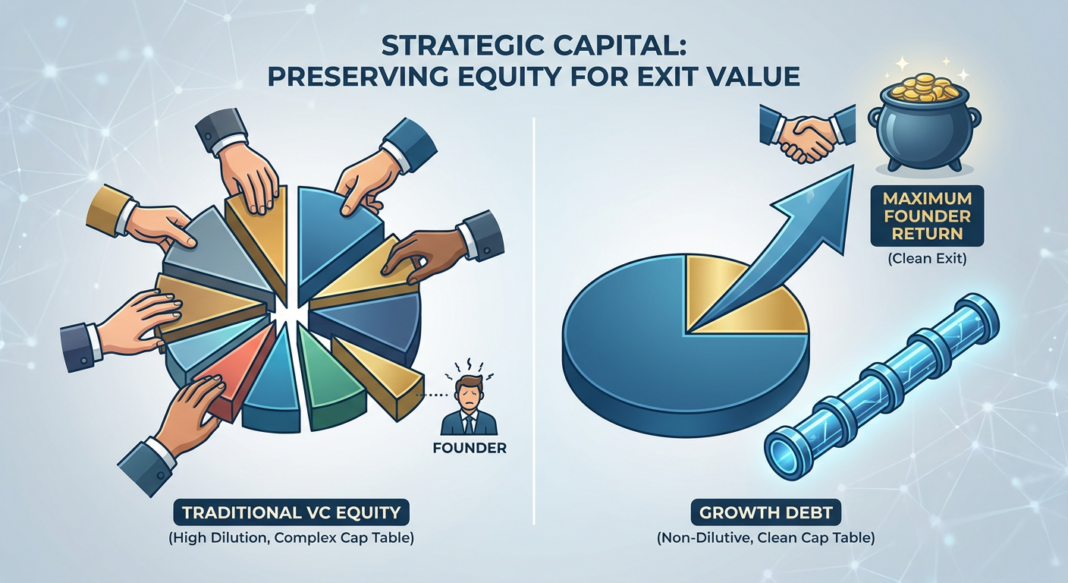
When Vyopta eventually began exploring strategic alternatives, the conversations that would lead to HP, the company presented a profile that acquirers in 2023 and 2024 were specifically seeking: profitable growth, a simple cap table with limited preference stack complexity, and a management team with proven operational discipline. A late-stage dilutive equity round in 2020 would almost certainly have introduced a significant preference stack, ratchets, or anti-dilution provisions that would have complicated the acquisition economics and potentially reduced proceeds to founders and early investors.
The debt structure preserved the clean exit. The clean exit maximized proceeds for everyone on the cap table who had been there since the beginning.
This story is not unique to Vyopta. Musely, a DTC telemedicine platform growing at 50% year-over-year and serving over 1.2 million patients, recently secured $360 million in non-dilutive capital from General Catalyst’s Customer Value Fund, a revenue-share structure that founder and CEO Jack Jia described as mathematically more compelling than either a bank loan or a dilutive equity round. Musely has not raised a single dollar of equity capital since its $20 million seed round in 2014. Twelve years of 100% founder ownership, now funded by a $360 million war chest for customer acquisition, without surrendering a point of equity. Similarly, Inkle, a financial operations platform for VC-backed startups, used non-dilutive revenue financing from Efficient Capital Labs to avoid two rounds of dilution entirely, retaining approximately 90% founding team equity and full board control while expanding to serve 500+ companies globally.
The Lessons: What Vyopta Teaches Every Scaling Founder
The instinct to reach for equity capital at a moment of market uncertainty is understandable. Equity doesn’t need to be repaid. There’s no debt service pressure. A new investor brings more than money; they bring network, expertise, and validation. These are real benefits, and in the right context, the dilution trade-off is worth making.
But the Vyopta story, and the growing cohort of founders like Jack Jia at Musely, Ken Hoppe at Modigi, and Omer Ozener at Hello Klean, suggests that equity capital has a hidden cost that rarely appears in the pitch deck: the cost to the exit. Every VC round adds preference complexity. Every preferred share issued is a claim that sits ahead of common equity in a sale. Every new board member is a vote that may not align with the founder’s timeline or strategic vision at the moment it matters most.
Non-dilutive growth debt, when structured correctly (long duration, non-amortizing, underwritten against business fundamentals rather than equity backstop) sidesteps all of those costs. It preserves the cap table, preserves founder control, and preserves the clean exit optionality that commands premium acquisition economics.
The framework for deciding which path to take is actually straightforward:
- Do you have predictable, recurring revenue? If yes, debt can be underwritten against it without equity support.
- Is your growth path capital-intensity or operational-intensity? Capital-intensive growth (customer acquisition, inventory, headcount) is debt-fundable. Structural business model rebuilds may require equity partners.
- What does your exit look like in 3–5 years? If a strategic acquisition is the likely outcome, cap table simplicity has measurable economic value. Protect it.
- What does the debt structure actually require? Non-amortizing, long-duration structures fund growth. Short-duration, amortizing structures fund operations. They are not the same product.
Vyopta answered all four of those questions correctly in March 2020, in the middle of a global pandemic, and HP wrote the check that validated every one of those answers four years later.
Key Insights
- Cap table simplicity is an exit asset. A clean cap table with minimal preference stack complexity commands better acquisition economics and fewer closing complications, non-dilutive debt preserves it structurally.
- Not all debt is the same. Non-amortizing, long-duration growth debt funded Vyopta’s product pivot; a traditional amortizing structure would have drained the cash needed to execute it.
- Equity support requirements are a red flag. Lenders who require fresh equity before extending debt are underwriting against the investor backstop, not the business, a fundamental misalignment for founders who want to minimize dilution.
- Non-dilutive capital is now a proven asset class. From Vyopta’s growth debt to Musely’s $360M revenue-share facility to Inkle’s tranche financing, the market has developed sophisticated, founder-aligned debt structures that simply did not exist a decade ago.
- The best time to choose debt over equity is before you need to. Vyopta signed its term sheet in peak uncertainty, not peak optimism, founders who wait until the market is perfect to optimize their capital structure often find the leverage window has closed.


