
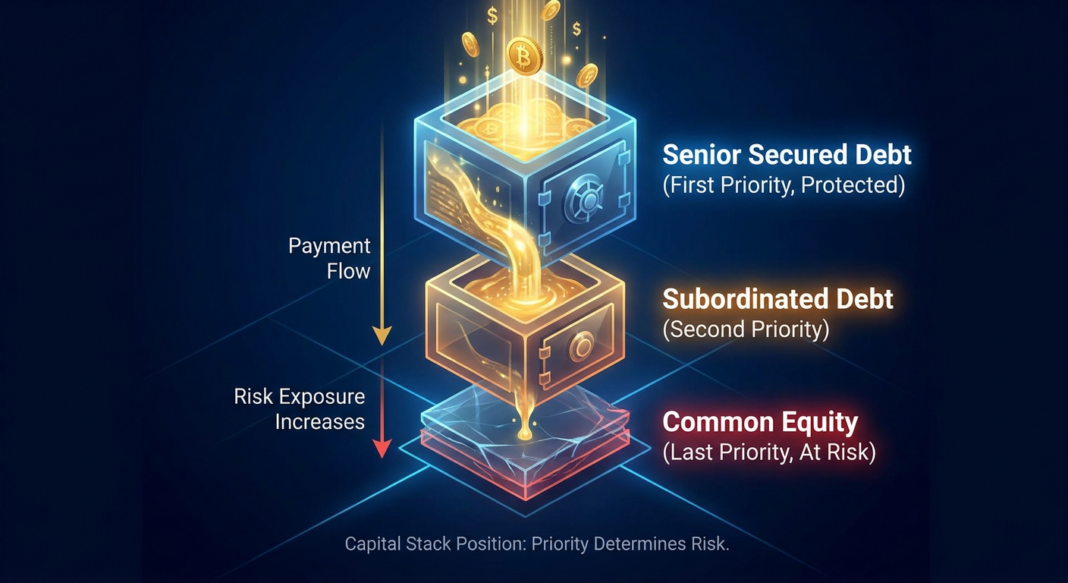
Where You Sit Determines What You Get
Every business that borrows money creates a hierarchy, a legally enforced pecking order that decides who gets paid first when cash is tight and who absorbs losses when things go wrong. In private credit, this hierarchy is called the capital stack, and understanding your position within it is arguably the single most important concept in the entire asset class.
It does not matter how attractive a yield looks on paper. A 14% return sitting at the bottom of a distressed capital structure carries fundamentally different risk than a 10% return sitting at the very top. The position is the underwriting. Everything else (covenants, collateral, sponsor quality) flows from it.
What the Capital Stack Actually Is
The capital stack is the ordered list of financial claims on a company’s assets and cash flows. From top to bottom, each layer represents a different combination of priority, risk, and expected return. Senior secured lenders sit at the top; they are repaid first in any scenario, including liquidation. Common equity holders sit at the bottom; they receive whatever remains after every other obligation has been satisfied.
According to BIP Wealth (April 2026), the layers from lowest risk to highest run as follows: working capital obligations, asset-based debt, senior secured debt, subordinated debt, convertible debt, preferred equity, and finally common equity. Each step down the stack earns a higher potential return, and accepts a higher probability of receiving nothing in a default scenario.
The logic is straightforward: lenders at the top of the stack have a contractual, legally enforceable claim. Equity holders at the bottom have a residual claim; they own whatever value remains. In a healthy business, that residual can be enormous. In a distressed one, it can be zero.
A Concrete Example With Real Numbers
Consider a private equity-backed manufacturing company with a total enterprise value of $100 million. The capital structure looks like this:
- Senior Secured Term Loan: $50 million at SOFR + 575 bps (~10.05% all-in as of Q1 2026)
- Subordinated (Mezzanine) Debt: $20 million at a fixed 14%
- Common Equity (PE Sponsor): $30 million
Now the company hits a downturn. Revenue contracts, and in a distressed sale the business fetches only $55 million: a 45% decline from peak enterprise value.
Here is what happens to each layer:
- The senior secured lender recovers the full $50 million. They are made whole.
- The mezzanine lender recovers the remaining $5 million of the $55 million, taking a $15 million loss on a $20 million position, or a 75% haircut.
- The equity sponsor recovers nothing. The $30 million is entirely wiped out.
The senior secured lender absorbed zero loss through a 45% enterprise value decline. That buffer (the equity and subordinated debt sitting below them) is what private credit professionals call the equity cushion. In this example, that cushion was $50 million, or 50% of total enterprise value. The senior lender had to survive a 50% loss in value before their principal was impaired at all.
Where the Market Stands in 2026
Direct lending, senior secured loans made directly to middle-market companies, has become the dominant form of private credit, and its structural position at the top of the capital stack is a core reason why. According to Long Angle’s Private Credit Investment Guide (March 2026), direct lending accounted for 38% of all private credit capital raised in H1 2025, making it the largest sub-strategy by a wide margin.
The yields on offer remain compelling. As outlined in research from PitchGrade (March 2026), typical all-in rates for middle-market direct lending in 2026 run approximately SOFR + 500–650 bps, translating to gross yields in the 9.8–10.3% range based on Q1 2026 SOFR levels near 4.3%. Large-cap direct lending trades tighter, at SOFR + 425–525 bps, reflecting increased competition from broadly syndicated alternatives.
The structural case for that premium is well-documented. The same PitchGrade analysis notes that historical default rates on middle-market direct lending have run between 1.5–2.5% annually, with senior secured recovery rates of 65–80%: materially higher than the roughly 40% recovery rate on high-yield bonds, which lack the same collateral and structural protections. According to Meketa Investment Group’s Private Credit Primer (April 2024), private credit financed approximately 85% of leveraged buyouts in 2023, cementing its role as the primary capital provider for sponsor-backed transactions where capital stack discipline matters most.
Global private credit assets under management have grown to an estimated $2 trillion as of 2025, with projections pointing toward $4.5 trillion by 2030, per Long Angle (2026). Much of that growth has been concentrated in senior secured strategies precisely because institutional allocators have prioritized structural protection alongside yield.
Decision Framework: Investors and Operators
For investors evaluating private credit allocations: Capital stack position should be the first filter, not a secondary consideration. Investors consider what percentage of enterprise value sits below their position before a single dollar of their principal is at risk. A senior secured loan at 50% loan-to-value (LTV) with strong maintenance covenants is a fundamentally different instrument than a mezzanine note at 70% LTV with incurrence-only covenants, even if both are labeled “private credit.” Investors also evaluate whether a fund’s stated strategy matches its actual portfolio composition, since covenant packages and seniority in large-cap deals have been quietly eroding as competition intensifies.
For operators and business owners seeking capital: The capital stack is a cost spectrum. Senior secured debt, while carrying restrictive covenants, is almost always the least expensive form of non-dilutive capital available. Mezzanine debt costs more and typically includes equity participation features like warrants. Bringing in equity is the most expensive long-term option because ownership is surrendered in perpetuity, whereas debt has a defined maturity. Operators evaluate whether the company’s cash flows can comfortably service senior debt before reaching for cheaper equity alternatives that carry permanent dilution.
Key Takeaways
- Position is the primary risk variable. In private credit, where you sit in the capital stack determines your loss exposure before any other factor is analyzed.
- The equity cushion is your margin of safety. Senior secured lenders are protected by every layer of equity and subordinated debt below them. A thicker cushion means more enterprise value must be destroyed before principal is impaired.
- Higher yield always means lower stack position. The return premium on mezzanine or subordinated debt is compensation for accepting a junior claim, not evidence of superior underwriting.
- Middle-market direct lending still offers a meaningful spread over public alternatives. The 200–350 bps premium over broadly syndicated loans reflects the illiquidity premium and structural protections that senior secured private credit provides.
- For operators, debt is cheaper than equity, but only if cash flows support the service burden. Using the capital stack strategically means taking the least expensive form of capital your business can genuinely sustain.


