
The Most Important Question in Private Credit
Before evaluating any private credit opportunity (whether you are deploying capital or raising it) one question anchors every other consideration: where in the capital stack does this money sit? That single variable determines your repayment priority, your risk exposure, your yield, and your recovery outcome if the borrower runs into trouble. Yet the term “private credit” gets applied to instruments across the entire risk spectrum, from highly protected senior secured loans to equity-adjacent mezzanine tranches. Understanding the stack is not optional. It is the foundation.
What the Capital Stack Actually Is
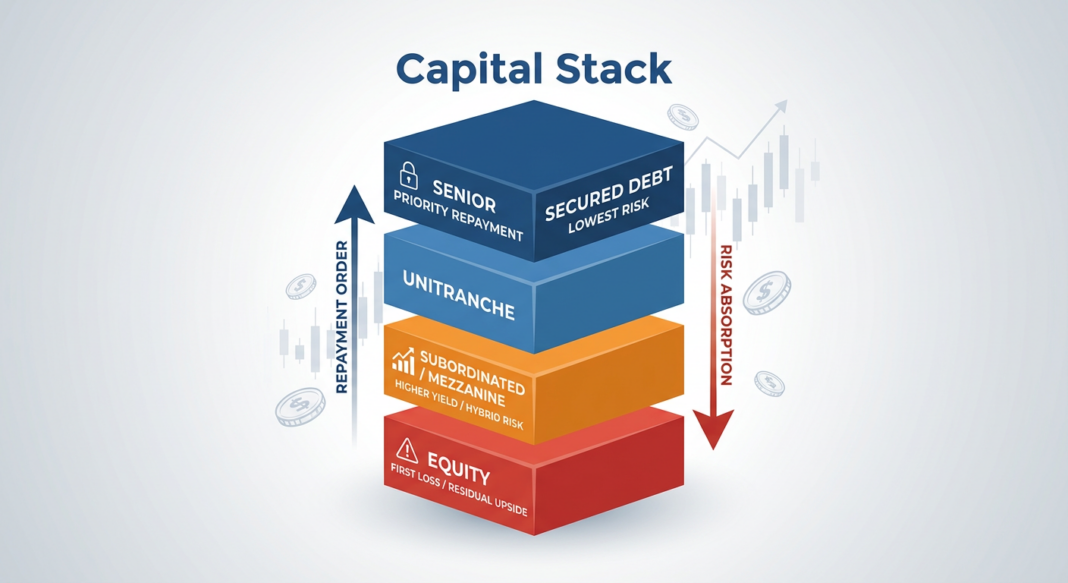
The capital stack is the ordered hierarchy of claims on a company’s assets and cash flows. Think of it as a repayment line: when a business generates cash (or is forced to liquidate) obligations are satisfied from the top of the stack downward. The further up the stack a lender sits, the earlier they get paid. The further down, the longer they wait, and the greater the chance they absorb losses before anyone above them feels any pain.
From top to bottom, the major layers of a typical private credit capital structure look like this:
- Working Capital Facilities: Short-term revolving lines covering payroll, inventory, and operating expenses. First priority, lowest yield.
- Senior Secured Debt (First Lien): Long-term loans backed by collateral: equipment, receivables, intellectual property, or enterprise value. Priority repayment after working capital. This is where the majority of institutional direct lending activity concentrates.
- Unitranche Debt: A hybrid instrument that blends first-lien and second-lien economics into a single facility, typically used in middle-market leveraged buyouts to simplify the lender group.
- Subordinated / Second-Lien Debt: Repaid only after senior lenders are made whole. Carries a higher yield to compensate for the lower priority position.
- Mezzanine Debt: Sits between debt and equity, often structured with warrants or equity conversion rights. Higher yield, higher risk, hybrid recovery profile.
- Preferred Equity: Ownership with distribution priority over common shareholders, but junior to all debt in a liquidation.
- Common Equity: Last in line. Absorbs all losses first and receives all residual upside if the company succeeds.
As explained by BIP Wealth (April 2026), each layer earns a return that reflects the level of risk the investor is accepting. The relationship between position and risk is not complicated, but it may be one of the most important concepts in private credit investing.
A Concrete Example: The $50M Middle-Market LBO
Consider a private equity firm acquiring a manufacturing company with $10 million in EBITDA at a 5x enterprise value multiple, a $50 million purchase price. The deal is capitalized as follows:
- Senior Secured Term Loan (First Lien): $25M at SOFR + 550 bps (~9.2% all-in as of mid-2026)
- Subordinated / Mezzanine Note: $10M at a fixed 13.5% with a warrant kicker
- Sponsor Equity: $15M (30% of enterprise value)
Now stress the scenario: the company underperforms, EBITDA drops to $6 million, and the enterprise value compresses to $30 million in a forced sale. Here is what the recovery waterfall looks like:
- Senior secured lender recovers their full $25M, 100 cents on the dollar.
- Mezzanine lender receives the remaining $5M of a $10M claim, 50 cents on the dollar.
- Equity sponsor receives zero.
The 30% equity cushion below the senior loan absorbed the first $15M of enterprise value decline before the senior lender lost a single dollar. That buffer, the equity cushion, is structural protection built into the capital stack. Senior lenders are underwriting not just the company’s cash flow, but the distance between their claim and potential impairment.
Current Market Relevance: Where the Stack Stands in 2026
Private credit’s capital stack dynamics are playing out in a market that has scaled dramatically. According to Long Angle’s Private Credit Investment Guide (March 2026), private credit assets under management exceeded $2 trillion in 2025 and are projected to reach $4.5 trillion by 2030. That growth reflects sustained institutional demand for the risk-return profile that senior stack positioning delivers.
Within strategy composition, Long Angle (2026) reports that direct lending accounted for 38% of all private credit capital raised in H1 2025: the largest single sub-strategy by AUM, reflecting continued institutional preference for senior secured positions. Meanwhile, bank lending as a share of U.S. GDP declined from 59% in Q4 2008 to 44% as of Q1 2025, according to the same source, widening the origination opportunity for non-bank lenders across the stack.
On the credit quality side, Long Angle (2026) cites Proskauer’s Private Credit Default Index showing that default rates for direct lending have remained under 4% since 2021: a figure that reflects the structural protection of senior stack positioning and covenant discipline, not just favorable macro conditions.
| Metric | Data Point | Source |
|---|---|---|
| Private Credit AUM (2025) | >$2 trillion | Long Angle, 2026 |
| Projected AUM by 2030 | $4.5 trillion | Long Angle, 2026 |
| Direct lending share of H1 2025 fundraising | 38% | Long Angle, 2026 |
| Bank lending as % of U.S. GDP (Q1 2025) | 44% (down from 59% in 2008) | Long Angle, 2026 |
| Direct lending default rate since 2021 | <4% | Long Angle / Proskauer Index, 2026 |
| Sponsor-backed share of direct lending market | ~80% | Meketa / Cliffwater, 2024 |
Decision Framework: Investors and Operators Reading the Same Stack Differently
For investors evaluating private credit funds or direct lending opportunities, the capital stack position is the first filter, not the yield. A higher headline coupon on a mezzanine fund versus a senior secured fund is not a comparison of equivalent instruments. Investors often consider the following when analyzing stack position:
- What is the loan-to-value (LTV) or loan-to-EBITDA ratio? How much enterprise value must erode before the lender’s position is impaired?
- Is there a meaningful equity cushion below the debt? Sponsor equity at 30–40% of capital structure provides meaningful loss absorption.
- What collateral backs the claim? Hard assets (equipment, real estate) and financial assets (receivables) differ significantly in liquidation value.
- Are covenants maintenance-based or incurrence-based? Maintenance covenants provide earlier warning signals and more lender control.
For business owners and operators raising private capital, the capital stack determines your cost of capital and your flexibility. Debt at the senior secured level is cheaper than mezzanine, and mezzanine is cheaper than equity, but each layer comes with different covenants, dilution risk, and control implications. Operators often evaluate whether a unitranche structure (one lender, blended pricing) simplifies execution versus a bifurcated senior/subordinated stack with multiple lenders and intercreditor complexity. As noted by Gridline (January 2024), unitranche debt has gained popularity precisely because it allows borrowers to satisfy their full debt requirement through a single relationship while giving lenders a blended risk-return position.
Key Takeaways
- Position determines protection. Senior secured lenders sit at the front of the repayment line and are shielded by every dollar of subordinated debt and equity below them before they absorb a loss.
- The equity cushion is structural armor. In a sponsor-backed deal with 30–40% equity at closing, senior lenders have significant enterprise value decline to absorb before their capital is at risk.
- Yield reflects risk, not just return. A mezzanine fund offering 13–15% and a senior secured fund offering 9–10% are not the same product with different coupons; they occupy fundamentally different positions in the recovery waterfall.
- Bank retreat has opened the senior stack. The decline of bank lending as a share of GDP has created durable deal flow for non-bank senior lenders, particularly in the middle market, without requiring investors to move down the capital stack for yield.
- Operators should map the full stack before choosing an instrument. The cheapest debt is not always the right debt. Covenant structure, lender flexibility, and intercreditor dynamics matter as much as the coupon when a business faces stress.


