
The Story: A Startup, A Gap in the Market, and a Choice That Changed Everything
In August 2020, Jonathan Benjamin walked into a conversation with Sage Growth Capital carrying 47 customers, less than $1 million in annual revenue, and a company operating at a loss. His startup, Unity Laundry Systems, now rebranded as UnityLab, had pioneered a direct-to-business e-commerce model for commercial appliances, the kind of heavy-duty washers and dryers that dry cleaners, hotels, and small manufacturers depend on. The concept was validated. The demand was real. What he needed next was capital.
Benjamin could have pursued a traditional venture capital raise. Early-stage VC term sheets were available. But he understood the cost, not just in carried interest or board seats, but in the compounding dilution that would undermine every dollar of value he was building. “We always knew that delaying traditional equity raises would benefit our founding team, since early-stage VC funding could prove both expensive and detrimental to the business,” he later explained. “And with negative operating cash flow, traditional debt wasn’t an option.”
Instead, he turned to revenue-based financing, a non-dilutive instrument where repayment is structured as a percentage of monthly revenue, not a fixed debt obligation. Sage Growth Capital deployed an initial $150,000. It was a modest check, but it lit the fuse on one of the more instructive growth stories in the non-dilutive capital playbook. By 2024, UnityLab had grown more than tenfold (with offices in the U.S., China, and Italy) without surrendering the cap table that would ultimately fund its founders’ futures.
The Decision: Equity Was Available. Debt Was Smarter.
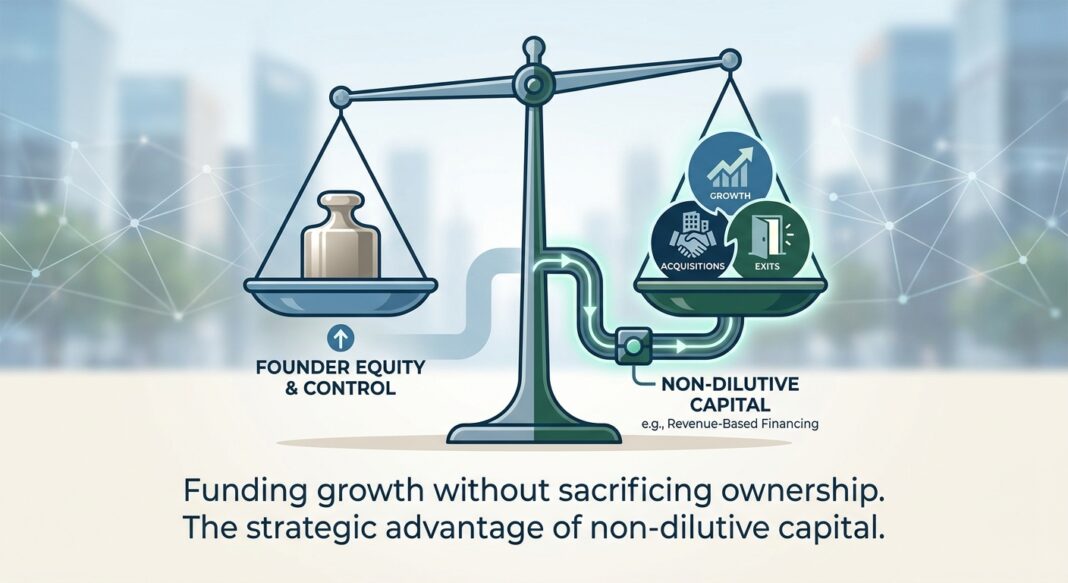
Benjamin’s situation in 2020 illustrates the fork in the road that thousands of founders face every year. The equity path is familiar: accept dilution, gain capital, cede some governance, and bet on the company growing fast enough that the pie, even a smaller slice, is worth more in the end. The non-dilutive path is less traveled, often misunderstood, and frequently more aligned with how founders actually want to build.
Sage’s revenue-based financing provided Unity with capital in exchange for a share of monthly revenue until a predetermined repayment cap was reached. There was no collateral requirement, no equity surrender, and no board seat handed to an outside investor. The cost of capital was real, but calculable, finite, and bounded by Unity’s own revenue performance.
The comparison becomes sharper when you look at what happened next. By December 2021, Unity needed $750,000 to finalize the acquisition of Hoffman New Yorker, a well-known Pennsylvania-based manufacturer of industrial pressing equipment with 24 employees and a global customer base. Equity investors would have priced that acquisition capital against a pre-acquisition valuation, punishing Benjamin for buying an asset before it delivered results. Instead, Sage provided the bridge capital at the critical moment. Benjamin acquired Hoffman using a combination of debt, grants, and the Sage facility. He proved the thesis. And then he went to venture investors, on his terms, from a position of demonstrated strength.
The result: a Series A round of $6.6 million in Q3 2022, raised at a valuation that reflected both the organic growth and the Hoffman integration. “This strategy proved successful, allowing us to secure our Series A financing at a favorable valuation,” Benjamin noted. Non-dilutive capital didn’t replace equity; it sequenced it more intelligently, according to the sagegrowthcapital.com case study.
The Outcome: Three More Founder Stories That Confirm the Pattern
UnityLab’s capital journey isn’t an isolated case. Across industries and deal sizes, founders who chose non-dilutive structures over VC equity are generating outcomes that deserve serious attention.
Ken Hoppe, CEO of Modigi, built a profitable SaaS company serving billion-dollar enterprises inside the Salesforce ecosystem, with six full-time employees and $1.7 million in ARR. When he needed working capital to hire his first salesperson and customer success manager, he turned to Founderpath’s revenue financing, drawing $400,000 in non-dilutive capital with an 8–12% cost over a 12-month payback period. No equity changed hands. No board was formed. Hoppe and his co-founder retained 100% ownership. The result was a 2x pipeline efficiency gain with zero marketing spend, and a clear runway toward $3–4 million in EBITDA within 24 months, per the founderpath.com case study.
Greg and Timothy Holifield, the father-son founders of SafePointe, an AI-based weapons detection system, took a $1 million venture debt facility from TIMIA Capital in September 2022. The capital resolved a painful structural problem: their hardware-enabled SaaS model required upfront hardware investment that was straining working capital and constraining new contract wins. With three disbursements from TIMIA, SafePointe tripled its monthly recurring revenue. Less than 12 months later, the company was acquired by SoundThinking (Nasdaq: SSTI), a public safety technology firm. Equity investors who participated in the same round made 10x in nine months. TIMIA’s debt cost a fraction of that, and delivered the same enabling effect. “When there are no warrants associated with debt, it is truly fantastic money, and much cheaper than equity. I love this class of debt,” said Greg Holifield, per the timiacapital.com case study.
Simon Turner’s retail sales enablement company, Myagi, followed a parallel arc. Having bypassed a planned equity round when COVID disrupted timelines in 2020, Myagi used a $2.5 million TIMIA facility in 2021 to fund sales, marketing, and customer success expansion. ARR climbed from $2.4 million to $4.4 million. In 2023, Myagi was acquired by Rallyware, two years after the TIMIA engagement. Turner’s reflection is pointed: “If I were building a software company again, I would really weigh up the impact, time, and challenges of bringing on venture capital, as well as all the expectations that come with it,” he told timiacapital.com.
The Lessons: When Non-Dilutive Capital Wins, and When It Doesn’t
These four stories share a common structural logic. Non-dilutive capital (whether revenue-based financing, venture debt, or growth loans) works best when several conditions align:
- Predictable, recurring revenue: Revenue-based financing requires revenue to repay. SaaS ARR, recurring service contracts, and subscription models create the predictability that makes these instruments viable and cost-effective.
- A defined capital catalyst: Each of these founders knew precisely what the capital was for: two new SKUs, a specific acquisition, key hires, or hardware deployment. Precision of purpose keeps the cost of non-dilutive capital proportionate to its return.
- A valuation-building window ahead: Benjamin used Sage’s capital to prove the Hoffman thesis before raising his Series A. Holifield used TIMIA’s capital to triple MRR before the exit conversation. The debt bought time to build value before equity investors could price it.
- Founder alignment over VC-paced growth: Turner’s observation about venture capital is one of the most honest assessments in growth finance: “Many businesses have a natural cadence at which they grow. For many companies, growing too fast can be detrimental.” Non-dilutive capital respects that cadence. VC equity often does not.
Where this approach carries risk: companies with lumpy or unpredictable revenue, capital-intensive business models without clear payback cycles, or founders who mistake non-dilutive instruments for low-cost capital. Revenue-based financing is not cheap in absolute terms; it is relationally cheap when compared to the dilution it prevents at precisely the wrong moment in a company’s valuation curve.
The sevdesk story adds one more dimension. The German accounting SaaS provider used a RAC Growth Loan in September 2024, not because they lacked cash, but because they wanted strategic optionality ahead of an anticipated equity raise. In 2025, they were acquired by Cegid, a major European cloud management firm, according to the riverside.ac case study. The non-dilutive runway gave the leadership team the ability to choose their acquirer on their schedule, not a venture investor’s.
Key Insights
- Sequence capital intelligently. Non-dilutive financing used before an equity round allows founders to prove value, not give it away. UnityLab’s Series A at a “favorable valuation” was a direct consequence of debt-funded proof points.
- Debt is cheaper than it looks when warrants are absent. SafePointe’s equity investors made 10x in nine months. TIMIA’s debt cost a fraction of that to deliver the same growth-enabling effect. The comparison is stark.
- VC alignment and founder alignment are often structurally opposed. Venture capital is engineered for portfolio-level returns across a fund cycle. Founder capital should be engineered for the specific company’s natural growth rate and long-term ownership goals.
- Non-dilutive capital buys optionality, not just runway. Sevdesk didn’t need cash; they needed strategic flexibility. The right instrument unlocks choices, not just months.
- Hardware-enabled SaaS and acquisition bridges are especially well-suited to venture debt. When working capital constraints threaten contract execution or deal closure, targeted debt resolves the bottleneck without restructuring ownership at a critical inflection point.


