
The Most Important Address in Private Credit
In private credit, your position in the capital stack is not just a technical detail; it is the single most important variable determining your risk exposure, your return potential, and your likelihood of recovering capital if a deal goes wrong. Whether you are an institutional investor evaluating a direct lending fund or a business owner structuring a financing deal, understanding where each dollar sits in the hierarchy of claims is foundational to every decision you make.
The capital stack is the ordered hierarchy of all financial claims on a company’s assets and cash flows. Think of it as a building: in a fire, the tenants on the top floors get out first. In a default, the creditors at the top of the stack get paid first. Equity holders, at the very bottom, get whatever is left, which is sometimes nothing at all.
How the Capital Stack Works
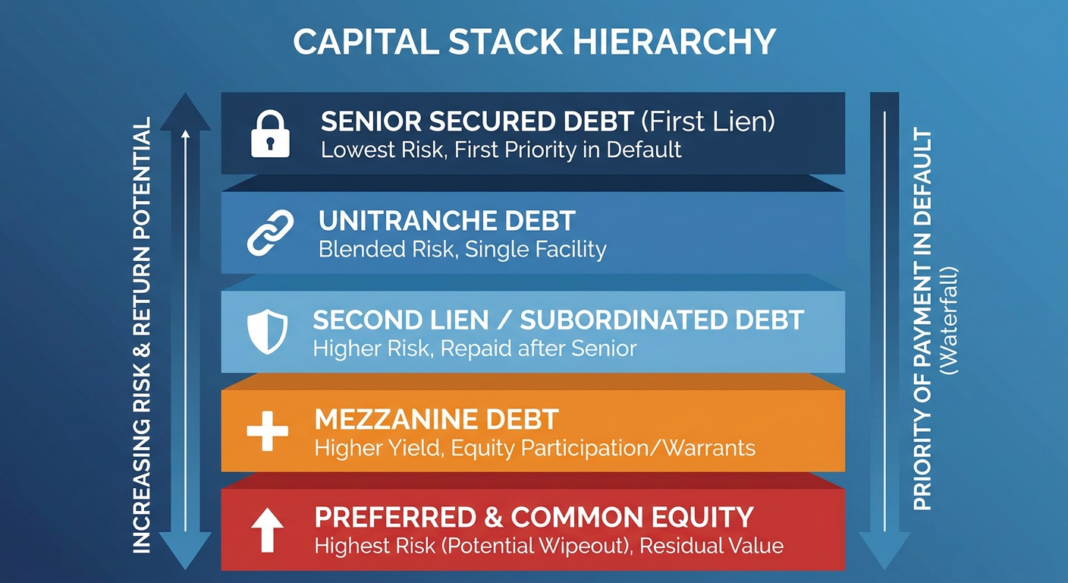
A typical private credit capital structure moves from least risky to most risky as follows:
- Senior Secured Debt (First Lien): The top of the stack. This lender holds a legal first claim, a “first lien”, on the company’s assets. In a default or liquidation, this creditor is repaid before anyone else. Lowest risk, lowest yield.
- Unitranche Debt: A hybrid instrument that blends senior and subordinated debt into a single facility from one lender. The interest rate sits between the two, reflecting the blended risk. Increasingly popular for its simplicity in sponsor-backed buyouts.
- Second Lien / Subordinated Debt: Junior to first lien debt. This creditor is only repaid after the senior lender is made whole. Carries meaningfully higher risk, and demands a higher yield to compensate.
- Mezzanine Debt: Sits between senior debt and equity. Often unsecured or lightly secured, structured with warrants or equity participation to capture upside. Higher yield, higher loss risk.
- Preferred and Common Equity: The bottom of the stack. Equity holders receive residual value only after all debt obligations are satisfied. Highest potential upside, highest risk of total loss.
Subordination is the legal and contractual mechanism that enforces this hierarchy. When a borrower defaults, subordination dictates the precise waterfall through which proceeds flow: senior lenders are paid in full before subordinated lenders receive a dollar, and subordinated lenders are paid before equity holders see anything.
A Concrete Example with Numbers
Consider a middle-market company acquired in a leveraged buyout (LBO) at an enterprise value (EV) of $100 million. The deal is financed as follows:
- $50 million, First Lien Senior Secured Loan (50% of EV)
- $15 million, Second Lien / Mezzanine Debt (15% of EV)
- $35 million, Private Equity (35% of EV)
Now assume the business deteriorates and is liquidated at just $55 million: a 45% decline in enterprise value. Here is how the waterfall plays out:
- The first lien lender receives the first $50 million, fully recovered.
- The second lien lender receives the remaining $5 million out of $15 million owed, a 67% loss on that position.
- The equity holders receive $0, a complete wipeout.
This example illustrates why senior secured positions in private credit are considered structurally defensive. The first lien lender absorbed a 45% decline in asset value and still received full repayment. The equity cushion below, the $35 million in private equity, absorbed the losses first, protecting the debt above it.
Current Market Relevance
Understanding capital stack dynamics is especially important in today’s lending environment. According to Long Angle’s Private Credit Investment Guide (2026), bank lending as a share of U.S. GDP has declined from 59% in Q4 2008 to approximately 44% as of Q1 2025, with private credit filling the void, particularly in senior secured, first lien positions that banks historically dominated.
Private credit assets under management were estimated at over $2 trillion in 2025 and are projected to reach $4.5 trillion by 2030, according to Long Angle (2026). This growth is concentrated in direct lending, the strategy most closely associated with senior secured, first lien capital stack positions.
According to Coller Capital’s Private Credit Secondaries Primer (2025), global private credit AUM reached approximately $1.7 trillion at end of 2024, up from just $300 billion in 2010, a near six-fold increase driven in large part by institutional appetite for senior secured, capital-stack-protected income.
As noted in the Meketa Investment Group Private Credit Primer (April 2024), approximately 80% of the direct lending market is sponsor-backed, meaning a private equity firm holds the equity cushion below the debt, providing the structural subordination that protects senior lenders.
Capital Stack Data Snapshot
| Metric | Data Point | Source |
|---|---|---|
| Private Credit AUM (2025 est.) | $2 trillion+ | Long Angle, 2026 |
| Private Credit AUM (end of 2024) | ~$1.7 trillion | Coller Capital / Preqin, 2025 |
| Projected AUM by 2030 | $4.5 trillion | Long Angle, 2026 |
| Sponsor-backed share of direct lending | ~80% | Meketa / Cliffwater, 2024 |
| Bank lending share of U.S. GDP (Q1 2025) | ~44% (vs. 59% in 2008) | Long Angle, 2026 |
Decision Framework
For Investors Evaluating Private Credit
When evaluating any private credit fund or direct lending opportunity, investors consider capital stack position as the primary risk filter. Key questions include: Is the fund lending in first lien senior secured positions, or further down the stack? What is the typical loan-to-value (LTV) ratio, meaning, how large is the equity cushion below the debt? Does the fund focus on sponsor-backed deals where a well-capitalized private equity firm holds equity and absorbs first losses? Senior secured strategies historically offer lower yields but more predictable capital preservation. Mezzanine and subordinated strategies offer higher headline yields but carry materially greater loss exposure when borrowers face distress.
For Business Owners Seeking Capital
Operators evaluating financing structures weigh capital stack position from the cost and control perspective. Senior secured debt is cheaper, lenders accept lower rates because they hold superior claims. Mezzanine and subordinated capital is more expensive, providers demand higher rates to compensate for their junior position. Operators often evaluate whether taking on subordinated debt to preserve equity is worth the premium in interest cost, versus diluting ownership through an equity raise. The capital stack is ultimately a negotiation between cost of capital, dilution, and risk tolerance on both sides of the transaction.
Key Takeaways
- Position determines priority: In any default or liquidation, capital is returned strictly in order, senior secured first, equity last. Where you sit in the stack defines your downside scenario.
- The equity cushion is your buffer: For debt investors, the equity below them absorbs losses first. A 35% equity cushion means the enterprise value must fall more than 35% before senior debt is impaired.
- Higher yield means lower stack position: Every step down the capital stack, from first lien to second lien to mezzanine, comes with a higher yield and a commensurately higher risk of loss in a stress scenario.
- Unitranche structures simplify complexity: For borrowers and lenders alike, unitranche debt consolidates the capital stack into a single facility, trading structural simplicity for a blended rate that reflects the combined risk.
- Market context matters: With private credit now a $2 trillion asset class and banks continuing to retreat from corporate lending, first lien senior secured private credit has become the dominant product, making fluency in capital stack mechanics essential for anyone participating in this market.


