
The Underwriting Question Every Lender Must Answer Before Closing
Consider a $10 million EBITDA specialty manufacturer seeking a $45 million senior secured term loan, a 4.5x leverage multiple at close. The borrower’s trailing twelve-month cash flows look solid. Customer concentration is manageable. The management team has navigated one prior cycle. The credit committee approves. But here is the question that separates disciplined lenders from the ones who end up in a workout two years later: What happens when EBITDA erodes 20%, and what contractual mechanism triggers your right to act before that erosion becomes a default?
The answer lives in the covenant package. Covenant design is not a legal formality appended at the end of underwriting. It is the structured translation of your credit thesis into enforceable, measurable financial guardrails. When written with precision, covenants give lenders early warning and meaningful leverage. When written loosely (with inflated EBITDA definitions, wide carve-outs, or no maintenance tests at all) they leave lenders exposed to exactly the kind of liability management exercises (LMEs) that have become standard practice for distressed borrowers, including well-documented cases like Serta and Pluralsight, where lender protections were undermined by documentation gaps that allowed borrowers to pit creditors against one another.
This article teaches the full covenant underwriting process: framework, threshold mechanics, monitoring cadence, and the red flags that signal a covenant package is protecting a borrower rather than a lender.
The Covenant Framework: Maintenance Tests, Incurrence Tests, and Negative Covenants
A well-constructed covenant package in a private credit agreement typically contains three layers of protection, each serving a distinct purpose in the credit monitoring architecture.
1. Maintenance Covenants (The Active Warning System)
Maintenance covenants require the borrower to comply with a financial ratio on a periodic, typically quarterly, basis regardless of any borrower action. This is the critical distinction from incurrence covenants, which only test when the borrower does something, such as incurring additional debt or paying a dividend. For private credit lenders, maintenance covenants are the preferred structure because they provide regular, proactive insight into borrower health.
The three most commonly used maintenance covenants in leveraged lending are:
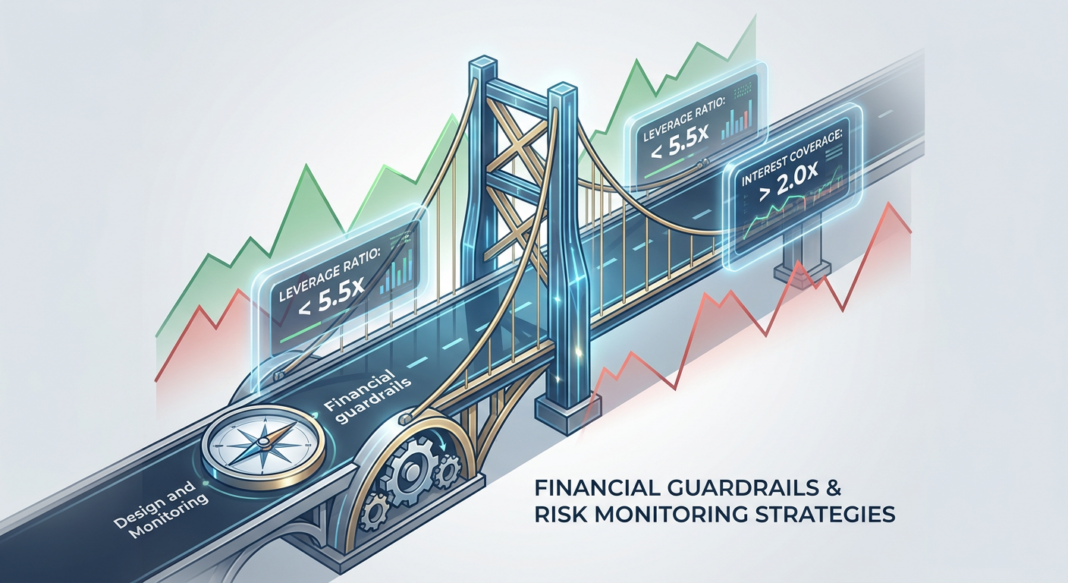
- Total Net Leverage Ratio: Total Net Debt ÷ EBITDA (LTM). This measures how many years of operating earnings it would take to retire the debt load. A tighter maintenance covenant sets a maximum threshold (for example, 5.5x) that steps down as the loan seasons.
- Interest Coverage Ratio: EBITDA ÷ Cash Interest Expense. As noted in standard credit analysis frameworks, a ratio migrating below 1.5x signals that the borrower’s ability to service interest from operating cash flows is becoming structurally impaired. Institutional lenders typically require a floor of 2.0x–2.5x at close for middle-market borrowers.
- Minimum Liquidity Test: Unrestricted Cash + Revolver Availability above a defined floor. This is particularly critical in businesses with high working capital seasonality, where a leverage test alone may not capture a near-term liquidity event.
2. Incurrence Covenants (Action-Based Triggers)
Incurrence covenants activate only when the borrower takes a specific action: most commonly incurring incremental debt, making an acquisition, or distributing cash to equity. They are less protective than maintenance covenants in a passive deterioration scenario, but essential for preventing capital structure manipulation. Key incurrence tests include debt caps as a multiple of EBITDA, restricted payment baskets, and investment limitations.
3. Negative Covenants (Behavioral Restrictions)
Negative covenants restrict what the borrower may not do without lender consent. These include prohibitions on asset dispositions above a threshold, restrictions on subsidiary guarantees, and limitations on liens. The precision of definitions here (particularly how EBITDA is defined and what addbacks are permissible) is where covenant quality is most frequently degraded. Loose EBITDA definitions remain one of the primary tools borrowers use to create headroom artificially, allowing them to appear covenant-compliant while fundamental credit quality deteriorates.
Walking Through the Numbers: Setting and Stress-Testing Covenant Thresholds
Returning to the $10 million EBITDA manufacturer with a $45 million senior loan: here is how a disciplined underwriter would size and stress-test the maintenance covenant package.
Step 1, Establish the Closing Ratio: At $45M debt and $10M EBITDA, the opening leverage ratio is 4.5x. The coverage ratio, assuming $2.5M in annual cash interest at a blended rate of approximately 5.5%, is 4.0x, well above the 1.5x threshold where credit risk becomes acute.
Step 2, Apply a Stress Scenario: Model a 20% EBITDA decline, a reasonable base case for a single-product manufacturer with one major customer, reducing EBITDA to $8 million. Leverage rises to 5.6x. Coverage compresses to 3.2x. Now stress further with a 35% EBITDA decline (severe recession scenario): EBITDA falls to $6.5 million, leverage hits 6.9x, and coverage drops to 2.6x, still above 1.5x, but rapidly approaching critical territory.
Step 3, Set the Covenant Threshold With Cushion: A common institutional practice is to set the maintenance leverage covenant at a 25–35% headroom to the stressed case. In this example, setting a 5.5x maintenance leverage threshold provides meaningful early warning while leaving the borrower operational room in a moderate stress scenario. A 30% cushion to the severe stress case would suggest a 5.25x threshold.
Step 4, Build in Step-Downs: Structure the leverage covenant to step down 0.25x per year as the borrower deleverages over the loan’s life. This disciplines financial performance toward the exit thesis rather than allowing the borrower to grow into static headroom.
This scenario analysis illustrates a core principle from institutional credit practitioners: recovery rates, not just default rates, drive realized returns. Research from Oak Hill Advisors found that when comparing two portfolios with identical spreads and identical default rates, the portfolio with higher recovery rates generated a 44% higher loss-adjusted spread: underscoring why covenant-driven early intervention, before a default crystallizes, is the primary driver of economic outcome for private credit lenders. (troweprice.com)
What Institutional Lenders Look For, and Where Covenants Break Down
Experienced credit managers consistently identify covenant documentation quality as a primary differentiator in workout outcomes. The following data points, drawn from institutional research and rating agency data, frame the stakes:
- According to PitchBook LCD data cited by Oak Hill Advisors, borrowers with EBITDA of $100 million or more experienced a 32% lower default rate compared to smaller borrowers over the period from 1Q 1995 through 4Q 2025, highlighting how scale influences both operational resilience and covenant headroom. (troweprice.com)
- Larger-scale borrowers with tighter credit documentation have historically demonstrated lower defaults and higher recovery rates in private credit, as documented in PGIM’s large cap private credit case study analysis. (pgim.com)
- Standard credit analysis frameworks identify EBITDA-to-Interest Expense below 1.5x as the level at which a borrower’s ability to service debt from operations becomes structurally questionable, making this a near-universal floor for maintenance coverage covenants. (overbond.com)
- Out-of-court restructurings and LMEs are increasingly used by distressed borrowers to bypass covenant protections, underscoring the importance of tightly drafted anti-layering provisions, collateral access protections, and restricted payment limitations at the time of original underwriting. (troweprice.com)
- Leverage ratio trending within 0.5x of the maintenance threshold for two consecutive quarters, escalate to watch list
- EBITDA addbacks exceeding 15–20% of reported EBITDA: signals definitional erosion of cash flow quality
- Coverage ratio declining more than 0.5x year-over-year: requires cash flow re-underwriting
- Borrower requests for covenant amendments within 12 months of close: high correlation with subsequent default
Common Covenant Design Mistakes
- Overly permissive EBITDA definitions that allow unlimited addbacks for synergies, cost savings, and non-recurring items, creating phantom headroom not supported by actual cash generation
- Static covenant thresholds with no step-down schedule, allowing borrowers to grow into headroom rather than deleverage
- Missing liquidity tests in seasonal businesses where a quarterly leverage test may not capture a short-term cash crisis
- Weak collateral provisions that allow asset transfers to unrestricted subsidiaries outside the collateral package, a tactic commonly deployed in J. Crew-style transactions
Covenant Underwriting Checklist: Step-by-Step Diligence Points
- Define EBITDA precisely. Enumerate permitted addbacks with hard dollar or percentage caps. Reject open-ended language such as “management-determined synergies.”
- Set the opening leverage ratio. Calculate total net debt ÷ LTM EBITDA at close. Confirm the ratio is supported by at least two years of audited financials.
- Stress-test to 20% and 35% EBITDA decline. Confirm the coverage ratio stays above 1.5x in the moderate stress case. Understand the recovery scenario in the severe case.
- Design a step-down schedule. Require the leverage maintenance covenant to decrease by at least 0.25x annually, aligned with the amortization and deleveraging thesis.
- Include a minimum liquidity maintenance test. Set a floor of unrestricted cash plus revolver availability that covers at least one quarter of fixed charges.
- Restrict collateral transfers. Ensure the credit agreement contains explicit anti-J. Crew provisions preventing asset transfers to unrestricted subsidiaries without lender consent.
- Require quarterly compliance certificates. Mandate delivery within 45 days of each quarter-end, certified by the CFO, with a detailed reconciliation of EBITDA to addbacks.
- Establish an amendment protocol. Any covenant amendment request should trigger a full re-underwriting of the credit, not just a fee negotiation.
- Document incurrence basket limits. Cap incremental debt at a defined leverage ratio, not an open-ended dollar basket, to prevent silent capital structure dilution.
- Assign a portfolio monitoring owner. Each credit in the book should have a designated relationship manager responsible for quarterly covenant tracking and watch list escalation.
Key Takeaways
- Covenants are underwriting, not documentation. The precision of your covenant package directly determines how early you can intervene when a borrower’s credit quality deteriorates, and how much leverage you retain to influence outcomes before a formal default.
- EBITDA definitions are the highest-risk variable in a covenant package. Permissive addback language can inflate reported EBITDA by 15–25% or more, creating artificial covenant headroom that masks true credit deterioration.
- Recovery rates drive realized returns more than headline spreads. A lender who intervenes early via covenant enforcement typically recovers materially more than one who waits for a payment default, making monitoring cadence a direct return driver.
- Borrower size and scale matter at origination. Larger borrowers with greater scale, management depth, and pricing power have historically demonstrated meaningfully lower default rates across multiple credit cycles, validating a size-tiered underwriting approach.
- Liability management exercises have changed the risk calculus. The rise of out-of-court restructurings means lenders can no longer rely on bankruptcy as the primary recovery mechanism. Tight structural protections (anti-layering provisions, restricted subsidiary limitations, and collateral ring-fencing) must be built in at origination, not negotiated during a crisis.


