
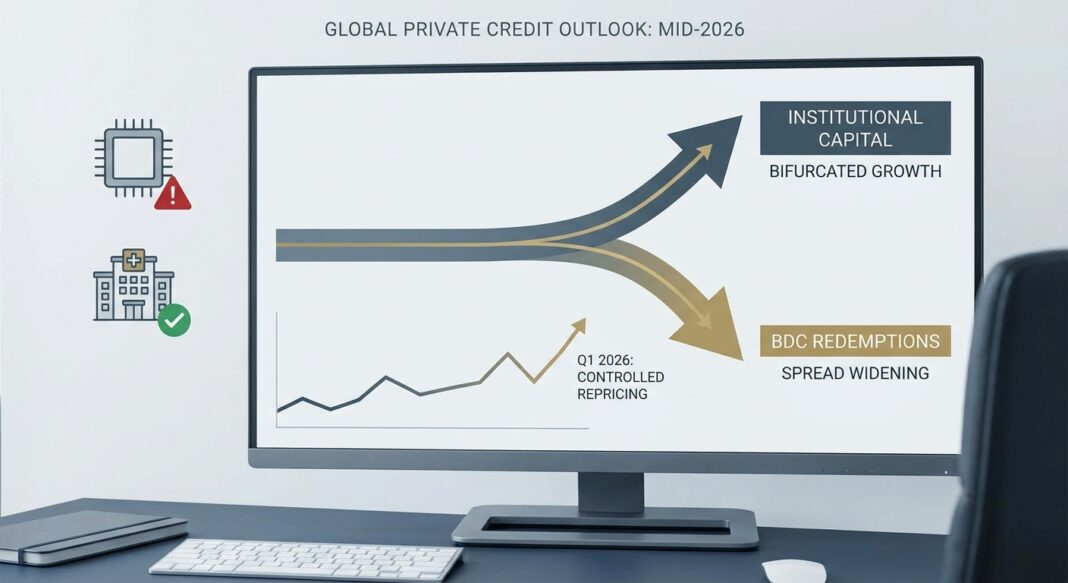
The Main Story: A Credit Market in Controlled Repricing, But Bifurcation Is Accelerating
Private credit entered the second quarter of 2026 at a genuine inflection point. After nearly two years of spread compression and voracious lender appetite, the first quarter delivered a sharp course correction: leveraged loan spreads widened materially, retail-oriented Business Development Companies (BDCs) faced multi-year peak redemption requests, and deal volumes fell sharply year-over-year: all against a macro backdrop defined by elevated inflation, geopolitical tension in the Middle East, and AI-driven disruption reshaping entire sectors overnight.
Critically, this is not a market in crisis. It is a market in repricing. The Federal Reserve held its target Fed Funds rate steady at 3.50%–3.75% through Q1 2026, and the forward curve has shifted meaningfully higher, with market participants now projecting an average base rate of approximately 3.5% through 2028, roughly 20 basis points above prior-quarter expectations, per northleafcapital.com. In this environment, direct lending continues to generate high single-digit unlevered returns, an attractive premium over public credit, but the dispersion between winning and losing credits is widening fast. For institutional investors and operators, understanding where lender appetite is concentrating (and where it is retreating) is now the most consequential analytical task of the cycle.
Quantitative Market Snapshot: Spreads, Volumes, Leverage & Defaults
The table below synthesizes Q1 2026 market data across the key metrics Bond Capital tracks for credit cycle positioning.
| Metric | Current Value (Q1 2026) | Prior Period (Q4 2025) | Change | Source |
|---|---|---|---|---|
| U.S. Direct Lending New Issue Spread (avg.) | ~SOFR + 25 bps wider vs. Q4 | Prior quarter tights | ▲ +25 bps | northleafcapital.com |
| BSL / High Yield New Issue Spread Widening | ~+15–30 bps on new issues | Near post-GFC tights | ▲ Widening | northleafcapital.com |
| European Unitranche Spread, Traditional MM (≤€75mm EBITDA) | ~5.25%–6.25% (incl. OID) | ~5.00%–6.00% | ▲ ~25–50 bps for stressed credits | valuationresearch.com |
| U.S. Total Institutional Loan Issuance (Q1 2026) | $241 billion | $157 billion (Q4 2025) | ▼ –32% YoY; +54% QoQ | portagepointpartners.com |
| European Direct Lending Deal Volume (Q1 2026) | €8.3 billion | €12.4 billion (Q4 2025) | ▼ –33% QoQ | valuationresearch.com |
| U.S. Private Credit Annualized Default Rate | ~1.5% (2025 actual); projected 2.0% by YE 2026 | 1.5% (2025) | ▲ Rising modestly | northleafcapital.com (citing KBRA) |
| European Speculative-Grade Default Rate (Projected Sep 2026) | 3.25% (S&P projection) | 3.70% (Sep 2025) | ▼ Declining | valuationresearch.com |
| U.S. M&A/LBO Deal Volume Growth (Q1 2026 vs. Q1 2025) | +30% YoY by volume; deal count declined | Q1 2025 base | ▲ Volume up; concentration risk elevated | northleafcapital.com |
The headline leverage loan market saw its most active segment, broadly syndicated repricing, contract sharply, with the most liquid portion of the market experiencing spread widening of approximately 100 basis points between January and March, per sikich.com. Lenders are re-rating risk, not exiting, but the cost of execution has risen materially for anyone south of a BB credit profile. For middle market operators, lenders are now demanding tighter fixed charge coverage ratios (FCCR), with coverage floors of 1.20x–1.25x becoming harder minimums rather than cushioned covenants, particularly in cyclical sectors.
Sector Analysis: Where Capital Is Flowing, and Where Lenders Are Pulling Back
Technology & Software: Elevated Scrutiny, Premium Pricing
The single most disruptive force reshaping lender appetite in Q1 2026 is AI-driven disruption of the software sector. European credit spreads within IT services and software widened by more than 200 basis points versus year-end 2025, according to valuationresearch.com. In the U.S., Anthropic’s Claude Cowork launch triggered a meaningful syndicated loan selloff and was a direct catalyst for BDC share price declines, per portagepointpartners.com. Lenders remain open to software credits with deeply embedded products, high switching costs, and low cyclicality, but AI-exposed business models are now command 50–100 bps pricing premiums, where financing is available at all.
Consumer Sector: Stress Concentrated in 2021–2022 Vintages
Consumer-facing credits, especially those originated during the 2021–2022 pandemic-era deployment surge, are the most visible pocket of stress. These borrowers carry elevated leverage from a low-rate origination environment and face refinancing at materially higher all-in costs. Lenders are increasingly deploying PIK toggle adjustments, maturity extensions, and covenant resets rather than forcing defaults, a constructive workout dynamic that keeps headline default rates contained but signals real underlying pressure on FCCR metrics for levered retail and consumer businesses, per russellinvestments.com.
Healthcare, Industrials & Defense-Adjacent: Relative Outperformers
Sectors with regulatory moats, inelastic demand, and limited AI exposure (healthcare services, specialized industrials, and defense-adjacent businesses) continue to attract competitive direct lending terms. Lenders remain willing to fund add-on acquisitions and buy-and-build strategies within these verticals, where debt-to-EBITDA leverage multiples of 5.0x–6.0x for upper middle market credits remain accessible to high-quality sponsors, per multiple market participants cited in northleafcapital.com.
Structural Shift: Institutional Capital Gains Negotiating Power
Retail-oriented BDC redemption pressure is producing a structural supply-demand shift that favors well-capitalized institutional lenders. As certain large platforms moderate deployment to manage liquidity, borrowers are turning to institutional direct lenders offering greater execution certainty. This dynamic is creating a more favorable negotiating environment on documentation, covenant packages, and pricing for disciplined, long-duration capital providers, a dynamic not seen since the post-COVID repricing window of late 2022, per northleafcapital.com.
Implications: What This Means for Borrowers, Lenders, and Institutional Investors
For Borrowers and Operators
The window of frictionless, covenant-lite, aggressively priced financing has closed, at least temporarily. Borrowers with near-term maturities and leverage above 5.5x EBITDA face a refinancing environment that is meaningfully more expensive than their original cost of capital, with lender scrutiny concentrated on FCCR cushion, revenue predictability, and AI business model exposure. Operators in AI-adjacent software, consumer discretionary, and cyclical industrials should engage lenders early, well ahead of maturity, to explore extension, repricing, or recapitalization options before pipeline pressure further tightens available options. For creditworthy, well-sponsored businesses, however, liquidity remains available; execution certainty from direct lenders continues to command a premium over broadly syndicated alternatives.
For Institutional Lenders and Investors
The repricing environment is delivering a more attractive entry point for new capital deployment. Institutional platforms with dry powder and no retail redemption overhang are positioned to set terms, tighten documentation, and price risk more accurately than at any point since 2022. The key differentiator going forward will be selectivity and portfolio construction discipline: according to russellinvestments.com, portfolios with concentrated exposure to U.S. PE-backed software, even if diversified by loan count, carry correlated risk that is now being repriced simultaneously. True diversification across economic drivers, collateral types, and capital structures is the defining risk management discipline of this phase of the cycle.
Forward View: The Next 3–6 Months
The trajectory for private credit through Q3 2026 will be shaped by three variables: the path of oil prices and their inflation pass-through, the pace of private equity sponsor M&A resumption, and the rate at which BDC redemption pressure stabilizes. If geopolitical conditions in the Middle East ease and oil prices stabilize, multiple deal pipelines held in reserve since Q1 could come to market simultaneously, creating a meaningful acceleration in direct lending volume in H2. European private equity fundraising, already down to €18.0 billion YTD from €23.7 billion in the prior-year period per valuationresearch.com, will remain a headwind for new deal formation until LP confidence in exit timelines recovers. In the U.S., with M&A issuance highly concentrated, more than 40% of Q1 institutional loan volume derived from just five mega-transactions per sikich.com, the breadth of deal activity remains fragile and dependent on macro stabilization.
The base case is a gradual H2 recovery in deal volumes, with spreads stabilizing 25–50 bps wider than 2025 lows and all-in yields remaining in the high single digits on a gross basis, attractive for long-duration institutional capital, but demanding stronger underwriting than the prior cycle rewarded.
Key Market Insights
- Spreads are repricing, not collapsing: U.S. direct lending new issue spreads are approximately 25 bps wider versus Q4 2025, and broadly syndicated loan spreads widened up to 100 bps in February–March, but all-in yields remain attractive on an absolute basis, sustaining the private credit return premium over public markets. (northleafcapital.com)
- BDC redemption pressure is a structural opportunity: Retail-driven redemptions are moderating deployment at large platforms, creating a favorable supply-demand window for institutional capital providers with no liquidity overhang to deploy on tighter terms and stronger documentation. (northleafcapital.com)
- AI exposure is now a pricing variable: European IT services and software credit spreads widened more than 200 bps in Q1 2026 alone. Lenders are demanding 50–100 bps premiums for AI-exposed business models in both the U.S. and Europe, where financing is offered at all. (valuationresearch.com)
- 2021–2022 vintage stress is the key default watch: KBRA projects U.S. private credit annualized defaults rising from 1.5% in 2025 to 2.0% by year-end 2026, concentrated in pandemic-era vintage loans now refinancing into a higher-rate regime. Operators in these cohorts should engage lenders proactively. (northleafcapital.com)
- Deal volume recovery is pipeline-dependent, not organic: Over 40% of Q1 U.S. institutional loan issuance came from just five mega-transactions, and much of Q1 M&A volume reflected late-2025 pipeline carryover. Sustained H2 recovery requires new deal formation, which hinges on PE sponsor confidence and macro stabilization. (sikich.com)


