
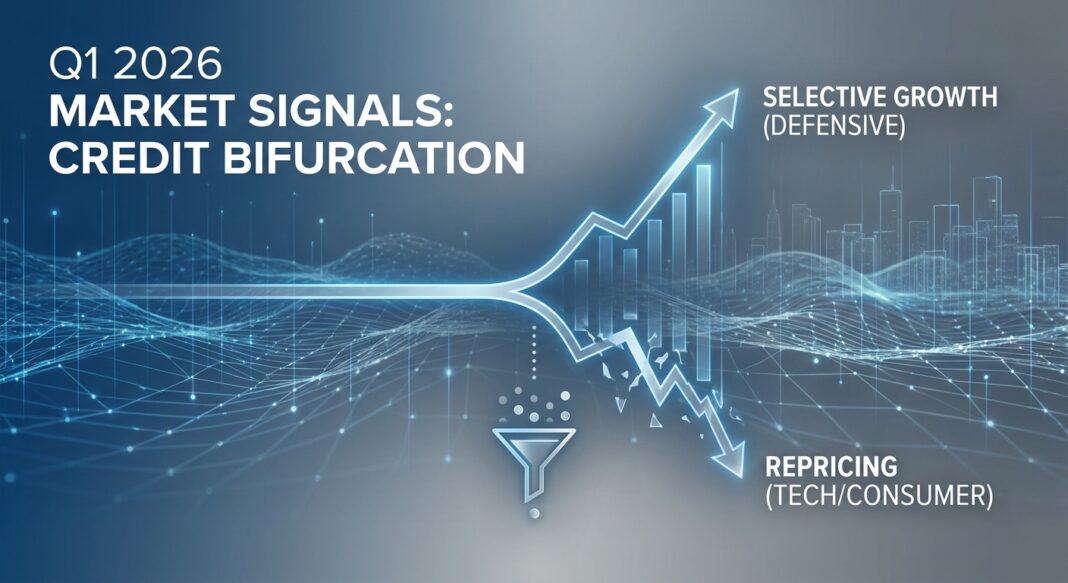
The Credit Cycle Has Turned a Corner, But Not All Borrowers Are Turning With It
The first quarter of 2026 confirmed what many credit professionals had been anticipating: the extraordinary period of spread compression and frictionless capital access that defined 2024 and early 2025 is over. What has replaced it is not a crisis, but it is unambiguously a tighter, more selective, and more bifurcated lending environment. Macro headwinds including persistent inflation, a hawkish Federal Reserve hold at 3.50%–3.75%, escalating geopolitical tension, and a sharp AI-driven selloff in software and IT credits have combined to shift the risk-pricing calculus across both public and private markets. The structural signal for institutional operators is clear: underwriting discipline and covenant quality now matter again.
The Federal Open Market Committee held its target range steady through Q1, while the forward curve shifted upward by approximately 20 basis points relative to prior quarter expectations, with market participants now projecting an average base rate of roughly 3.5% through 2028, according to northleafcapital.com. That revision, modest in isolation, carries material consequences for fixed charge coverage ratios (FCCR) across leveraged capital structures, particularly those originated during the low-rate vintages of 2021–2022, where debt service assumptions were built on a substantially different rate environment.
Quantitative Market Snapshot: Spreads, Volumes, and KPI Thresholds
| Metric | Q1 2026 (Current) | Prior Period | Source |
|---|---|---|---|
| U.S. Direct Lending New Issue Spread (vs. Q4 2025) | ~+25 bps wider | Q4 2025 baseline | northleafcapital.com |
| BSL / HY New Issue Spreads (Q4 2025 to Q1 2026) | ~+15–30 bps wider | Q4 2025 baseline | northleafcapital.com |
| Most Active BSL Segment Spread Widening (Feb–Mar) | ~+100 bps | January 2026 | sikich.com |
| Total Institutional Loan Activity (Q1 2026) | $241B (-32% YoY) | Q1 2025 | portagepointpartners.com |
| U.S. LBO/M&A Direct Lending Volumes (Q1 2026 vs. Q1 2025) | +30% YoY (volume); deal count down | Q1 2025 | northleafcapital.com |
| European Direct Lending Deal Volume (Q1 2026) | €8.3B (-33% QoQ vs. €12.4B in Q4 2025) | Q4 2025 | valuationresearch.com |
| KBRA Projected Private Credit Default Rate (YE 2026) | ~2.0% (up from 1.5% in 2025) | Full-Year 2025 | northleafcapital.com |
| European IT/Software Credit Spread Widening (Q1 2026) | +200 bps vs. YE 2025 | December 2025 | valuationresearch.com |
Sources: Northleaf Capital Partners, Pitchbook/LCD, Portage Point Partners, Valuation Research Corp., KBRA DLD, Cliffwater LLC. Data as of March 31, 2026.
Sector Analysis: Bifurcation Is the Story
The dominant structural theme in Q1 2026 is credit bifurcation, not broad-based deterioration. Lender appetite remains robust for high-quality, sponsor-backed credits with defensible business models, predictable free cash flow, and FCCRs demonstrating comfortable headroom above 1.25x. The challenge is that a meaningful share of the private credit market, particularly 2021–2022 vintage transactions, was underwritten with leverage multiples and interest coverage assumptions that do not survive the current rate-for-longer environment without covenant relief or sponsor equity support.
Software & Technology: The sharpest repricing has occurred here. European IT services and software credits saw spreads widen more than 200 basis points in Q1 alone, per valuationresearch.com. AI-driven disruption concerns, amplified by market reactions to competing large language model launches, have caused lenders to apply meaningful risk premiums to any software business model perceived as exposed to displacement. In the U.S., the IT selloff in public markets elevated loan-to-value (LTV) ratios across tech-backed private credit portfolios, though lenders note that historically conservative LTV underwriting in the sector provides some structural buffer, according to northleafcapital.com.
Consumer Sector: Consumer-facing credits have emerged as another pocket of idiosyncratic stress. Lenders cite margin compression, weaker-than-expected same-store performance, and sensitivity to discretionary spending slowdowns as factors elevating scrutiny on FCCR covenants and revolver availability conditions.
Defensive and Industrial Sectors: Healthcare services, infrastructure-adjacent businesses, and companies with regulatory moats or compliance-driven revenue streams are attracting the most competitive lender terms. These credits benefit from lower revenue cyclicality and higher lender confidence in forward EBITDA projections, a direct input to leverage multiple and FCCR underwriting.
M&A Deal Concentration: A notable structural warning: more than 40% of U.S. institutional loan volume in Q1 2026 came from just five mega-transactions, according to sikich.com. This concentration signals that the broad-based M&A recovery narrative for 2026 is, so far, a story of a few large deals rather than a genuine expansion of deal count and financing activity across the middle market.
Implications for Institutional Investors and Operators
For Borrowers: The window for covenant-lite, borrower-friendly terms has materially narrowed for all but the highest-quality credits. Operators should expect tighter FCCR covenant packages, lenders are increasingly requiring ongoing FCCR compliance at or above 1.20x–1.25x, with stepped-up testing frequency for leveraged structures. Debt-to-EBITDA multiples for new middle-market transactions remain available in the 4.5x–5.5x range for strong credits, but weaker or cyclically exposed businesses are seeing meaningful compression in available leverage and wider pricing. Businesses carrying 2021–2022 vintage debt should proactively engage lenders on maturity management and covenant headroom before refinancing timelines become distressed, particularly given the projected default rate creep toward 2.0% by year-end per KBRA.
For Institutional Lenders and Investors: The BDC redemption cycle is creating a structural opportunity for well-capitalized, institutional-grade private credit managers. As retail-oriented vehicles moderate deployment to manage liquidity, institutional lenders with stable capital bases are gaining negotiating leverage: wider spreads, tighter covenants, and better structural protections on new originations, as noted by northleafcapital.com. Direct lending continues to generate high single-digit unlevered returns, a compelling premium over public credit at equivalent credit quality. Public corporate bond markets, by contrast, show improving liquidity metrics with bid-ask spreads near all-time lows and rising turnover across both IG and HY, per pimco.com, which may present relative value opportunities for investors weighing public versus private credit allocation.
Forward Outlook: Selective Opportunity Within Persistent Uncertainty
The six-month outlook is constructive but conditional. Several converging forces (approaching loan maturities, significant private equity dry powder, extended sponsor hold periods, and all-in debt costs that remain below 2024 peaks) are likely to support a gradual acceleration in refinancing and M&A-driven deal flow through H2 2026. However, this recovery is predicated on geopolitical stabilization and a soft landing for inflation. If oil prices remain elevated and inflation persists, rate cut expectations will continue to recede, further compressing FCCR headroom across leveraged portfolios and accelerating the bifurcation between credits that can absorb rate-for-longer and those that cannot.
For practitioners, the operative lens for the remainder of 2026 is selectivity: lender discipline on FCCR covenants, conservative LTV underwriting in technology-adjacent sectors, and premium allocation to businesses with durable competitive moats and low cyclicality. The credit cycle has not broken, but it has clearly reasserted its discipline.
Key Market Insights
- Spreads are repricing, not spiking: U.S. private credit new issue spreads have widened approximately 25 bps from Q4 2025, with broadly syndicated loan spreads widening 15–100 bps depending on credit quality, a meaningful directional shift without systemic dislocation.
- BDC redemptions are a structural tailwind for institutional managers: Retail-oriented vehicle outflows are moderating deployment from several large private credit platforms, improving supply/demand dynamics and negotiating leverage for well-capitalized institutional lenders.
- Software and IT credits require enhanced due diligence: European IT/software spreads have widened 200+ bps; U.S. tech LTV ratios are elevated. Lenders and investors should stress-test AI disruption exposure explicitly in underwriting models.
- Deal concentration is masking middle market softness: Five mega-transactions accounted for over 40% of Q1 U.S. institutional loan volume, broad-based M&A recovery has not yet materialized across the middle market.
- FCCR covenant management is the operational priority for 2021–2022 vintage borrowers: With KBRA projecting default rates rising to 2.0% by year-end 2026 and base rates holding at 3.50%–3.75%, operators carrying legacy leveraged structures should initiate proactive lender dialogue now rather than at maturity pressure points.


