
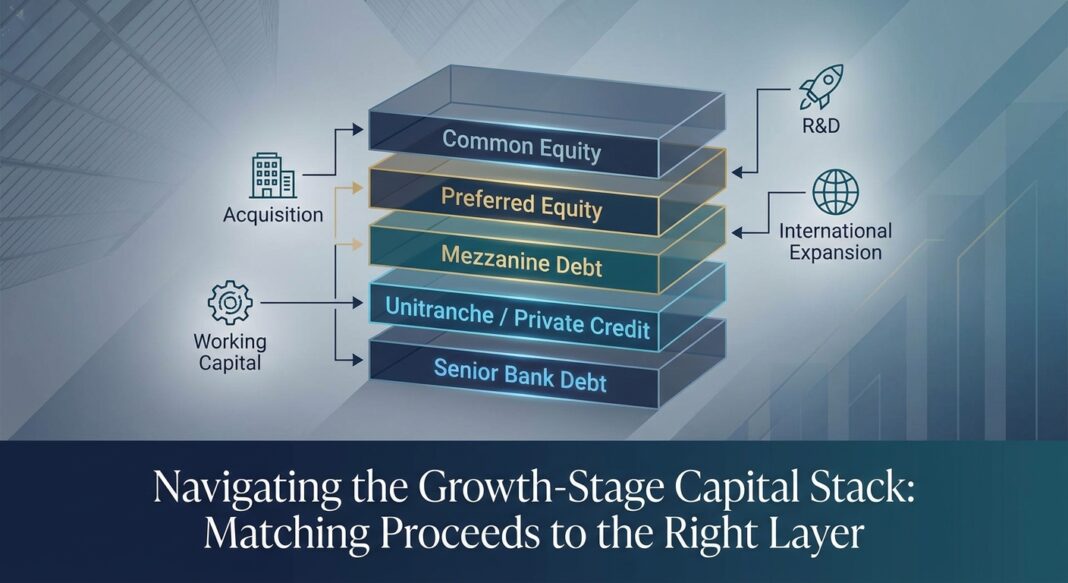
The Growth-Stage Financing Gap: Why the Wrong Layer Kills Momentum
Between a proven Series B and sustainable free cash flow, growth-stage companies sit in the most structurally complex and often most expensive zone of the capital stack. Revenue is real, but EBITDA is thin or negative. The business has product-market fit, but the balance sheet cannot yet support traditional senior bank leverage at scale. Meanwhile, equity dilution from another priced round carries a steep ownership cost at a valuation inflection point.
This is the growth-stage capital gap, and navigating it correctly is a direct function of one thing: matching the precise use-of-proceeds to the appropriate layer on the cost of capital spectrum. Founders and CFOs who treat all capital as interchangeable at this stage routinely overpay, over-dilute, or over-covenant themselves into strategic paralysis. Those who map the stack deliberately preserve optionality for the next phase.
The Cost of Capital Spectrum: From Banks to Equity
Understanding the cost hierarchy is the first structural discipline. At the growth stage, the realistic universe of capital (ranked from lowest cost and highest seniority to highest cost and most junior) looks like this:
- Senior secured bank debt (revolvers, term loans): Lowest cost, highest covenant burden. Typically requires two to three years of positive EBITDA and tangible collateral. Most growth-stage SaaS or tech-enabled businesses cannot fully access this layer yet, though recurring revenue-based credit facilities (ARR facilities) have expanded bank appetite for subscription businesses.
- Unitranche / Private credit: A blended senior-subordinated structure originated by a single non-bank lender. Pricing runs higher than bank debt but provides speed, flexibility, and fewer structural hurdles. As noted by capital stack practitioners, unitranche structures embed multiple risk layers within a single instrument, making them a practical bridge for companies not yet bankable at scale. axisgroupventures.com
- Mezzanine debt: Unsecured or lightly secured, often incorporating PIK (payment-in-kind) interest, warrants, or equity kickers. Junior to all senior debt, but senior to all equity. Pricing typically runs in the 12–18% range on an all-in basis, with warrant coverage layered on top. Best deployed for use-of-proceeds that generate discrete, measurable returns (acquisitions, international buildouts, capex programs) where the equity kicker payoff is justified by the outcome.
- Preferred equity: Senior to common equity but junior to all debt. Offers structured returns or liquidation preferences. Preferred equity rounds are often used to bridge valuation gaps, fund large capital needs where debt capacity is exhausted, or provide a non-dilutive-at-common alternative when priced rounds would be damaging to the cap table.
- Common equity (priced round): The most expensive and most dilutive form of capital. Appropriate for funding high-uncertainty growth bets (new markets, R&D, platform pivots) where returns are long-dated and asymmetric. Should be reserved for initiatives that genuinely require patient, risk-tolerant capital.
Use-of-Proceeds Mapping: The Core Discipline
The single most important structuring decision is mapping each dollar of capital need to its corresponding layer. Here is a practical use-of-proceeds framework for growth-stage companies:
| Use of Proceeds | Optimal Capital Layer | Why |
|---|---|---|
| Working capital / AR financing | Revolving credit / ABL | Self-liquidating, asset-backed; cheapest source for cyclical needs |
| Organic growth / go-to-market hiring | Venture debt or ARR facility | Extends runway without dilution; covenants tied to revenue metrics |
| Bolt-on acquisition | Unitranche or senior + mezz | Acquisition generates discrete EBITDA; debt can be sized against combined cash flows |
| International expansion / platform capex | Mezzanine + preferred equity | Longer payback; mezz PIK preserves near-term cash; equity layer absorbs execution risk |
| Founder / early investor liquidity | Secondary + preferred recapitalization | Separates liquidity from primary capital raise; avoids valuation reset on operating equity |
| High-uncertainty R&D / new vertical entry | Priced equity round | Long-dated, binary outcomes require risk capital with no fixed repayment obligation |
The governing principle, articulated clearly in modern capital stack frameworks, is to use equity for discovery and high-uncertainty growth, and debt for repeatable, measurable cash flows. alvren.com Violations of this principle (using equity to fund working capital, or using senior debt to fund speculative R&D) are among the most common and costly structuring errors at the growth stage.
The Gap Capital Playbook: Four Steps to Executing the Raise
Once the use-of-proceeds map is built, execution follows a disciplined four-step sequence:
Step 1: Quantify the Gap With Precision
Build a 24-month cash model with three scenarios: base, downside, and stress. Identify the specific month and dollar amount where the capital need crystallizes. Separate the need into tranches: how much is required on day one versus drawn over time. Lenders and investors underwrite to a specific gap, not a general ambition number. Imprecision at this stage signals operational immaturity and weakens negotiating position.
Step 2: Prepare the Data Room Around the Stack Layer
Each capital layer requires a different diligence package. Debt providers underwrite cash flow coverage, covenant headroom, and collateral quality. Equity investors underwrite TAM, team, and unit economics. Mezzanine lenders want to see both, enterprise value coverage on the equity side and EBITDA coverage on the debt side. Prepare materials that speak directly to the underwriting logic of your target layer. A revenue cohort analysis matters more to an ARR lender than a pitch deck narrative; an EBITDA bridge matters more to a mezz provider than a product roadmap.
Step 3: Run the Process With Layer-Appropriate Counterparties
Target capital providers who specialize in your specific layer and stage. A bank term lender, a private credit fund, a mezz manager, and a growth equity fund each have distinct mandate constraints, return targets, and structural preferences. Running a parallel process across all four simultaneously is inefficient. Sequence by cost: exhaust cheaper layers first before opening conversations with more expensive capital. Negotiate debt term sheets before finalizing equity conversations, confirmed debt capacity materially improves equity negotiating leverage. re-cap.com
Step 4: Model the Full Stack Before Signing Anything
Before executing any single instrument, model the complete post-close capital stack across three exit scenarios. Map each layer’s repayment waterfall: who gets paid first, at what return, under what conditions. Identify whether stacked liquidation preferences compress common equity outcomes at realistic exit multiples. As capital stack practitioners note, a complex ownership structure can create cap table gridlock that slows or blocks future financings and exits regardless of operating performance. axisgroupventures.com
Negotiation Guidance: What to Push On by Layer
Structuring discipline extends into the negotiation room. Key leverage points by layer:
- Senior / unitranche debt: Push on covenant definition (EBITDA add-backs, revenue maintenance vs. incurrence tests), prepayment penalties, and incremental facility baskets. The difference between a maintenance covenant and an incurrence covenant is the difference between a lender who monitors your every quarter and one who only tests upon a trigger event.
- Mezzanine: Negotiate the PIK toggle option (ability to elect cash or PIK interest based on liquidity position), warrant coverage percentage (push below 3–5% if deal quality supports it), and the equity kicker strike price, the closer to current fair market value, the better for the borrower.
- Preferred equity: Hold the line on non-participating liquidation preferences (1× non-participating is market standard for growth equity). Participating preferred structures that allow investors to double-dip (receiving both their preference and pro-rata upside) disproportionately compress common equity returns at moderate exit multiples. re-cap.com
- All layers: Negotiate information rights and board governance provisions simultaneously with economic terms. Control provisions granted at one layer set the baseline for all future layers added above them.
Key Takeaways
- • Match capital to use-of-proceeds first: The layer of the stack is determined by the payback profile and risk profile of what the capital funds, not by what is fastest to close.
- • Sequence from cheap to expensive: Exhaust bank and private credit capacity before opening mezz or equity conversations; confirmed debt term sheets strengthen equity pricing leverage.
- • Model the full waterfall before committing: No single instrument should be signed without mapping how every layer gets repaid across realistic exit scenarios, including downside cases.
- • Negotiate structure, not just price: Covenant design, PIK optionality, warrant strike prices, and liquidation preference mechanics have more long-term impact on outcomes than the headline interest rate or entry valuation.
- • Avoid cap table gridlock proactively: Complex stacked preferences and fragmented governance rights introduced at the growth stage compound at every subsequent financing, structural simplicity is a strategic asset, not an administrative preference.


