
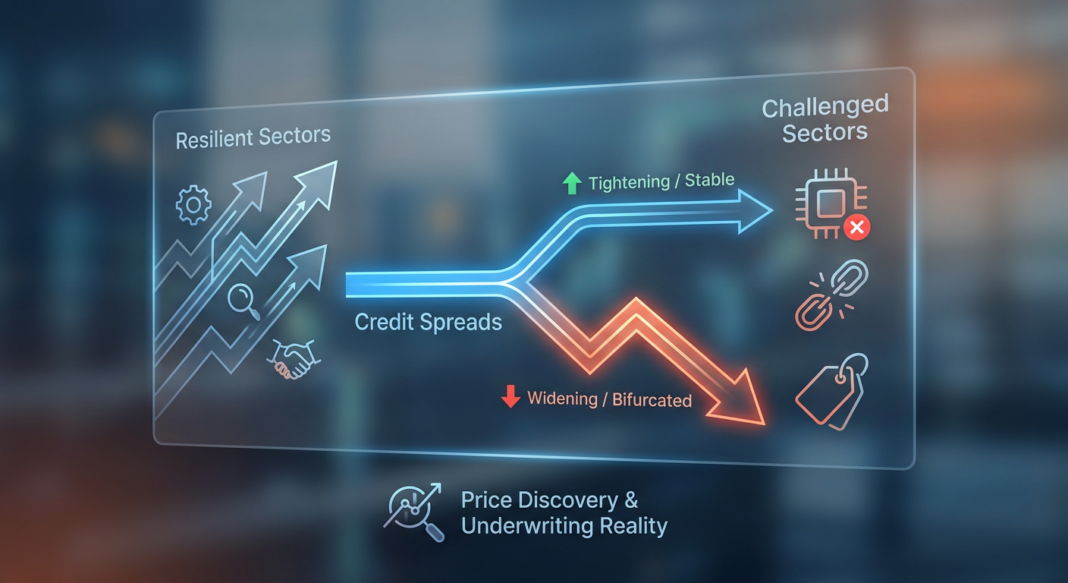
Macro Headline: Private Credit Enters a New Phase of Price Discovery
The opening quarter of 2026 delivered a sobering reset for participants who entered the year expecting a clean handoff from refinancing-driven activity to M&A-led issuance. Instead, three concurrent shocks (an AI-related software sector selloff, renewed geopolitical conflict in the Middle East, and accelerating retail fund outflows from non-traded BDCs) pushed private and public credit markets simultaneously into price discovery mode. The result: spreads widened materially, deal volumes contracted, and lenders sharpened their underwriting pencils along quality and sector lines. The credit cycle has not turned, but it has clearly shifted gears.
The Federal Reserve’s restrained posture is a critical backdrop. Following three 25-basis-point cuts in 2025 that brought 3-month SOFR to approximately 3.70% at year-end, the Fed signaled a slower pace of easing in 2026. Forward curves now imply an average base rate of roughly 3.3% over the 2026–2028 window, a meaningful recalibration that compresses the interest-rate tailwind borrowers and sponsors had been counting on heading into this year, according to northleafcapital.com.
Quantitative Market Snapshot
The following data, sourced from Valuation Research Corporation, Pitchbook LCD, Sikich Corporate Finance, and Northleaf Capital, provides a current cross-market view of rates, spreads, and underwriting conditions as of Q1 2026:
| Metric | Current Level (Q1 2026) | Prior Period (Q4 2025) | Change | Source |
|---|---|---|---|---|
| U.S. Middle Market Unitranche Credit Spread | +25 bps (matrix-wide increase) | Baseline Q4 2025 | Wider | valuationresearch.com |
| U.S. Secondary B-Rated Loan Spreads | ~+67 bps vs. year-end 2025 | Year-end 2025 | Materially wider | valuationresearch.com |
| Software/Tech Loan Spreads (U.S.) | ~+200 bps vs. year-end 2025 | Year-end 2025 | Severely wider | valuationresearch.com |
| U.S. Institutional Leveraged Loan Issuance (Q1) | $241B total / $182B leveraged | Q4 2025 (lower base) | +54% QoQ / -32% YoY | portagepointpartners.com |
| European Direct Lending Volume (Q1 2026) | €8.3B | €12.4B (Q4 2025) | -33% QoQ | valuationresearch.com |
| European Speculative-Grade Default Rate Forecast | 3.25% (projected Sep 2026) | 3.7% (Sep 2025) | Declining | valuationresearch.com |
On the KPI front, lenders are demonstrably tightening coverage and leverage expectations. Direct lenders are flagging interest coverage deterioration as a primary risk factor, particularly among 2021–2022 vintage credits that were underwritten at a significantly lower rate environment than today’s. For those credits, debt-service coverage ratios have compressed materially, and lenders are increasingly requiring covenant amendments, PIK toggle elections, or sponsor equity infusions before extending maturities. The implicit message to borrowers: fixed charge coverage ratios below 1.2x on stressed scenarios are receiving heightened scrutiny, and leverage multiples above 5.5x are facing meaningful pushback outside of the highest-quality credits, per northleafcapital.com.
Sector Analysis: Winners, Losers, and Structural Shifts
Under Pressure, Software & Technology Services: This is the most significant sector story of the quarter. The launch of advanced AI coding and workflow tools triggered a sharp reassessment of software business model durability. U.S. secondary loan spreads for software names widened by approximately 200 basis points versus year-end 2025, and lenders are applying an additional AI-risk premium of roughly 75 basis points for issuers with unresolved AI exposure, according to valuationresearch.com. Borrowers with opaque AI risk profiles are effectively shut out of primary markets until diligence is complete. Loan-to-value ratios in the sector have risen quarter-over-quarter as enterprise valuations compress, amplifying lender risk at current leverage levels. In Europe, IT services and software credits saw spreads widen by more than 200 basis points relative to year-end, per valuationresearch.com.
Resilient, Commercial & Professional Services, Diversified Financials: Sectors with durable cash flows, recurring revenue models, and limited AI disruption risk continue to attract competitive financing terms. Lenders active in commercial services and diversified financials are reporting strong deal pipelines and are willing to maintain tighter spreads for credits with demonstrated FCCR stability and low leverage, per northleafcapital.com. The core middle market (EBITDA of $20M–$80M) remains particularly attractive for direct lenders given maintenance covenants and meaningful equity cushions that the upper middle market, increasingly converging with the broadly syndicated market, cannot provide.
Bifurcated, Healthcare Services: Long-term demand drivers remain intact, but labor cost pressures and constrained staffing availability are squeezing near-term margins, particularly in physician practice management platforms. Lenders are selectively extending capital while requiring tighter covenant packages and enhanced reporting obligations, according to northleafcapital.com.
Challenged, Consumer-Facing Sectors: Softening consumer spending is beginning to pressure overleveraged borrowers in retail and consumer services. Higher-than-anticipated debt loads relative to current EBITDA and rate environments are creating refinancing friction, especially for credits approaching near-term maturities.
Implications for Institutional Investors and Operators
For Borrowers: The window for opportunistic repricing has closed. Borrowers that did not capitalize on the tight-spread environment of late 2024 through early 2025 are now facing materially higher all-in costs, particularly in AI-adjacent or cyclical industries. Companies approaching 2026 or 2027 maturities with leverage above 5x and FCCR below 1.3x should begin engaging lenders proactively, waiting for market normalization is a high-risk posture. Deal terms for high-quality credits remain competitive, but execution requires clean credit narratives that directly address AI exposure, tariff sensitivity, and interest coverage trajectory, according to sikich.com.
For Lenders and Investors: The current environment rewards selectivity and structural discipline. The core middle market continues to offer superior risk-adjusted returns relative to the upper middle market, where covenant erosion and spread compression have reduced the margin of safety. Investors in non-traded BDC vehicles should monitor liquidity provisions carefully, redemption pressure accelerated in Q1, and valuation adjustments tied to technology assets may not yet be fully reflected in NAV marks. Asset-based specialty finance (offering strong collateral coverage and lower correlation to corporate credit) is emerging as a compelling complement to direct lending allocations, per northleafcapital.com.
Forward-Looking Perspective: The Path to Market Normalization
The conditions for a Q2–Q3 recovery are identifiable but contingent. A stabilization in Middle East geopolitical tensions, a deceleration in oil price volatility, and clearer AI risk resolution for software portfolios could rapidly reopen deal pipelines. Dry powder among direct lenders remains substantial, and sponsor pressure to deploy capital and return liquidity to LPs is mounting, two-thirds of dealmakers surveyed by KPMG in late 2025 expected higher transaction volumes in 2026. What has changed is the sorting mechanism: capital will flow freely to high-quality, demonstrably resilient credits, while storied, cyclical, and AI-exposed borrowers will face a higher bar for both access and price. In that environment, underwriting quality, covenant discipline, and sector expertise are not differentiators; they are prerequisites.
Key Market Insights
- Spread Dispersion Is the New Normal: A blanket 25 bps widening across the U.S. middle market conceals far more severe stress in targeted sectors, software spreads are up 200 bps, signaling that lender risk pricing has become deeply sector-specific rather than macro-uniform.
- AI Exposure Is a Lender Gating Factor: Credits with unresolved AI business model risk are effectively shut out of primary markets; a documented AI diligence framework is now a prerequisite for capital access in technology-adjacent deals, per valuationresearch.com.
- Vintage Risk Is Crystallizing: 2021–2022 vintage credits underwritten to sub-4% rate environments are approaching a structural breaking point; lenders are actively restructuring coverage ratios through PIK toggles, covenant resets, and equity injections rather than forcing defaults.
- Core Middle Market Outperforms on Structure: The $20M–$80M EBITDA segment offers maintenance covenants and equity cushions absent in larger syndicated deals, making it the most defensible segment for direct lenders navigating spread volatility.
- Deal Concentration Is a Red Flag: With over 40% of Q1 institutional loan volume driven by just five mega-transactions, headline issuance figures are masking a significant slowdown in broad-based deal formation, a leading indicator that lender appetite remains selective and pipeline-dependent, per sikich.com.


