
The Financing Inflection Point Every Growth Company Faces
You have crossed the hardest threshold in business finance: the model works. Revenue is recurring, unit economics are positive, and the pipeline is real. Yet the gap between where you are and where the next phase of growth requires you to be (new hires, geographic expansion, a bolt-on acquisition, a working capital surge) is wider than your free cash flow can bridge alone.
This is the growth-stage capital challenge. It is not a shortage of options. It is a problem of matching. The wrong instrument at this stage (equity raised too early, debt structured too tightly, a mezzanine layer priced against a misread credit profile) creates friction that compounds. Dilution you cannot reclaim. Covenants that throttle your operating cadence. Amortization schedules that punish the very reinvestment that drives value.
The framework below is built for operators, CFOs, and founders at companies with $5M–$50M in revenue who are staring at a specific capital need and need to understand exactly how to structure it, layer by layer.
Step 1: Anchor to the Use-of-Proceeds, It Determines Everything
Before approaching any capital source, the use-of-proceeds must be defined with surgical precision. The capital markets price risk, not ambition. What you are funding determines which instruments are available, at what cost, and under what structure.
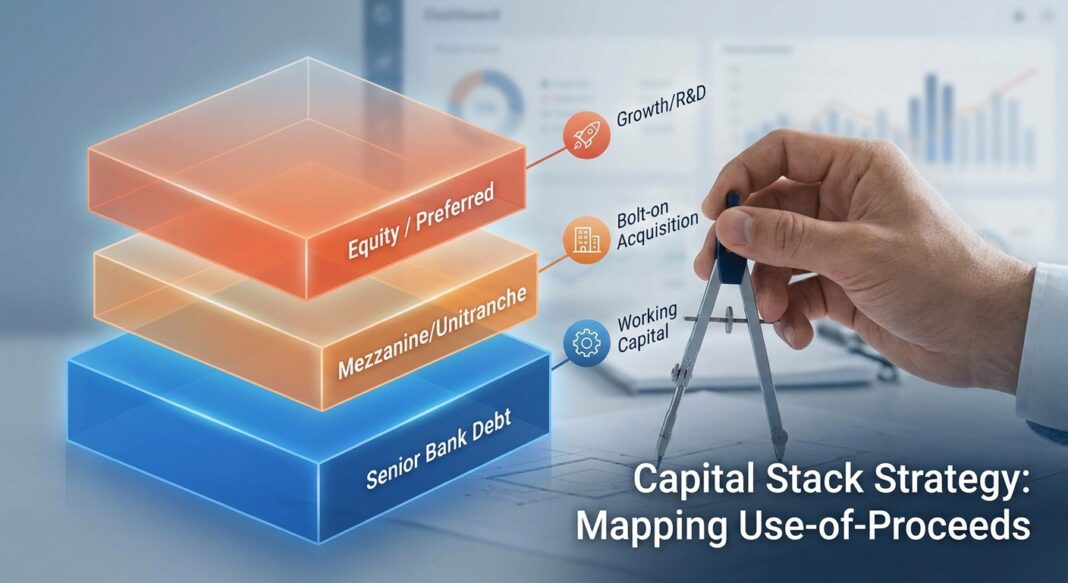
Here is a use-of-proceeds map and its capital stack implications:
| Use of Proceeds | Optimal Instrument | Why It Fits |
|---|---|---|
| Working capital / receivables | Revolving credit facility / ABL | Self-liquidating; tied to asset conversion cycle |
| Sales team expansion / CAC investment | Term loan / venture debt | Predictable ROI timeline; repayable from incremental revenue |
| Bolt-on acquisition | Senior + mezzanine / unitranche | Asset purchase requires full-capital-stack solution; cash flow supports debt service |
| R&D / product development | Equity / convertible note | High uncertainty; no predictable repayment schedule; equity absorbs discovery risk |
| Ownership transition / recap | Subordinated debt + preferred equity | Bridges value between retiring equity and new capital without full dilution |
As re-cap.com makes clear in its capital stack framework, capital structure describes what you have while the capital stack describes who gets paid and in what order. Optimizing for the wrong question (raising equity when you need a revolver, or taking term debt for discovery-stage product work) is the structural error that compounds across every subsequent round.
Step 2: Map the Cost of Capital Spectrum for a Growth-Stage Company
Every capital decision involves an access-versus-cost trade-off. Here is how the spectrum runs for a growth-stage company with proven revenue and positive EBITDA or near-term path to it:
- Senior bank debt (lowest cost, highest covenant density): Typically 1.0x–2.5x EBITDA for companies with hard assets or strong cash flow visibility. Covenants are maintenance-based, tested quarterly, with leverage and coverage thresholds that must be met regardless of trajectory. The cost is low (base rate + 200–350bps in most markets), but the operating constraints are real.
- Asset-based lending (ABL): Availability tied to a borrowing base, receivables at 80–85 cents on the dollar, inventory at 50–65%. For businesses with lumpy cash flow but strong assets, this is often more accessible than cash flow lending and carries lower all-in costs than mezzanine.
- Private credit / direct lending: The unitranche market has expanded significantly, offering a single-tranche solution that blends what would otherwise be a senior/mezz split. According to frameworks analyzed by re-cap.com, instruments that match operational reality outperform those that optimize only for headline cost. Unitranche pricing typically runs 500–700bps over the reference rate at the growth stage.
- Mezzanine debt (subordinated, PIK-eligible): Sits below senior debt, above equity. Pricing reflects the risk: 12–18% all-in is the standard range, often with a PIK toggle allowing interest to accrue rather than cash-pay during investment periods. Warrants or equity kickers are common, typically 1–5% warrant coverage on the facility amount. This is the instrument that bridges the gap between what senior lenders will provide and what the total capital need requires.
- Preferred equity: No fixed repayment obligation, but carries liquidation preferences (typically 1x non-participating at institutional standards) and board governance rights. More expensive than mezzanine in dilution terms, but appropriate when cash flow cannot support additional debt service.
- Common equity (highest cost, maximum flexibility): Patient capital, but permanently dilutive. As noted by alvren.com, the sequencing principle holds: use cheaper, lighter instruments first and reserve equity for use-of-proceeds where uncertainty is highest.
Step 3: The Gap Capital Playbook, Quantify, Prepare, Run the Process
Quantify the Gap
The gap is the difference between what your existing capital structure will support and what the use-of-proceeds requires. Build three scenarios (base, upside, and downside) with explicit cash flow projections at each. As re-cap.com documents from 500+ startup funding structures, companies that fail at this stage are almost never failing on fundamentals: they are failing because their structure did not survive the base case, let alone the downside. Model debt service coverage at each scenario and identify the maximum debt load the business can carry without covenant breach.
Prepare the Materials
A growth-stage capital raise requires: a detailed information memorandum (IM) with at least three years of historicals and three-year projections; a borrowing base certificate if pursuing ABL; an EBITDA bridge showing adjustments; a use-of-proceeds schedule tied directly to milestones; and a capital structure diagram showing current and proposed layers. Messy cap tables and undocumented adjustments are the fastest way to trigger a valuation discount, firstratefunding.net cites a 15–20% control discount applied by sophisticated acquirers and institutional lenders when the structure is unclear.
Run the Process
Approach capital sources in order of cost. Start with your existing bank, an amendment or accordion feature on a senior facility is the cheapest capital available and requires no new relationship build. If the senior market is tapped or unavailable for this use-of-proceeds, move to direct lenders for a unitranche solution. Only layer mezzanine or preferred equity when the senior market alone cannot fill the gap. Running all conversations simultaneously compresses your timeline but can create confusion on deal structure. Stagger the conversations: confirm senior appetite first, then use that anchor to structure subordinated tranches.
Step 4: Negotiation Guidance, Where the Structure Is Won or Lost
On covenant design: Push for incurrence-based covenants over maintenance covenants wherever the lender will accept it. Maintenance covenants test performance on a schedule regardless of what you are doing with the capital; incurrence covenants only trigger upon a specific action (taking on new debt, making an acquisition). For a growth company actively deploying capital, incurrence-based packages preserve operating flexibility.
On PIK toggles: In mezzanine structures, negotiate the right to PIK interest during investment periods, the 12–18 months following a deployment event when EBITDA may temporarily compress before the use-of-proceeds generates returns. This preserves cash for operations without triggering default.
On warrant coverage: Mezzanine lenders will seek equity participation. The negotiation is on strike price (insist on current fair market value, not a discount) and on buyout mechanics (ensure you have a call right to repurchase warrants at a formula price before they convert into permanent dilution).
On accordion features: Build future capacity into the structure now. An accordion provision allows you to expand the facility by a defined amount without renegotiating the full agreement. This is particularly valuable if the use-of-proceeds includes a pipeline of bolt-on acquisitions where timing is uncertain.
Key Takeaways
- Use-of-proceeds is the anchor: The instrument must match the economic profile of what it funds: self-liquidating assets get revolvers, uncertain discovery gets equity, cash-flow-generative acquisitions get term debt.
- Sequence from cheapest to most expensive: Exhaust senior bank and ABL capacity before approaching mezzanine; exhaust mezzanine before issuing equity. Each layer you skip saves permanent cost or dilution.
- Model the downside before you sign: The structure must be survivable at 40–50% of projected performance, not just optimized for the base case.
- Incurrence beats maintenance: Growth-stage companies should negotiate hard for covenant packages that do not penalize them for the investment phase that precedes the returns.
- Build optionality into the structure: Accordion features, PIK toggles, and warrant call rights are not minor legal points; they are the mechanisms that keep your next round of financing accessible on your terms, not your lender’s.


