
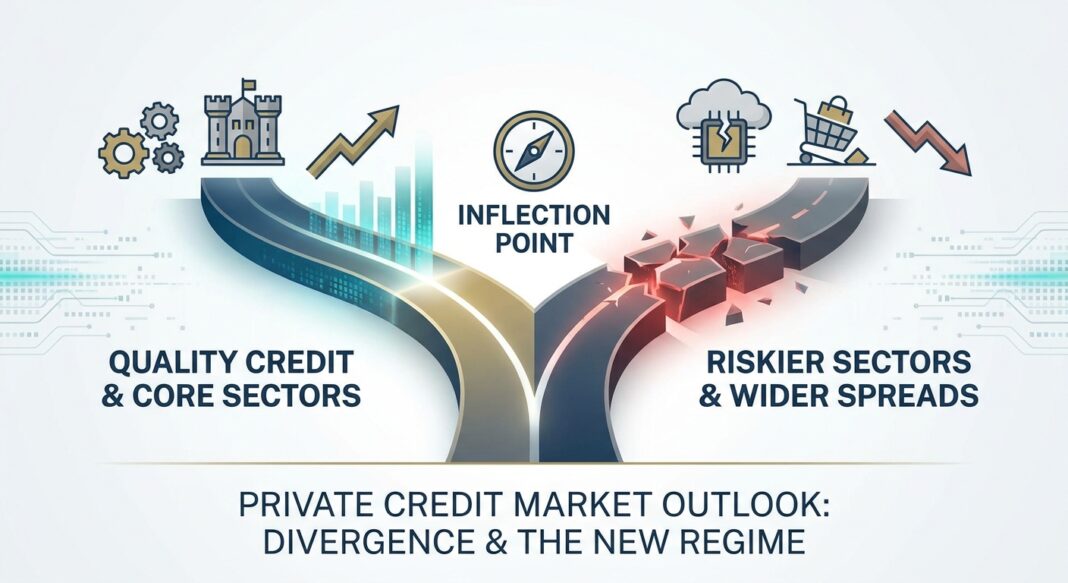
The Credit Cycle Has Turned: A New Regime of Selectivity and Dispersion
The easy-money era of private credit is over, at least for now. After two years of relentless spread compression, record fundraising, and near-frictionless deal execution, Q1 2026 has introduced a materially different environment. Macro uncertainty driven by elevated geopolitical tensions in the Middle East, renewed inflationary pressure from rising oil prices, AI-related disruption across software-dependent business models, and persistent tariff policy ambiguity have collectively shifted the risk calculus for lenders and borrowers alike.
The defining characteristic of this moment is not a market shutdown (liquidity remains available and lenders continue to deploy capital) but rather a sharp and accelerating divergence between credit tiers. Higher-quality borrowers with durable cash flows, clean capital structures, and defensible competitive positions are still attracting competitive terms. Lower-rated, cyclical, or AI-exposed credits face widened spreads, constrained access, and, in some cases, are simply not coming to market at all. This bifurcation has structural implications that extend well beyond Q1.
For institutional investors managing private credit allocations, and for operators seeking to refinance or leverage acquisitions, the central message is unambiguous: underwriting standards are tightening, documentation protections are re-emerging as a negotiating priority, and the days of covenant-lite structures at sub-500 bps all-in yields are facing meaningful compression. Credit cycle positioning, not just yield optimization, is now the dominant analytical framework.
Quantitative Market Snapshot: Rates, Spreads, and KPI Benchmarks
The table below synthesizes the most current available data across public and private credit instruments, capturing the directional shift in both pricing and structural expectations as of Q1 2026.
| Metric | Current Value (Q1 2026) | Prior Period (Q4 2025) | Change | Source |
|---|---|---|---|---|
| U.S. Middle Market Unitranche Spread (Traditional, ≤$80M EBITDA) | ~5.25% – 6.25% | ~5.00% – 6.00% | +25 bps (midpoint) | valuationresearch.com |
| U.S. Leveraged Loan, Most Active Segment Spread Widening | ~+100 bps (Feb–Mar 2026) | Tight / Compressed | Widened materially | sikich.com |
| Total U.S. Institutional Loan Issuance (Q1 2026) | $241B | ~$157B (Q4 2025) | +54% QoQ / −32% YoY | portagepointpartners.com |
| U.S. Net New (Non-Refinancing) Loan Issuance (Q1 2026) | ~$70B | Below 2-year quarterly avg. | Resilient; modestly below YoY | sikich.com |
| Weighted Average Performing Loan Price (Feb 2026 trough) | 94.17 cents on the dollar | Above April 2025 lows | Below prior Liberation Day lows | invicocapital.com |
| European Speculative-Grade Default Rate Forecast (Sep 2026) | 3.25% (projected) | 3.7% (Sep 2025 actual) | Declining, but risk rising | valuationresearch.com |
| 3-Month SOFR (End Q4 2025) | 3.70% | ~4.10% (early 2025) | Easing; lowest in 3 years | northleafcapital.com |
From a KPI benchmarking perspective, lenders are recalibrating their minimum thresholds for credit approval. Fixed Charge Coverage Ratios (FCCR) are receiving heightened scrutiny, particularly for 2021–2022 vintage loans originated at higher leverage multiples that are now being stress-tested against elevated base rates. Debt-to-EBITDA tolerance has compressed across the broadly syndicated market, with BB-rated and above borrowers commanding the lion’s share of new issuance. According to sikich.com, BB-or-higher rated borrowers represented a growing share of Q1 issuance while the lowest-rated segment accounted for a historically small proportion of M&A-related volume, a direct signal that lenders are applying a quality filter at the underwriting gate.
Sector-Specific Lender Appetite: Where Capital Is Flowing, and Where It Is Pulling Back
The sector story in Q1 2026 is one of pronounced divergence. Software and technology remain the most visible fault line. AI-related disruption, specifically the implications of large language model proliferation for legacy software business models, triggered a meaningful sell-off in syndicated loans tied to the sector. As reported by invicocapital.com, software credits were among the primary drivers of the weighted average loan price falling to 94.17 cents in February. In Europe, IT services and software credit spreads widened by more than 200 basis points compared to year-end 2025, per valuationresearch.com, a severe repricing that reflects structural, not merely cyclical, concern.
By contrast, commercial and professional services, diversified financials, and asset-based specialty finance are attracting continued and in some cases stronger lender interest. Per northleafcapital.com, asset-based specialty finance in particular offers compelling risk-adjusted returns through strong collateral coverage, lower correlation to corporate credit cycles, and robust downside protection, structural attributes that resonate powerfully in a more volatile macro environment.
Healthcare services present a mixed picture. Long-term demand fundamentals remain intact, but physician practice management and other labor-intensive sub-segments are experiencing margin compression from elevated staffing costs, per northleafcapital.com. Lenders active in this space are requiring tighter covenants, enhanced reporting milestones, and in some cases PIK toggle provisions to manage interim cash flow risk.
Consumer-facing sectors face additional headwinds as softer spending trends filter through to borrower performance. Lenders are applying wider spread premiums to consumer credits, particularly those with direct exposure to discretionary spending or import-cost sensitivity from ongoing tariff policy. The core middle market (EBITDA $20M–$80M) continues to be highlighted by institutional lenders as offering the most favorable risk-adjusted opportunity set, given its retention of maintenance covenants, more conservative leverage structures, and meaningful equity cushions relative to the upper middle market and broadly syndicated tiers.
Implications for Institutional Investors and Business Operators
For Institutional Investors and Lenders
The widening dispersion in credit outcomes is creating alpha opportunities for managers with deep sector expertise and disciplined underwriting frameworks. The mass-market approach to private credit deployment, characteristic of the 2022–2024 fundraising supercycle, is yielding to a more selective, conviction-driven posture. Investors allocating to private credit should be stress-testing their existing portfolio exposure to 2021–2022 vintage loans, which carry above-market leverage and are most vulnerable to FCCR compression as base rates remain elevated. The Cliffwater BDC Index returned −9.95% YTD through Q1 2026, per invicocapital.com, a stark reminder that vehicle structure and vintage exposure matter as much as asset class selection.
CLO issuance remained relatively resilient in Q1 but was insufficient to offset the broader pullback in retail loan fund demand, which fell to a three-year low per sikich.com. This structural demand gap has direct consequences for pricing in the broadly syndicated market and reinforces the relative value case for non-traded, directly originated private credit that is insulated from retail redemption pressure.
For Business Operators and Borrowers
Operators seeking debt capital in the current environment face a narrower window and a higher bar. Lenders are intensifying due diligence around FCCR durability under stressed base rate scenarios, AI-related business model risk, and supply chain exposure to geopolitically sensitive inputs. Businesses that can demonstrate recession-resilient revenue streams, pricing power, and low working capital volatility will command the most competitive terms. Those with any of the flagged risk factors (software dependency, consumer exposure, legacy leverage) should anticipate spread premiums of 50–100 basis points above market norms, per valuationresearch.com, and should proactively engage lenders well in advance of refinancing deadlines.
Forward-Looking View: The Next 3–6 Months
The setup for Q2–Q3 2026 is conditionally constructive but fragile. Private credit dry powder remains substantial across both U.S. and European platforms, and lender demand for quality paper is high. Should geopolitical tensions ease and oil prices stabilize, several structural catalysts could accelerate deal activity: mounting pressure on PE sponsors to return capital after extended hold periods, a significant volume of approaching loan maturities, and all-in borrowing costs that remain below 2024 peak levels.
However, the pace of Fed rate cuts has slowed materially. CME FedWatch pricing implies only 0–2 additional 25 bps cuts through year-end 2026, per valuationresearch.com, meaning base rate relief will be limited. For borrowers, this keeps all-in interest burdens elevated and sustains FCCR pressure on highly leveraged capital structures. For lenders, the persistence of elevated base rates remains a yield-supportive dynamic that extends the attractiveness of the floating-rate direct lending product.
The most significant near-term risk is a further deterioration in software and tech-adjacent credits, which could accelerate BDC net asset value erosion and trigger additional retail fund outflows, a feedback loop that would further constrain broadly syndicated market liquidity. In the core middle market, where structural protections are stronger and retail redemption pressure is absent, conditions remain more insulated. The divergence between these two segments is likely to widen before it narrows.
Key Market Insights
- Spread divergence is the dominant theme: U.S. leveraged loan spreads widened ~100 bps in the most active market segment in Q1 2026, while high-quality direct lending terms remained broadly competitive, the gap between credit tiers is the widest it has been since 2022. (sikich.com)
- Software sector is the epicenter of credit stress: European IT services and software spreads widened 200+ bps versus year-end 2025; U.S. software loans drove weighted average prices to multi-year lows of 94.17 cents in February. Lenders are demanding AI-disruption risk analysis as a standard underwriting input. (valuationresearch.com, invicocapital.com)
- Core middle market retains structural advantage: EBITDA $20M–$80M companies continue to benefit from maintenance covenants, conservative leverage, and meaningful equity cushions, structural protections now commanding a clear premium over upper middle market and BSL-equivalent structures. (northleafcapital.com)
- 2021–2022 vintage loans are the pressure point to monitor: Loans originated at post-pandemic leverage peaks are facing increasing FCCR stress and are disproportionately represented in restructuring activity, PIK amendments, and covenant modifications. Investors should conduct vintage-specific portfolio diagnostics immediately. (valuationresearch.com)
- Dry powder and deal concentration create a bifurcated opportunity set: Over 40% of Q1 U.S. institutional loan volume came from just five mega-transactions, while European PE fundraising declined 24% YoY to €18B, signaling that capital is concentrating in fewer, higher-conviction deals rather than dispersing broadly. Managers with proprietary sourcing and sector depth are best positioned to capture risk-adjusted returns. (portagepointpartners.com, valuationresearch.com)


