
The Growth-Stage Financing Gap: When Revenue Outruns the Balance Sheet
A company generating $8M–$25M in annual revenue occupies one of the most structurally complex positions in the capital markets. It has outgrown the flexibility of startup equity but lacks the free cash flow coverage that traditional bank lenders require for full underwriting. Sales are accelerating. Headcount is expanding. Working capital is being consumed faster than it is being generated. Yet the balance sheet cannot absorb another equity round at a dilutive valuation, and the senior bank line has already been drawn to its covenant ceiling.
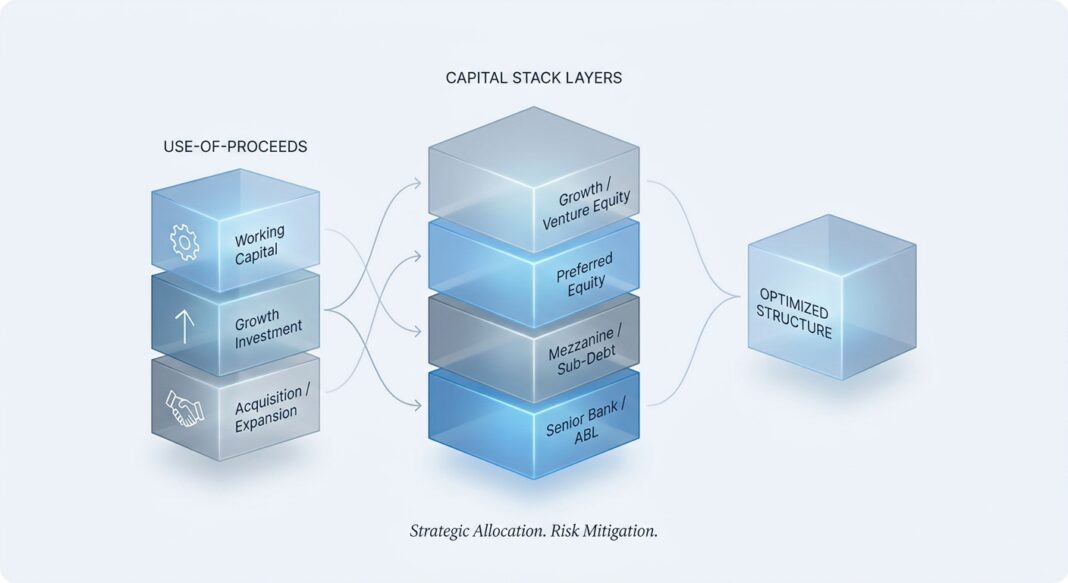
This is the growth-stage financing gap: the zone where use-of-proceeds discipline and capital stack architecture determine whether a business scales on its own terms or is forced into a suboptimal structure by timing and desperation. As re-cap.com documented across 500+ startup funding structures, the companies that navigate this gap successfully treat capital as a designed system, not a transaction, mapping each instrument to a specific operational purpose before approaching any source of capital.
This article walks practitioners through the exact mechanics of growth-stage capital stack design: how to map use-of-proceeds to the right financing layer, how to sequence instruments to preserve optionality, and how to run the process when the gap needs to be filled on a compressed timeline.
Step 1: Define Use-of-Proceeds Before You Define the Instrument
The most common structural error at the growth stage is selecting a financing instrument before defining what the capital actually needs to do. Each use-of-proceeds category carries a different risk profile, repayment timeline, and appropriate cost of capital. Before any lender or investor conversation, map each dollar of the raise to one of the following functional categories:
- Working Capital: Receivables gaps, inventory cycles, payroll during rapid hiring. These needs are short-duration, self-liquidating, and suited to revolving credit facilities or asset-based lending (ABL) structures. As re-cap.com explains, senior debt sits at the base of the capital stack precisely because it is secured by these predictable, tangible asset flows.
- Growth Investment: Sales team expansion, new market entry, customer acquisition cost (CAC) funding. These proceeds take 12–24 months to generate measurable return and tolerate higher-cost, longer-duration capital: venture debt, unitranche facilities, or growth credit lines with interest-only periods.
- Acquisition or Inorganic Expansion: Platform acquisitions, tuck-ins, or strategic asset purchases. These are event-driven, require certainty of close, and typically demand a structured capital stack combining senior secured debt with a subordinated or mezzanine tranche to bridge the equity gap.
- Recapitalization or Transition: Founder liquidity, balance sheet restructuring, or ownership transition financing. These proceeds do not generate operating cash flow directly and therefore carry the highest structural risk, appropriate for mezzanine debt with PIK optionality or preferred equity with defined dividend mechanics.
As alvren.com frames it: use equity for discovery and high-uncertainty bets, debt for repeatable and measurable cash flows, and hybrid instruments for bridging between the two. Conflating these categories (funding long-duration growth investment with short-tenor revolving debt, for example) is how companies engineer their own covenant breaches.
Step 2: Map the Cost of Capital Spectrum to Each Layer
Once use-of-proceeds are defined, the next step is to map each need to the appropriate layer of the cost of capital spectrum. From lowest cost and highest seniority to highest cost and most subordinate, the growth-stage stack typically assembles as follows:
- Senior Bank / ABL Facility (Cost: SOFR + 200–350 bps): First lien, highest security, lowest all-in rate. Appropriate for working capital, receivables, and inventory. Governed by maintenance covenants, typically a minimum fixed charge coverage ratio (FCCR) of 1.1x–1.25x. Covenant headroom must be stress-tested against downside scenarios before drawing.
- Unitranche / Direct Lending (Cost: 10%–13% all-in, floating or fixed): Combines senior and subordinated economics into a single facility. Eliminates inter-creditor complexity for acquisition financing. Particularly effective for sponsor-backed mid-market transactions where speed and execution certainty matter more than marginal cost savings. re-cap.com benchmarks junior debt return expectations at 12%–18%, consistent with current direct lending all-in pricing for growth-stage credits.
- Mezzanine / Subordinated Debt (Cost: 13%–18%, often with PIK toggle or equity warrant coverage): Subordinate to senior debt, senior to equity. Useful when the senior tranche cannot reach the required leverage multiple for an acquisition and equity is too dilutive to bridge the gap. PIK mechanics defer cash interest, preserving operating liquidity in the near term at the cost of compounding principal.
- Preferred Equity (Cost: 15%–22% preferred return, non-dilutive to common control): Structurally subordinate to all debt but senior to common equity in the liquidation waterfall. Appropriate for recapitalization proceeds or transition financing where the business cannot service additional fixed debt obligations.
- Growth Equity / Venture Capital (Cost: 25%–40%+ implied IRR hurdle): The most expensive and most flexible capital. No repayment obligation, no covenant. Appropriate for high-uncertainty growth initiatives, new market entry, or pre-profitability R&D investment. As firstratefunding.net notes, an imbalanced over-reliance on equity can trigger a 15%–20% valuation discount by introducing cap table complexity that repels future institutional capital.
Step 3, The Gap Capital Playbook: Quantify, Prepare, Run the Process
Quantify the Gap. Build a rolling 24-month cash model with three scenarios (base, upside, and downside) as re-cap.com recommends. Identify the month in which cash falls below a 90-day operating reserve under the base case. That is the size of the gap. Add 20% for execution friction. The result is your minimum raise target. Separate the gap by use-of-proceeds category. This will determine which layers of the stack you need to access.
Prepare the Materials. The capital markets package for a growth-stage raise should include: (1) a 5-year integrated financial model with a debt schedule showing covenant headroom; (2) a use-of-proceeds memo with ROI or payback analysis for each category; (3) a capital stack summary showing current obligations, proposed structure, and pro forma leverage multiples; and (4) a management presentation that leads with the business’s demonstrated unit economics: retention, CAC payback, gross margin trajectory. Lenders underwrite to coverage; equity investors underwrite to growth. The materials must speak both languages simultaneously.
Run the Process. Approach senior lenders first to anchor the base of the stack before soliciting subordinated or equity capital. The senior commitment establishes the leverage ceiling and signals market credibility to junior capital providers. As alvren.com advises, negotiate debt only after equity interest is established in parallel; this sequencing creates competitive tension and prevents either market from dictating terms unilaterally.
Step 4, Negotiation Guidance: The Terms That Define the Structure
Once indicative terms are in hand, the negotiation phase determines whether the structure works under stress, not just under plan. Focus on four structural variables:
- Covenant Design: Push for incurrence-based covenants over maintenance-based wherever the instrument permits. Incurrence covenants only test at the moment of a new action (an acquisition, a dividend); maintenance covenants test every quarter and can trigger technical default even in a healthy business experiencing temporary softness. Growth-stage businesses should resist any maintenance covenant with less than 20% headroom in the downside scenario.
- PIK Toggle Optionality: For mezzanine tranches, negotiate the right, not the obligation, to PIK interest in any quarter where FCCR falls below 1.15x. This preserves cash in stress without triggering default, and is a standard feature in sponsor-backed subordinated structures.
- Draw Schedules and Delayed Draw Commitments: For growth investment proceeds, structure delayed draw term loans (DDTLs) tied to operational milestones rather than receiving the full commitment upfront. This reduces commitment fees and avoids the behavioral trap of overcapitalization that re-cap.com identifies as a consistent driver of burn-rate discipline failures.
- Equity Warrant Coverage: If a lender requires warrant coverage as part of a venture debt or mezzanine structure, negotiate coverage as a percentage of the facility amount (typically 5%–15% of principal), with a strike price set at or above the last priced equity round. Ensure warrants are capped, transferability is restricted, and exercise mechanics are clearly defined before signing.
Key Takeaways
- Use-of-proceeds drives instrument selection: working capital belongs in revolving facilities, growth investment in term debt or mezzanine, and high-uncertainty bets in equity. Conflating categories engineers structural failure.
- Build the stack from the bottom up: anchor senior commitments first, then layer subordinated or equity capital. The senior commitment sets the leverage ceiling and creates credibility for the rest of the process.
- Model three scenarios before signing anything: base, upside, and downside. If the downside scenario produces a technical covenant breach, renegotiate the covenant before closing.
- Negotiate terms as the operating system of the business: PIK toggles, DDTL structures, and incurrence covenants determine operational flexibility for the next 24–36 months, not just at close.
- Raise less than you could, structure more than you need: overcapitalization distorts decision-making and inflates burn. A committed but undrawn facility preserves optionality without imposing the behavioral pressure of a full balance sheet.


