
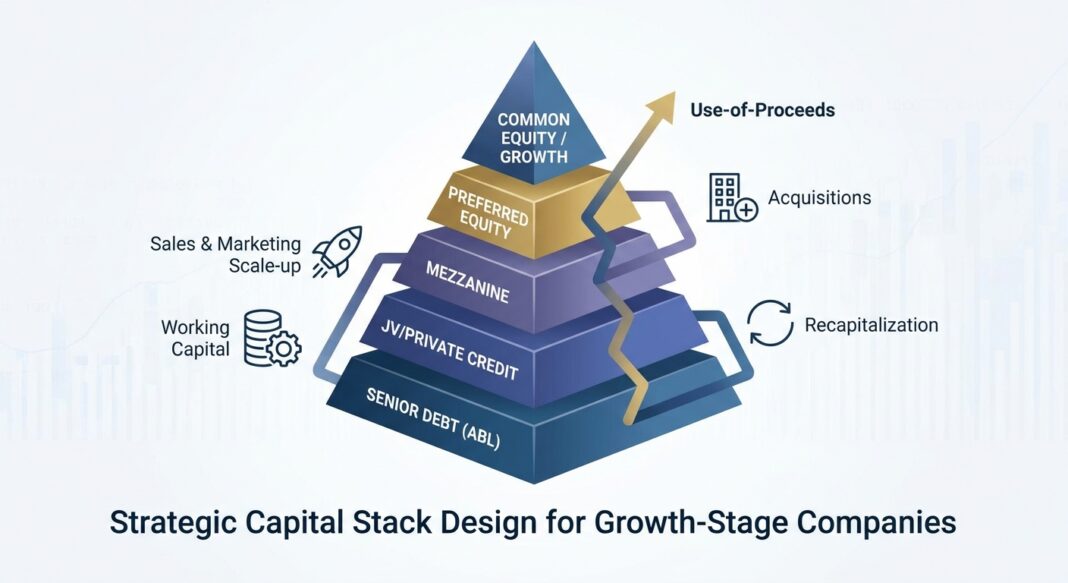
The Growth-Stage Financing Gap: Why the Capital Stack Demands Deliberate Design
Growth-stage companies occupy the most structurally complex position in the capital lifecycle. They have moved past the binary simplicity of seed financing, where equity is the default because nothing else is available, but they have not yet reached the scale where institutional equity, investment-grade credit, or broadly syndicated loans are accessible on favorable terms. The result is a financing gap that punishes improvisation and rewards architectural thinking.
At this stage, the core question is not how much capital do we need but rather what is the capital for, and which layer of the stack is the most appropriate instrument to fund it? Use-of-proceeds is not a disclosure formality. It is the primary variable that should drive every instrument selection, pricing negotiation, and covenant discussion.
As frameworks observed across hundreds of growth-company financing structures consistently show, the most resilient capital stacks combine instrument types deliberately, matching patient capital to uncertain investments and time-bound debt to proven, repeatable cash flows. re-cap.com The structural errors that compound over time almost always trace back to founders and operators who chose capital based on availability or peer behavior rather than use-of-proceeds fit.
Stage and Use-of-Proceeds: The Two Variables That Drive Instrument Selection
Before mapping the capital stack, every growth-stage operator must anchor two coordinates: the company’s current stage maturity and the specific use-of-proceeds being funded. These two variables together determine the appropriate cost of capital, the right lender or investor profile, and the covenant structure the business can realistically support.
The most common growth-stage use-of-proceeds categories (and their structural implications) break down as follows:
- Working capital and receivables financing: Highly bankable against eligible assets. Asset-based lending (ABL) structures advancing 70–85% of qualifying accounts receivable are the lowest-cost, least-dilutive option available to companies with Fortune 500 or institutional customer bases. angelinvestorsnetwork.com This is the bottom of the cost-of-capital spectrum and should be accessed first whenever asset quality supports it.
- Sales and marketing scale-up: Funded most efficiently through revenue-based financing (RBF) or venture debt when unit economics are demonstrably positive, specifically when LTV/CAC ratios exceed 3:1 and gross margins exceed 60%. RBF repayment as a percentage of monthly revenue provides structural flexibility that fixed-amortization term loans do not.
- Acquisitions and platform builds: Require a full capital stack design, senior secured debt layered with mezzanine or subordinated debt, and potentially a preferred equity tranche to bridge the gap between debt capacity and purchase price. The acquisition use-of-proceeds justifies more structural complexity and higher all-in cost because the acquired asset itself expands the collateral and earnings base.
- Recapitalizations and shareholder liquidity: Typically financed through cash-flow-based senior debt or unitranche structures, where the lender underwrites EBITDA multiples rather than asset values. Covenant packages here are negotiated around leverage ratios, EBITDA definitions, and permitted distributions, not receivables quality.
The Cost-of-Capital Spectrum: From Banks to Equity
Understanding where each instrument sits on the cost-of-capital spectrum is essential for stack design. Moving from lowest to highest cost (and correspondingly from most to least accessible) the spectrum at the growth stage looks like this:
- Senior bank debt / ABL: Lowest cost (benchmark + 200–350 bps), secured by specific assets, maintenance covenants, personal guarantee risk for smaller businesses. Requires demonstrated cash flow coverage or hard asset collateral.
- Private credit / unitranche: Single-tranche structure combining first-lien and second-lien economics, typically priced at SOFR + 500–700 bps at the growth stage. Provides certainty of execution and covenant flexibility that bank debt does not, at a cost premium. The unitranche structure is particularly well suited to sponsor-backed acquisitions and growth buyouts where speed of close and documentation simplicity are valued.
- Mezzanine / subordinated debt: Sits junior to senior secured debt, typically priced at 12–18% all-in (cash pay plus PIK), often accompanied by an equity warrant or co-investment right. The PIK feature preserves cash during the growth phase at the cost of compounding principal. Mezzanine is the appropriate instrument when senior debt capacity has been fully utilized but an equity raise would be excessively dilutive or premature. re-cap.com
- Preferred equity: Occupies the layer between debt and common equity. Carries liquidation preferences (market standard is 1× non-participating), dividend rights, and sometimes board representation. Preferred equity is appropriate when the business needs patient, equity-like capital but the common equity valuation is not yet established or is contested. alvren.com
- Common equity / growth equity: Highest cost in terms of dilution and governance concession, but carries no repayment obligation. Reserved for situations where the capital is funding genuinely uncertain, long-duration investments (market entry, product development, or transformational M&A) where the risk profile does not support debt service.
The Gap Capital Playbook: Quantifying, Preparing, and Running the Process
Once use-of-proceeds and the appropriate stack layer are identified, the execution discipline separates successful raises from distressed ones. The following four-step playbook applies across growth-stage structures:
Step 1: Quantify the Gap with Precision
Gap capital analysis begins with a three-scenario cash model: base case, downside (approximately 40% of base growth), and stress case (near-flat or negative growth). The capital quantum should be sized to the base case, but the structure (covenants, amortization schedule, repayment flexibility) must be survivable in the downside scenario. Operators who size to the base case and structure for the upside are the ones who encounter technical defaults when reality diverges from plan. The covenant package you agree to today is the operating system of your business for the next 24–36 months.
Step 2: Prepare the Data Room Before Outreach
Growth capital lenders underwrite cash flow and unit economics, not narrative. The data room must include 24 months of bank statements, accrual-basis financials, a fully reconciled cap table, a revenue cohort analysis showing retention and expansion behavior, and a debt summary if existing obligations are outstanding. Clean books are not a formality, lenders interpret disorganized financials as an operational risk signal that directly affects pricing and structure.
Step 3: Run Parallel Processes Across Lender Types
Sequencing lender conversations (approaching one source, waiting for a rejection, then approaching the next) destroys negotiating leverage and compresses timelines dangerously. Growth-stage operators should approach three to five lenders across the spectrum simultaneously: a bank or ABL lender for the senior layer, one or two private credit or unitranche funds for the middle layer, and a mezzanine or preferred equity provider if the stack requires a junior layer. Competing term sheets are the most effective negotiating tool available.
Step 4: Negotiate Structure, Not Just Pricing
The interest rate is the least important negotiating variable in a growth-stage financing. The terms that determine whether the structure succeeds or constrains the business are: the EBITDA or revenue covenant definition and the headroom built in, the PIK election mechanics if applicable, the permitted acquisition and distribution baskets, the equity warrant coverage percentage and strike price, and the prepayment premium schedule. Operators should prioritize covenant headroom and prepayment flexibility over marginal improvements in spread, a 25-basis-point reduction in pricing is economically irrelevant if a tight revenue covenant triggers a default in a soft quarter.
Key Takeaways
- Use-of-proceeds is the primary variable. Working capital funds with ABL; growth investment with RBF or venture debt; acquisitions with a layered senior-mezz or unitranche stack. The instrument must match the asset being funded.
- The cost-of-capital spectrum runs from bank debt to common equity. Each layer has a defined role. Skipping layers to access equity too early destroys value at exactly the moment when valuation should be building.
- Covenant structure matters more than pricing. A covenant package designed for upside execution will fail in a base-case outcome. Build in headroom for the downside scenario before signing.
- Parallel processes create leverage. Competing term sheets from lenders across the stack spectrum are the most effective negotiating mechanism available to growth-stage borrowers.
- Capital stack architecture is cumulative. Each instrument layered today constrains or enables the next raise. Sequence deliberately: take cheaper, less restrictive instruments first and preserve the equity layer for genuinely uncertain, long-duration capital needs.


