
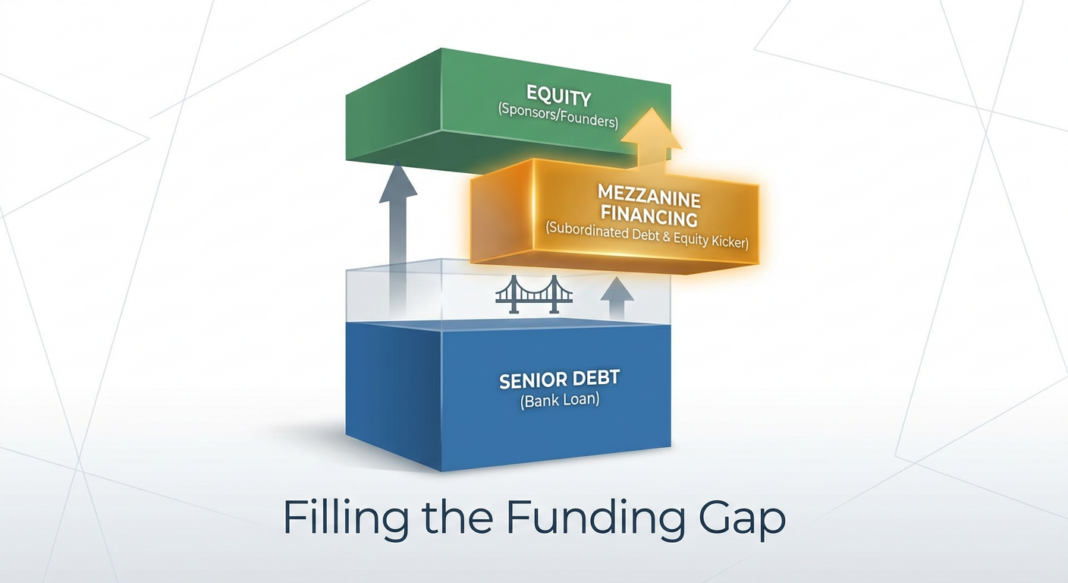
When Senior Debt Hits Its Ceiling
A growth-stage company generating $8M in EBITDA has identified a bolt-on acquisition priced at $60M, a 7.5x multiple. The company’s existing bank group will stretch to 3.5x leverage, offering $28M in senior secured debt. Equity sponsors or founding owners don’t want to inject the full remaining $32M in equity and absorb that dilution. The gap between what the bank will lend and what the deal requires is exactly where mezzanine financing lives.
This scenario plays out repeatedly across the lower and middle market. Senior lenders underwrite to cash flow coverage and collateral constraints. Equity holders protect against over-dilution. The capital stack (the layered, priority-ordered hierarchy of all funding sources) has a structural gap in the middle. Filling that gap intelligently, at the right cost and with the right terms, is one of the most consequential decisions an operator or financial sponsor will make at the growth stage. Getting it wrong means either leaving the deal undone or accepting terms that constrain the business for years.
This article walks through how mezzanine financing works as a structural solution, how to evaluate it against alternatives, and how to run a disciplined process to negotiate the best possible terms.
The Mezzanine Layer: Components and Mechanics
Mezzanine debt occupies the second layer of the capital stack, sitting below senior secured debt in repayment priority and above preferred or common equity. Because mezz lenders accept subordination, they get paid after senior lenders in a liquidation, they price for that risk with higher yields, typically combining a current cash coupon with deferred payment mechanisms and equity participation features.
A standard mezzanine package for a $60M acquisition in the current market might look like this:
- Senior Secured (First Lien): $28M at SOFR + 350–400 bps (roughly 8.5–9.0% all-in), 5-year term, maintenance covenants including a total leverage test and fixed charge coverage ratio of 1.10x–1.15x.
- Mezzanine Tranche: $18M structured as subordinated notes with a 13–15% blended yield, typically 10–11% cash pay plus 3–4% PIK (payment-in-kind) interest that accrues to principal rather than paying current. This preserves near-term cash flow for the business while compensating the lender for subordination risk.
- Equity Kicker / Warrant Coverage: The mezz lender takes warrants representing 3–7% of fully diluted equity, exercisable at a nominal strike, giving them upside participation beyond the interest yield. In some structures this is replaced by a revenue participation right or a defined equity co-investment.
- Equity Contribution: $14M from the sponsor or owner group, roughly 23% of total capitalization, preserving the majority of ownership while closing the acquisition.
PIK interest is a critical design feature. It allows the borrower to conserve cash in years one and two of integration, when EBITDA may be temporarily compressed. The trade-off is that the principal balance grows, increasing total indebtedness. Operators must model the PIK roll carefully: a $18M mezz tranche with 4% PIK becomes approximately $20.2M outstanding after three years, before any cash amortization.
As frameworks from re-cap.com illustrate, junior debt in the stack typically targets 12–18% blended returns and often includes equity warrants or conversion rights, consistent with current market pricing for sub-investment-grade, subordinated acquisition paper.
Mezzanine vs. Alternatives: Access, Cost, and Control Trade-Offs
Operators evaluating a capital gap have several structural alternatives, each with distinct cost-of-capital and control implications:
- Unitranche (Direct Lending): A single blended facility that combines senior and subordinated economics into one tranche, typically from a direct lender. Pricing currently runs SOFR + 550–650 bps (roughly 10.5–11.5% all-in) for growth-stage credits. Unitranche eliminates inter-creditor complexity and is faster to close, but at larger deal sizes it can be more expensive than a bifurcated senior/mezz structure and typically imposes tighter covenant packages.
- Second Lien: Sits between first lien senior and true mezzanine in the priority waterfall. Second lien is secured (unlike most mezz) but junior to first lien lenders per an intercreditor agreement. Current pricing: SOFR + 700–900 bps. It generally lacks PIK optionality and equity kickers, making it less flexible than mezz for acquisitions where near-term cash flow is uncertain.
- Preferred Equity: A non-debt solution that avoids leverage covenants entirely. Preferred holders receive a fixed dividend (often 10–14%) with a liquidation preference above common equity but below all debt. It doesn’t show up as debt on the balance sheet, which can preserve senior covenant headroom. The trade-off is that preferred dividends are typically not tax-deductible, raising the true cost, and preferred investors often require board observation rights or protective provisions.
- Additional Common Equity: The cheapest structural option in terms of fixed obligations, but the most dilutive. At the growth stage, founders and sponsors use equity last; it is the highest-cost capital in terms of ownership given up per dollar raised.
The sequencing principle articulated by alvren.com applies directly: take the cheapest, least-restrictive instrument first, and reserve equity for last. For an acquisition with predictable post-close cash flows, mezz is typically the right middle layer, more flexible than second lien, less dilutive than preferred or common equity.
Current Market Terms: What the Market Is Pricing in 2025–2026
The mezzanine market has repriced meaningfully since the 2021–2022 low-rate environment. Practitioners should calibrate to the following current benchmarks:
- All-in yield: 13–16% blended (cash + PIK) for sub-$25M mezzanine tranches in the lower middle market. Larger tranches ($25M–$75M) from institutional mezz funds price tighter, at 12–14% blended.
- Warrant coverage: Typically 3–7% of fully diluted equity for standalone mezz, with the upper end reserved for credits with higher leverage or less seasoned cash flow histories.
- Cash/PIK split: Most 2025–2026 structures split the yield approximately 70% cash pay / 30% PIK, though borrowers with strong cash flow sometimes negotiate all-cash pay at a lower headline rate to avoid PIK accrual.
- Leverage tolerance: Mezz lenders are generally underwriting to 5.0x–6.0x total debt-to-EBITDA at close for acquisition financings, with first lien lenders holding 3.0x–4.0x and mezz occupying the upper 1.5x–2.5x of the stack.
- Covenants: Mezz debt typically uses incurrence-based covenants: tested only when the borrower takes an action (new debt, dividends, asset sales) rather than on a quarterly maintenance basis. This is meaningfully more borrower-friendly than senior bank debt maintenance covenants.
Capital stack hierarchy and return expectations by layer are consistent with frameworks outlined by re-cap.com, which notes junior debt layers targeting 12–18% returns with limited equity upside participation, aligned with current institutional mezz fund return targets.
The Gap Capital Playbook: Quantify, Prepare, Run the Process
Executing a mezzanine raise for an acquisition requires a structured process. Here is the practitioner’s sequence:
Step 1: Quantify the Gap Precisely
Map the full sources-and-uses table. Lock in the purchase price, transaction costs (legal, advisory, financing fees), and working capital adjustments. Then confirm the senior lender’s commitment in writing (letter of intent or term sheet) before approaching mezz lenders. Mezz lenders won’t price subordination risk until they know exactly what sits above them.
Step 2: Prepare the Information Package
A mezz information memorandum must include: (a) last three years of audited financials plus trailing twelve months, (b) a five-year integrated model with debt service coverage analysis under base, downside, and stress cases, (c) EBITDA bridge from reported to adjusted, with add-backs clearly documented, and (d) management biographies and ownership structure. Mezz lenders underwrite the management team as much as the financial profile; they are subordinated and need confidence in execution.
Step 3: Run a Targeted Process
The mezz market is relationship-driven at the lower end and competitive at the institutional level. For tranches below $20M, target regional business development companies (BDCs), family offices with credit mandates, and SBIC-licensed funds. For tranches above $20M, engage dedicated mezz funds and the credit arms of larger private equity platforms. Run a structured four-to-six week process with simultaneous term sheet requests rather than sequential conversations, competitive tension is the borrower’s primary negotiating tool.
Step 4: Negotiate the Structure
The most negotiable elements, in order of priority for borrowers:
- Warrant coverage and exercise price: Push for the lower end of the 3–5% range; warrants represent permanent dilution and should be sized conservatively.
- Cash/PIK split: Maximize PIK in years one and two if integration cash flow is uncertain; negotiate a PIK toggle so you can elect cash pay when coverage improves.
- Prepayment penalties: Mezz lenders typically charge a make-whole or step-down call premium (e.g., 103/102/101 in years one through three). Negotiate a shorter no-call window or a lower make-whole floor; this matters significantly if you plan to refinance upon reaching investment-grade metrics.
- Incurrence covenant baskets: Define permitted debt, restricted payments, and investment baskets broadly enough to allow operational flexibility and future add-on acquisitions without requiring lender consent.
The capital structure optimization principles outlined by firstratefunding.net reinforce a core principle: each funding decision builds on the last, and the terms negotiated today constrain (or enable) the next raise. Negotiate for flexibility, not just rate.
Key Takeaways
- Mezzanine fills the structural gap between senior debt capacity and equity dilution tolerance; it is the purpose-built instrument for growth-stage acquisitions where the arithmetic of the capital stack doesn’t close with bank debt alone.
- PIK interest is a cash flow tool, not a free lunch: model the principal accrual carefully and build a clear path to refinancing or repayment before you accept PIK mechanics.
- Warrant coverage is permanent dilution: negotiate the percentage and exercise price aggressively, and consider whether a cash-pay premium structure (eliminating warrants entirely) pencils out better over the hold period.
- Incurrence covenants are a major structural advantage over senior maintenance covenants, understand the distinction before signing, and negotiate covenant baskets wide enough to support operational and M&A flexibility.
- Run a competitive process: mezz terms are not standardized, and a parallel process across four to six credible lenders is the most effective mechanism for compressing pricing and loosening structure in the borrower’s favor.


