
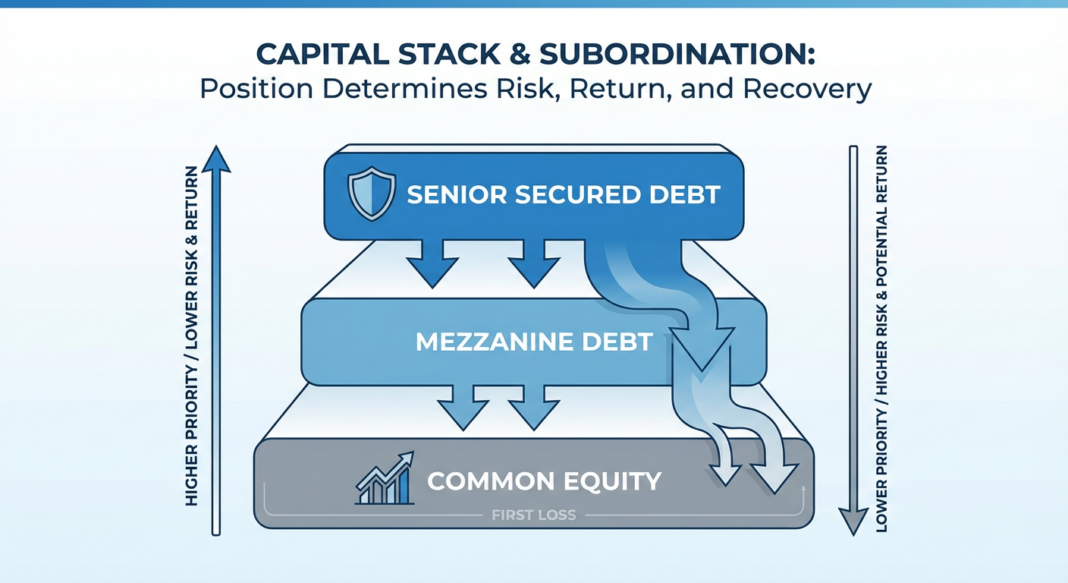
Where You Sit Determines What You Get
In private credit, one principle governs nearly every lending and investment decision: position in the capital stack determines risk, return, and recovery. Whether you are a pension fund allocating to a direct lending strategy or a mid-market operator seeking growth financing, understanding where each piece of capital sits (and what that means when things go wrong) is foundational to every transaction you will ever evaluate.
The capital stack is not a complex Wall Street abstraction. It is simply the ordered hierarchy of every funding source used in a deal, organized by who gets paid first. Senior lenders at the top. Common equity holders at the bottom. Everything else (mezzanine debt, subordinated notes, preferred equity) fills the middle. That sequence of repayment priority is called subordination, and it is the single most important structural concept in private credit.
The Mechanism: How the Stack Actually Works
Think of the capital stack as a waterfall. Cash flows (whether from operations, an asset sale, or a liquidation) pour in at the top and flow downward. Each layer of capital drinks before the one below it receives a drop. Senior secured lenders drink first. Mezzanine lenders drink second. Equity holders wait at the bottom. If the waterfall runs dry before reaching a layer, that layer absorbs the loss.
This structure creates three distinct trade-offs that every participant in a private credit deal must evaluate:
- Risk vs. Return: Higher position in the stack means lower risk and lower expected return. Lower position means higher risk and higher potential return.
- Control vs. Cost: Senior lenders impose the most restrictions (covenants, collateral liens, approval rights) precisely because they accept the lowest yield. Equity investors accept fewer restrictions but bear first-loss exposure.
- Certainty vs. Upside: A senior secured lender knows approximately what they will earn. An equity investor has theoretically unlimited upside, and theoretically unlimited downside.
A Concrete Example: The $10M Acquisition Deal
Consider a private equity-backed acquisition of a regional logistics company valued at $10 million. The buyer structures the deal as follows:
- Senior Secured Loan, $5.5M (55% of deal value): Provided by a direct lender at SOFR + 500 bps (approximately 9.2% all-in as of early 2026). First-lien position on all company assets. Paid first in any liquidation or sale.
- Mezzanine Debt, $2M (20% of deal value): Subordinated to the senior loan. Higher yield, typically 13–16%, reflecting the additional risk of sitting below $5.5M of senior claims. Includes a small equity warrant.
- Common Equity, $2.5M (25% of deal value): Contributed by the private equity sponsor. Last in line. No guaranteed return. Entire upside if the business grows to $15M or $20M in value, entire loss if the business fails with insufficient assets to repay even the senior lender.
Now model a stress scenario: the company underperforms and is sold for only $6M. The senior lender recovers their full $5.5M. The mezzanine lender recovers $500K of their $2M, a partial loss. The equity sponsor recovers nothing. Same capital, same deal, dramatically different outcomes, determined entirely by stack position.
Current Market Relevance: Why Stack Position Matters More Right Now
Private credit’s rise as an asset class has made capital stack literacy more commercially urgent than ever. According to Long Angle’s Private Credit Investment Guide (2026), private credit assets under management exceeded $2 trillion in 2025 and are projected to reach $4.5 trillion by 2030. That capital is being deployed across every layer of the stack, and investors who cannot distinguish senior secured exposure from mezzanine exposure are making allocation decisions they do not fully understand.
Bank lending has structurally retreated from this market. The same Long Angle guide notes that bank lending as a share of U.S. GDP declined from 59% in Q4 2008 to 44% as of Q1 2025: a multi-decade contraction driven by post-GFC regulation, Dodd-Frank constraints, and the regional banking stress of 2023. Private credit lenders have absorbed the majority of that volume, particularly in the senior secured, first-lien direct lending segment serving middle-market companies with $1–$10 billion in revenue.
According to the same source, direct lending represented 38% of all private credit capital raised in H1 2025: making first-lien senior secured the dominant strategy by a significant margin. Institutional allocators are concentrating there deliberately: the senior position offers covenant protections, collateral security, and historical default rates below 4% since 2021, per the Proskauer Private Credit Default Index as cited by Long Angle.
| Metric | Data Point | Source |
|---|---|---|
| Private Credit AUM (2025) | $2 trillion+ | Long Angle, 2026 |
| Projected Private Credit AUM (2030) | $4.5 trillion | Long Angle, 2026 |
| Direct Lending Share of Capital Raised (H1 2025) | 38% | Long Angle, 2026 |
| Direct Lending Default Rate (Since 2021) | Under 4% | Long Angle / Proskauer Index, 2026 |
| Bank Lending as % of U.S. GDP (Q1 2025) | 44% (down from 59% in 2008) | Long Angle, 2026 |
Decision Framework: Investors and Operators
For Investors Evaluating Private Credit Allocations
Before committing capital to any private credit strategy, experienced allocators evaluate stack position as the primary risk filter. Investors consider questions such as: Is this fund lending at the senior secured level, or is it taking subordinated exposure? What is the loan-to-value ratio, and how much equity cushion sits below the loan? Does the strategy hold first-lien positions, or is collateral shared or second in priority?
Senior secured direct lending strategies, the dominant form of institutional private credit today, offer lower yield potential than mezzanine or distressed strategies, but substantially stronger downside protection. As Corporate Finance Institute notes, the layered structure of a capital stack means each tier carries a fundamentally different risk-return profile. Investors who understand subordination can calibrate their allocation (more senior exposure for capital preservation, more junior exposure for total return) rather than treating private credit as a monolithic asset class.
For Business Operators Seeking Capital
For operators, the capital stack is a cost and control optimization exercise. Senior debt is the cheapest capital available, but it comes with the most restrictions: financial covenants, collateral liens, reporting obligations, and prepayment constraints. As Peach Tree Capital explains, the structure of a deal should be designed before lenders are engaged, not assembled reactively after a single source declines.
Operators evaluate mezzanine debt when senior capacity is exhausted but equity dilution is undesirable. They consider preferred equity when they need flexible, non-amortizing capital without surrendering common equity upside. The right stack is deal-specific: driven by the asset’s cash flow predictability, the operator’s risk tolerance for covenants, and the realistic recovery scenario if the deal underperforms.
Key Takeaways
- Stack position is the primary risk variable in private credit. Senior secured lenders carry the lowest risk and lowest yield. Equity holders carry the most risk with the most upside. Every layer between them is a calibrated trade-off.
- Subordination determines recovery, not just yield. In a stress scenario, the difference between a senior lender and a mezzanine lender is often the difference between full recovery and a significant loss, regardless of the spread differential earned.
- Private credit’s growth is concentrated at the senior secured layer. With direct lending representing 38% of all capital raised in H1 2025, institutional capital is prioritizing first-lien, covenant-protected exposure as the asset class matures.
- Operators should design capital structure before approaching lenders. Understanding which layer of the stack fits each funding need (and what control trade-offs come with each) produces better deals than seeking single-source approval first.
- Equity cushion below the loan is what protects lenders. A deal with 40% equity below a senior loan is structurally safer than one with 15% equity, even if the interest rate on both loans is identical. Investors and operators alike should track loan-to-value as a primary structural metric.


