
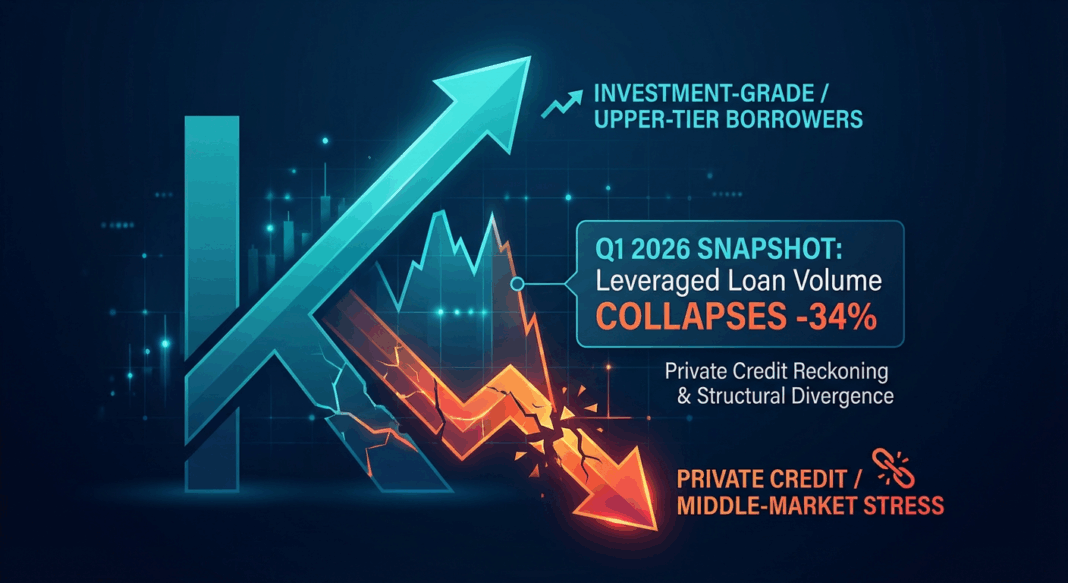
The Great Credit Bifurcation: A K-Shaped Market Demands Surgical Selectivity
The first quarter of 2026 has delivered an unambiguous verdict: the era of broad-based credit availability is over. A convergence of geopolitical instability, a trade-policy-driven oil shock that sent Brent crude above $120 per barrel, and a consequent Federal Reserve rate-cut pause has fractured the credit landscape into two sharply divergent arms. At the top, a narrow tier of investment-grade and upper-BB-rated borrowers (the Oracles, the Electronic Arts) continues to access capital at manageable all-in costs. At the bottom, a swelling cohort of software-heavy, high-leverage middle-market borrowers is being systematically priced out or locked out entirely.
Total primary leveraged loan activity fell to approximately $235–$241 billion in Q1 2026, a 32–34% decline versus Q1 2025’s $355 billion pace, the slowest quarterly start since the pandemic shock of 2020. Refinancings collapsed 42% and repricings fell 39%, as borrower opportunism evaporated under the weight of widening spreads and retreating investor demand. Meanwhile, private credit, long positioned as the resilient alternative, is confronting its own reckoning: record default rates, redemption gates at flagship funds, and a valuation-credibility crisis that public markets are already pricing in at roughly 78 cents on the dollar for listed BDCs, down from near par in early 2025.
The macro-to-micro read is clear: credit is available, but only for the disciplined, the well-capitalised, and the strategically positioned. For everyone else, the cost of capital has structurally repriced upward.
Quantitative Market Snapshot: Where Rates, Spreads & KPIs Stand Today
The table below captures the key credit market metrics as of late April 2026, benchmarked against prior-period readings. Sources are linked inline.
| Metric | Current Value | Prior Period | Direction | Source |
|---|---|---|---|---|
| High Yield Bond Spread (OAS) | 285 bps (as of Apr 15, 2026) | 328 bps (Apr 2, 2026); 322 bps (Mar 19, 2026) | ▼ Tightening | finexus.net |
| Investment Grade Bond Spread (OAS) | 80 bps (6th percentile historically) | 92 bps (one month prior) | ▼ Tightening | finexus.net |
| Direct Lending 1st Lien Spread (New Issue) | ~490–510 bps (SOFR+) | ~524 bps (Dec 2024); ~580 bps (Jan 2022) | ▼ Compressed vs. cycle peak; widening from Jan 2026 | antares.com |
| Primary Leveraged Loan Volume (Q1 2026) | ~$235–$241B | ~$355B (Q1 2025) | ▲ Down 32–34% YoY | wedbush.com | sikich.com |
| U.S. Private Credit Default Rate | 9.2% (2025, record high per Fitch) | 8.1% (2024) | ▲ Worsening | atlaspeakresearch.com |
| Distress Ratio (Loans <80 cents on dollar) | 7.23% (March 2026) | Sub-5% (mid-2025) | ▲ 3-year high | wedbush.com |
| Listed BDC Price / Reported NAV | ~78 cents on the dollar (Mar 12, 2026) | ~85 cents (Jan 2026); ~par (early 2025) | ▲ Deteriorating | atlaspeakresearch.com |
| Software Sector Avg. Leverage (Private Credit) | 7.4x EBITDA | 5.9x (broader loan pool avg.) | ▲ Elevated vs. market | atlaspeakresearch.com |
From a KPI underwriting perspective, the market shift is measurable. Lenders extending new direct lending facilities are now imposing materially tighter Fixed Charge Coverage Ratio (FCCR) floors, market participants report increasing resistance to credits with FCCR below 1.10x in cyclical sectors, versus a 1.0x threshold that was widely accepted during the 2021–2023 liquidity boom. Debt-to-EBITDA multiples are contracting across software and media, while infrastructure and energy borrowers with hard-asset coverage continue to attract leverage at or above 4.0–5.0x senior debt. The HY-IG quality spread of 205 basis points: historically tight, reflects a market that is not yet demanding a full premium for credit risk at the index level, even as dispersion at the borrower level has rarely been wider.
Sector Analysis: Energy and Infrastructure Win; Software and Media Bleed
The K-shaped bifurcation is not uniform across sectors; it is acutely structural. Two dynamics are driving sector rotation simultaneously: the AI-disruption repricing of software valuations, and a macro commodity shock that has rehabilitated hard-asset industries.
🔴 Under Pressure: Software & Legacy Media
Software has become the epicentre of private credit stress. According to Atlas Peak Research, software accounts for approximately 16% (~$235B) of the $1.5 trillion U.S. loan market, with private credit exposure estimated at around 20% of books by some managers. Critically, roughly 50% of software loans are rated B- or lower, over 80% are private-company issuers, and nearly 78% are sponsor-backed, creating a tightly correlated, illiquidity-amplified risk cluster. With software equities down approximately 22% since January 2026, loan-to-enterprise-value ratios have deteriorated sharply, and sales growth in the sector has slowed to 10% from 18% year-over-year. Lenders are repricing accordingly, with spreads on software credits widening by an estimated 100 basis points in February and March alone, per Sikich. The “SaaSPocalypse” narrative (driven by agentic AI tools from Anthropic and OpenAI automating core SaaS workflows) has introduced a structural valuation discount that is unlikely to fully reverse. Legacy media faces an analogous structural headwind; Cumulus Media filed its second Chapter 11 in eight years in March 2026 to restructure $592 million in debt.
🟢 Outperforming: Energy, Infrastructure & Healthcare (Selectively)
Capital is rotating decisively into hard-asset sectors. With Brent crude above $120 per barrel for much of Q1, energy infrastructure assets have attracted renewed lender appetite, the energy sector (XLE) is up +24.7% year-to-date through mid-April 2026, per Finexus Research. Lenders are offering more favourable leverage multiples and tighter spread premiums on cash-flow-stable energy and infrastructure credits. AI data centre infrastructure, as evidenced by Oracle’s successful $38 billion debt package, remains strongly bid. Healthcare is more bifurcated: pharmaceutical supply chain complexity under the shadow of 100% tariffs on certain branded drugs has tightened lender appetite for globally exposed platforms, while domestically focused healthcare services businesses continue to find receptive capital markets.
Implications: What Operators and Institutional Investors Must Act On Now
For Borrowers & Operators
The window for opportunistic refinancing at 2024-era terms has closed. Borrowers approaching debt walls in late 2026 or 2027 (particularly those in software, media, or with high international exposure) should treat the current environment as a pre-emptive restructuring opportunity, not a waiting game. New credit facilities will carry tighter covenant packages, including FCCR floors, tighter leverage caps, and in some cases mandatory amortisation requirements that were largely absent during the 2021 boom. Operators should run immediate sensitivity analyses on their debt service coverage under a 50–100 bps additional spread widening scenario and stress-test their FCCR at current floating base rates. For businesses with approaching maturities and leverage above 6.0x EBITDA, proactive engagement with lenders or strategic advisers is no longer optional; it is urgent.
For Institutional Investors & Lenders
The semi-liquid private credit vehicle structure, which drove explosive retailisation of the asset class, is under its first real stress test. Redemption gate events at BCRED ($3.7B in requests, Atlas Peak Research), BlackRock HLEND ($1.2B), and Cliffwater’s Corporate Lending Fund (~14% of NAV in requests) are structural warnings, not idiosyncratic events. Institutional allocators should re-examine the liquidity-matching assumptions embedded in their private credit sleeve allocations. Closed-end, drawdown-structure funds with genuine 5–8 year capital lockups retain the strongest structural integrity. Selective opportunity exists in distressed and special-situations strategies targeting software and media credits, but only where underlying enterprise value is credibly supportable independent of peak-multiple sponsor underwriting.
Forward-Looking View: Next 3–6 Months
The base case for Q2–Q3 2026 is a market that remains selectively open but operationally bifurcated. Per Antares Capital’s 2026 Outlook, direct lending continues to offer a meaningful yield premium over leveraged loans and high yield, supported by senior-secured positioning and disciplined underwriting, but performance dispersion among managers is at a cycle high, making manager selection a primary driver of returns. M&A deal formation slowed meaningfully in Q1, and the pipeline carryover effect that flattered Q1 issuance will not repeat in Q2. If the Fed remains on hold through mid-year and oil prices stay elevated, the 90/10 dynamic (where 90% of the market is stable and the bottom 10% faces existential liquidity pressure) will persist or steepen. A Fed pivot or meaningful commodity price correction would be the primary catalysts for a broader market re-opening.
Key Market Insights
- Volume collapse is structural, not cyclical: The 32–34% decline in Q1 leveraged loan issuance reflects exhausted repricing tailwinds, geopolitical risk premiums, and a genuine deceleration in private equity deal formation, not a temporary air pocket. New-money issuance held up better (~$70B) but was heavily concentrated in five mega-transactions, obscuring weak underlying deal flow.
- Private credit default rates are at a record: The U.S. private credit default rate hit 9.2% in 2025 (Fitch, via Atlas Peak Research), with double-digit defaults now recorded among borrowers with sub-$30M EBITDA. Lenders underwriting at 2021-era leverage multiples to this cohort face material impairment risk.
- Software is the single largest sector risk vector: With 7.4x average EBITDA leverage, ~20% private credit portfolio concentration, 50% of loans rated B- or below, and equity valuations down 22% YTD, software credit risk is the most concentrated and consequential sector exposure in current direct lending books.
- Semi-liquid vehicle redemption gates signal structural fragility: The simultaneous gate activation at BCRED, HLEND, North Haven, and Cliffwater, representing hundreds of billions in AUM, is a systemic signal about the liquidity mismatch embedded in retailised private credit structures, not a series of isolated events.
- Spread compression at the index level masks dangerous borrower-level dispersion: With HY spreads at 285 bps (5th historical percentile) and IG at 80 bps (6th percentile), headline credit conditions appear benign. The distress ratio of 7.23% and the BDC discount to NAV of 78 cents tell a sharply different story at the individual credit level: reinforcing that bottom-up underwriting rigour, not top-down beta exposure, is the only credible strategy in this environment.


