
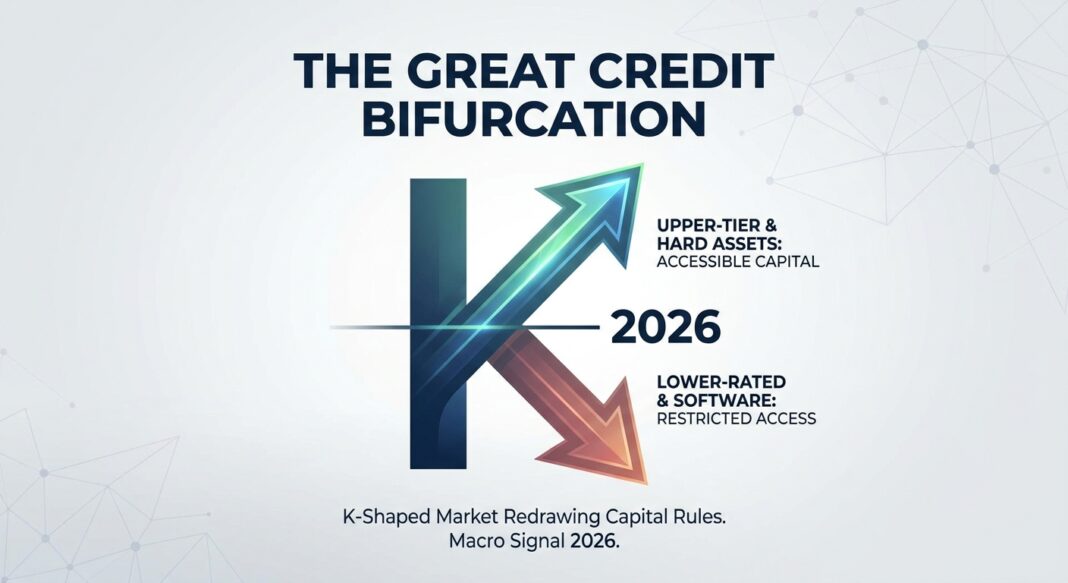
Macro Headline: The K-Shape Is No Longer a Theory
The first quarter of 2026 has delivered an unambiguous signal: the era of indiscriminate credit access is over. Primary leveraged loan issuance totalled approximately $235–$241 billion in Q1 2026, representing a 32–34% decline year-over-year versus the $355 billion recorded in Q1 2025, the weakest opening quarter for credit markets since the 2020 pandemic shock, according to investor.wedbush.com and corroborated by sikich.com.
The macro catalyst is a confluence of forces: geopolitical instability, an oil price surge above $120 per barrel that reignited inflation and forced the Federal Reserve to pause its rate-cutting cycle, and an accelerating structural disruption in the software sector driven by agentic AI adoption. The result is a hard bifurcation: a K-shaped market where investment-grade and upper-tier leveraged borrowers continue to access capital, while lower-rated credits, particularly in software and media, are effectively locked out. The Federal Reserve is not expected to cut rates in 2026, per breckinridge.com, keeping floating-rate debt burdens elevated for the most vulnerable borrowers.
This is not merely a cyclical slowdown. It is a structural repricing of credit risk, and operators and institutional investors who fail to adjust their capital structure assumptions will be caught off-guard.
Quantitative Market Snapshot
| Metric | Current (Q1 2026) | Prior Period | Source |
|---|---|---|---|
| Total U.S. Leveraged Loan Issuance (Q1) | ~$241B | $355B (Q1 2025) | sikich.com |
| Leveraged Loan Spreads (Most Active Segment) | ~+100bps wider vs. Jan 2026 | Favorable Jan 2026 conditions | sikich.com |
| High-Yield Bond Spreads (B-Rated) | +3.17% OAS | 2.65% (Q4 2025) | investor.wedbush.com |
| IG Corporate Bond Index OAS | +89bps | ~+78bps (Jan 2026 tightest in 20 yrs) | breckinridge.com |
| U.S. Private Credit Default Rate | 9.2% (2025 full year, record) | 8.1% (2024) | atlaspeakresearch.com (citing Fitch) |
| Private Credit Market Size (Global AUM) | ~$1.8T–$2.5T | ~1% of U.S. GDP (2008) | cressetcapital.com |
| Distress Ratio (Loans <80 cents) | 7.23% (March 2026) | Multi-year low (2025) | investor.wedbush.com |
Private credit middle-market loan yields have stabilised near ~5% spread over base rate for performing credits, per cressetcapital.com, while software-sector and lower-rated credits command materially wider pricing. Listed BDCs were trading at an average of 78 cents on the dollar of reported NAV as of mid-March, down from ~85 cents at the start of 2026 and near par in early 2025, per atlaspeakresearch.com.
Sector Analysis: Where Lender Appetite Is Opening and Closing
🔴 Software & SaaS: Structural Repricing Underway
Software has become the most critical fault line in private credit. Software and services represent approximately 20% of private credit exposure (BNP estimates, cited in atlaspeakresearch.com) and roughly 16% (~$235B) of the $1.5T U.S. loan market. Over 50% of software loans are rated B- or lower, and average software borrower leverage sits at 7.4x EBITDA versus 5.9x for the broader loan pool. Revenue growth has decelerated sharply, from 18% to 10% year-over-year, compressing the deleveraging path just as agentic AI threatens to erode the SaaS seat-licence model entirely. Lenders are applying higher covenant intensity, lower advance rates, and demanding clearer ARR durability metrics before extending credit. Operators in this sector carrying leverage above 6.5x EBITDA should expect refinancing friction and materially wider spreads at their next maturity.
🟡 Healthcare: Tariff Overhang Creating Selective Stress
The April 2026 anniversary of the 100% tariff on certain branded pharmaceuticals has injected supply-chain uncertainty into healthcare lending. Lenders are scrutinising international revenue exposure and input cost pass-through assumptions, making Fixed Charge Coverage Ratio (FCCR) covenants tighter, particularly for specialty pharma and distribution-dependent models. Healthcare companies with domestic, asset-light, or recurring-revenue profiles (e.g., diagnostics) continue to find receptive lender markets. Hologic’s successful $7.25B loan pricing despite broader malaise confirms that quality healthcare credits remain fundable.
🟢 Energy, Infrastructure & AI Data Centres: Lender Appetite Firm
In a striking rotation, capital is flowing toward hard-asset and infrastructure-linked credits. Energy was the best-performing IG sector in Q1 2026 (+2bps spread widening vs. +15bps for Technology), per breckinridge.com. AI data centre infrastructure, power grid build-out, and equipment finance are drawing strong lender appetite, with Oracle’s $38B debt package for AI-integrated data centres pricing successfully. Utilities issued $56B in IG bonds in Q1, the third-largest sector. Asset-backed lending strategies (equipment leasing, infrastructure cash flows, royalty streams) are attracting increased institutional allocation due to collateral clarity and tax efficiency, particularly post-restoration of full bonus depreciation, per cressetcapital.com.
🔴 Media & Legacy Sectors: Liquidity Effectively Closed
Media remains the clearest example of a sector facing existential liquidity pressure. Cumulus Media’s second Chapter 11 filing in eight years, to restructure $592M in debt, underscores the market’s unwillingness to refinance structurally declining cash flows at any spread, per investor.wedbush.com.
Implications for Institutional Investors & Operators
For Borrowers and Operators
The era of easy refinancing is over for sub-investment-grade and high-leverage credits. Operators should treat the next 12 months as a covenant-management and capital-structure-preservation period. Key lender thresholds have tightened: expect Debt/EBITDA ceilings of 5.0–5.5x for new-money transactions in most sectors (down from 6.0–6.5x in the 2024 cycle), and FCCR minimums of 1.20x–1.30x to be strictly enforced rather than loosely tested. Borrowers with debt walls in late 2026 or 2027: particularly in software and media, must begin proactive liability management now, including non-core asset disposals or private credit rescue financing at double-digit all-in rates. Waiting for a market re-opening that may not materialise before maturities arrive is a structural risk.
For Institutional Investors and Lenders
The private credit market is undergoing a necessary structural correction that separates the structurally sound from the retail-distribution-driven. The redemption gate events at BCRED ($3.7B in requests, 7.9% NAV), BlackRock’s HLEND ($1.2B, 9.3% NAV), and Cliffwater’s Corporate Lending Fund (~14% requests), per atlaspeakresearch.com, are liquidity-structure stress events, not credit quality collapses. Institutional investors in closed-end direct lending vehicles with proper duration match remain structurally insulated. However, investors in semi-liquid perpetual BDC structures should carefully audit their liquidity sleeve composition and software-sector concentration. The BDC discount to NAV, currently averaging 78 cents on the dollar, creates selective secondary market entry opportunities for patient capital, but only where underlying credit fundamentals are independently validated.
Forward-Looking View: The Next 3–6 Months
With the Fed on hold and oil prices elevated, the primary market will remain highly selective through at least mid-2026. M&A-driven issuance will provide a floor for deal volumes, but as sikich.com notes, Q1’s M&A strength was heavily pipeline-driven, over 40% of institutional loan volume came from just five mega-transactions. New deal formation from private equity has slowed materially, limiting organic volume recovery. The private credit default rate, already at a record 9.2% for 2025 per Fitch data, is on a trajectory toward double digits for the smallest borrower cohort. Distressed debt specialists and direct lenders with dry powder and underwriting discipline are positioned to provide rescue and special-situation capital at highly attractive risk-adjusted yields, but selectivity and structural protection (covenants, collateral, PIK monitoring) are non-negotiable. Capital is available; it is simply no longer indifferent.
Key Market Insights
- Bifurcation is structural, not cyclical: The K-shaped credit market (upper-tier borrowers funded freely, lower-rated credits effectively shut out) reflects a permanent repricing of AI disruption risk and leverage tolerance, not a temporary liquidity hiccup.
- Private credit gates signal structure risk, not solvency crisis: Redemption pressure at BCRED, HLEND, Cliffwater, and Blue Owl traces to vehicle design mismatches between illiquid assets and semi-liquid distribution channels, underlying portfolio credit quality across performing loans remains relatively stable.
- Software is the epicentre of underwriting repricing: With 7.4x average EBITDA leverage, 50%+ of loans rated B- or lower, and revenue growth decelerating, software-sector lenders are demanding tighter covenants, lower advance rates, and clearer ARR durability, with no signs of loosening through 2026.
- Hard assets and infrastructure are the capital rotation beneficiaries: Energy, AI data centre infrastructure, equipment finance, and asset-backed lending strategies are absorbing capital rotating out of software-heavy loan portfolios, with Utilities and Energy posting the tightest spread performance in Q1 2026.
- Operators with 2026–2027 debt maturities must act now: The refinancing window for sub-investment-grade credits is narrow and expensive. Proactive liability management (including asset sales, covenant amendments, and private credit rescue financing) is preferable to waiting for a market re-opening that may arrive after default.


