
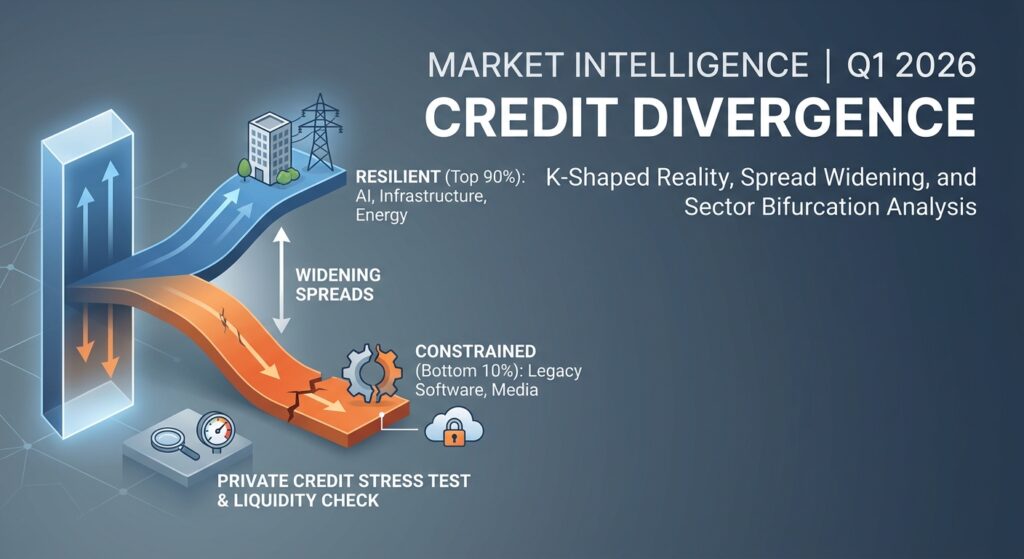
The K-Shape Is No Longer a Theory: It Is the Structural Reality of Credit in 2026
The first quarter of 2026 has delivered a definitive verdict on the credit cycle: bifurcation is no longer a risk scenario; it is the operating environment. Total U.S. leveraged loan primary activity, including repricings, reportedly reached approximately $241 billion in Q1 2026, running roughly 32–34% below the same period in 2025, and has been characterized as the slowest start to a year since the pandemic shock of 2020, according to commentary from sikich.com and investor.wedbush.com. The cited macro catalyst for this contraction is a mix of geopolitical instability, a sharp oil price move above $120 per barrel in what some analysts call the “March Oil Shock,” and a Federal Reserve forced to pause its anticipated rate-cutting cycle as inflationary pressures re-accelerated.
In that framing, the credit market is operating on a strict “90/10” rule: roughly 90% of the market (upper-arm, investment-grade-adjacent, cash-flow-positive borrowers) appears to retain market access. The remaining 10% (overleveraged, software-heavy, or sub-scale issuers) face a liquidity environment that is, functionally, far more constrained. Commentators argue this is less a temporary technical dislocation and more an underwriting-discipline repricing that is reshaping how credit risk is defined, priced, and allocated across both public and private markets.
Quantitative Market Snapshot (as reported by selected sources)
| Metric | Current Reading (Q1 2026)* | Prior Period* | Direction (source commentary) | Key Source |
|---|---|---|---|---|
| U.S. leveraged loan issuance (primary, incl. repricings) | ~$241B* | ~$355B* (Q1 2025) | ▼ ~32–34% YoY (slower start vs. 2025) | sikich.com |
| Single-B loan spreads (BSL, active segment) | SOFR + ~419 bps* | SOFR + ~319 bps* (Nov 2025) | ▲ ~100 bps (Feb–Mar widening) | sikich.com |
| Middle-market unitranche spreads (private credit) | SOFR + ~450 bps* (headline range) | SOFR + ~450 bps* (Q4 2025 baseline) | → Generally stable; some selective widening | mondaq.com |
| High-yield bond spreads (B-rated segment) | ~317 bps* (end Q1) | ~265 bps* (start Q1) | ▲ ~50 bps QoQ; wider vs. IG | investor.wedbush.com |
| U.S. private credit default rate | 9.2%* (2025 full year, Fitch, as cited) | 8.1%* (2024) | ▲ Described as a record high | atlaspeakresearch.com |
| Leveraged loan distress ratio (trading below 80 cents) | ~7.2%* (around March 2026) | Below 5%* (early 2025) | ▲ Noted as a multi‑year high | investor.wedbush.com |
| Listed BDC price-to-reported NAV | ~0.78x* (example composite, March snapshot) | ~0.85x* (start 2026); closer to par in early 2025* | ▼ Widening discounts | atlaspeakresearch.com |
*All data points are approximate, rounded, and based on the external sources cited; they should be treated as indicative, not as official time-series statistics.
Commentary from McDermott Will & Emery via Mondaq suggests that the spread between private credit unitranche pricing (often cited around SOFR + ~450 bps) and the best‑execution broadly syndicated loan (BSL) market for comparable credits remains above 100 basis points in many cases. That gap continues to support dual‑track financing processes, but for the largest, highest‑quality deals, the liquidity and syndication capacity of the BSL market can be a decisive advantage.
Sector Analysis: Hot, Cold, and Structurally Repriced
Software / SaaS, Higher Leverage, Greater Scrutiny. According to Atlas Peak Research, software accounts for roughly 16% (on the order of $200–250 billion) of the U.S. leveraged loan market, with a material share of these loans rated B– or lower. The same research notes that average leverage on many private‑credit software deals is higher than the broader loan pool. In parallel, public‑equity derating in parts of the software complex, combined with concerns that AI and automation may disrupt traditional seat‑based SaaS models, has reportedly led lenders and investors to emphasize tighter covenants, somewhat lower leverage, and richer pricing for new originations. In many sponsor‑lender discussions, interest‑coverage and fixed‑charge coverage metrics are receiving greater emphasis than in the immediate post‑COVID period.
AI Infrastructure, Energy & Hard Assets, Capital Still Flowing. Large, asset‑intensive, cash‑flow‑generative issuers in infrastructure, power, and certain technology adjacencies continue to access primary markets. As highlighted in the Wedbush commentary, financing packages for AI‑related data‑center build‑outs and select large technology transactions have been syndicated successfully, which suggests that investor demand remains robust for upper‑tier credits whose cash flows are perceived as durable and whose business models align with secular themes such as AI infrastructure and energy transition.
Healthcare, Resilient but Underwriting Is Nuanced. Transactions in healthcare and life sciences continue to clear the market, but lenders are paying close attention to reimbursement risk, labor costs, and supply‑chain exposure. Deals with diversified revenue bases, strong margins, and lower regulatory overhang appear to retain better access and more competitive pricing than those exposed to single‑product risk or reimbursement concentration.
Media & Legacy Telecom, Market Access More Challenged. Traditional media, broadcasting, and legacy telecom credits remain an area of caution. Several restructurings and distressed exchanges highlighted by research providers and news flow signal that lenders are more selective, with many new‑money solutions occurring in a distressed or special‑situations context rather than through plain‑vanilla primary issuance.
Implications for Borrowers
For corporate borrowers, especially in the non‑investment‑grade space, the current environment emphasizes proactive liability management:
- Refinancing early: Commentary from Wedbush suggests that both refinancing and repricing volumes materially slowed in early 2026 versus the prior year. Issuers facing maturities in 2026–2027 may have less ability to “wait out” volatility and may instead need to address maturities ahead of time while markets remain selectively open.
- Flexing structure, not just spread: Lenders are placing more weight on covenants, amortization profiles, and cash‑flow cushions. Borrowers may need to accept tighter structures and lower leverage in exchange for execution certainty.
- Stress‑testing at higher rates: Many middle‑market and private‑credit loans are floating‑rate. As Atlas Peak Research notes, the combination of elevated base rates and limited hedging in some portfolios increases the importance of forward‑looking interest‑coverage analysis under various rate scenarios.
Implications for Lenders and Institutional Allocators
Semi‑liquid private credit vehicles under scrutiny. Atlas Peak Research highlights that certain perpetual and interval‑fund structures have experienced elevated redemption requests, occasionally bumping up against stated redemption limits or gates. In response, managers have relied on cash balances, asset sales, and sponsor capital to honor redemptions while aiming to preserve portfolio integrity.
Across these vehicles, investors and regulators alike are focusing on:
- Valuation practices: Because private credit positions are not continuously marked to a centralized market, the methodologies for fair‑valuing loans (and how quickly those marks adjust when credit quality deteriorates) are a central topic of discussion.
- Use of payment‑in‑kind (PIK): The U.S. Financial Stability Oversight Council (FSOC), as referenced by Atlas Peak, has flagged the growing prevalence of PIK interest structures as a potential channel through which stress could be obscured temporarily if borrowers elect to PIK rather than pay cash interest.
- Liquidity premium vs. public markets: PIMCO’s work on public credit liquidity shows that, in many segments, trading depth and bid‑ask spreads in corporate bonds are comparable to or better than in much of the post‑GFC era. That raises the analytical question of whether the yields offered by private credit adequately compensate investors for reduced transparency, interim liquidity constraints, and potential valuation lag.
Forward‑Looking View: Selectivity as the Central Theme
Looking ahead into the rest of 2026, three themes dominate most market commentary:
- Rates and inflation risk: A “higher for longer” rate path, especially if driven by energy or geopolitical shocks, tends to benefit lenders in the short term via higher coupons but may challenge over‑levered borrowers with thin coverage.
- Private equity exit backlog: McDermott Will & Emery, citing industry data, notes that global PE portfolios still hold a large number of unexited companies. The timing and modality of these exits (trade sale, IPO, secondary buyout, or continuation vehicle) will shape demand for both syndicated and private‑credit financing.
- Re‑rating of business models: Software, media, and other sectors facing technological disruption could see further spread differentiation between resilient and challenged issuers as lenders dig deeper into unit economics and competitive dynamics.
In such a backdrop, the operative strategy for both borrowers and lenders is disciplined selectivity rather than broad de‑risking or across‑the‑board risk‑on positioning. For borrowers, early engagement with capital providers and realistic assumptions about leverage and pricing are key. For lenders and institutional allocators, the focus is on underwriting rigor, structure, and the balance between illiquidity premia and the transparency and tradability of public credit markets.


