
The Growth-Stage Capital Problem: Senior Debt Runs Out Before the Opportunity Does
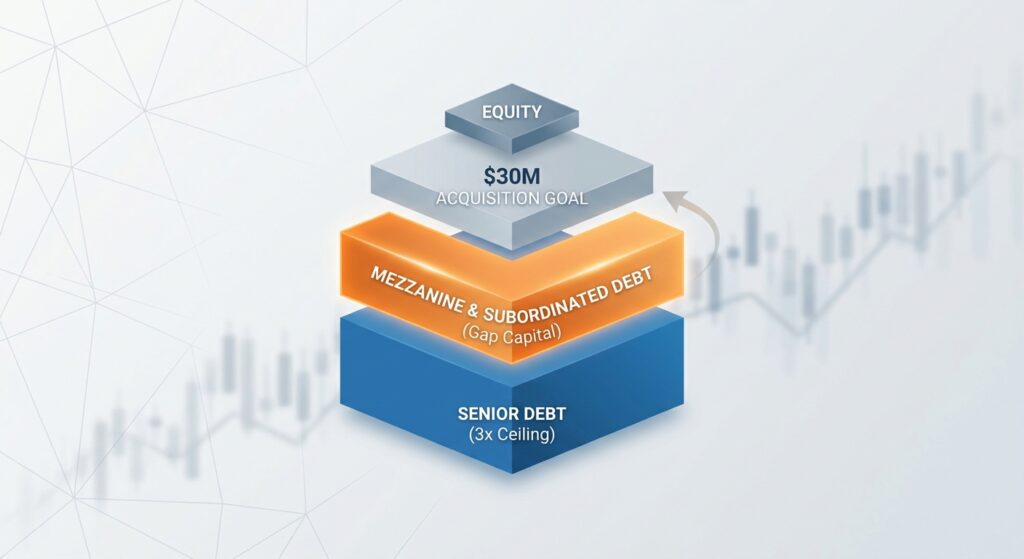
A manufacturing business generating $6M in EBITDA wants to acquire a competitor for $30M. Its bank will stretch to 3.0x leverage, roughly $18M in senior debt. Equity from the ownership group can cover $5M. That leaves a $7M gap sitting in the middle of the capital stack with no obvious home.
This is the defining capital challenge of the growth stage: the business is too mature for venture equity, too leveraged for additional senior bank debt, and too capital-intensive to self-fund. The answer lives in the gap layer: mezzanine debt, subordinated notes, and preferred equity instruments that bridge what banks won’t touch and what owners won’t give away in dilution. Knowing how to structure that gap, price it, and negotiate it is the difference between a closed deal and a missed opportunity.
Mapping the Cost of Capital Spectrum: From Banks to Equity
Before structuring anything, operators and their advisors must map the full cost-of-capital spectrum for the specific use of proceeds. In an acquisition or growth-capital scenario at the growth stage, the stack typically layers as follows:
- Senior Bank Debt (First Lien): Cheapest capital in the stack. Priced at SOFR + 200–350 bps for well-covered middle-market borrowers as of Q1 2026. Lenders apply leverage caps (typically 3.0x–4.0x EBITDA for traditional banks), require maintenance covenants, and take a first lien on substantially all assets. This layer is exhausted first, both in terms of availability and negotiating leverage.
- Unitranche / Direct Lending: Private credit funds can stretch leverage to 4.5x–5.5x EBITDA in a single facility, blending senior and junior risk into one instrument. Pricing runs SOFR + 500–650 bps as of early 2026, with incurrence-based covenant packages. For borrowers seeking simplicity and speed, unitranche eliminates intercreditor complexity but comes at a blended cost above pure senior debt. capitalxo.com outlines how the layering of debt tranches directly affects both pricing and lender control rights.
- Mezzanine Debt (Second Lien / Subordinated Notes): Sits below senior debt, priced between 10%–14% all-in (cash pay plus PIK), often including an equity kicker via warrants covering 1%–5% of the fully diluted capitalization. Mezzanine is the workhorse of the gap layer for acquisition and recapitalization scenarios.
- Preferred Equity: Sits above common equity but below all debt. Carries a fixed preferred return (12%–18%) with no mandatory cash coupon, preserving liquidity. Used when a business cannot service additional fixed debt obligations or where lenders are already at their intercreditor limit.
- Common Equity / Sponsor Equity: Most expensive capital in any stack, returns of 20%–30%+ demanded by institutional investors. Used last, sized to the minimum needed to close the deal.
As peachtreecap.com explains, capital structure follows the constraints of the deal: the goal is to align risk, cost, and feasibility by layer, not to add complexity for its own sake.
Structuring the Gap: Access vs. Cost Trade-Offs in Practice
Using the $30M acquisition example above, here is how a practitioner would think through the stack construction:
| Layer | Amount | Pricing (Indicative) | Key Feature |
|---|---|---|---|
| Senior Bank Term Loan | $18M | SOFR + 275 bps | First lien, maintenance covenants |
| Mezzanine Note | $7M | 12% cash + 2% PIK + warrants | Second lien, 5-year bullet, intercreditor agreement |
| Owner Equity | $5M | Common equity | First loss, no mandatory return |
The mezzanine note carries a PIK toggle, allowing 2% of the coupon to accrue rather than pay cash during the integration period, which protects free cash flow in year one. The warrant coverage (say, 3% of fully diluted equity at a pre-set strike) gives the mezz provider an equity upside kicker in exchange for the subordinated risk position. Structurally, an intercreditor agreement governs the relationship between the senior lender and mezz provider, defining standstill periods and enforcement rights.
The key access-versus-cost trade-off: mezzanine debt costs roughly three times what senior debt does on an all-in basis, but it avoids the dilution and governance intrusion of bringing in an equity co-investor. For a business owner who expects to exit at 6x–7x EBITDA in five years, paying 14% for gap capital that preserves 95%+ ownership is often the superior economic choice.
The Gap Capital Playbook: Quantify, Prepare, Run the Process
Executing a gap capital raise at the growth stage follows a disciplined four-step process:
- Quantify the Gap Precisely. Start with the total use of proceeds (purchase price, fees, working capital reserve). Subtract what senior lenders will commit (get a conditional term sheet first) and what equity is available. The remainder is your gap. Be precise, gap capital providers underwrite to specific leverage multiples and coverage ratios. A $6.8M gap is not the same as a $7M gap in a deal with tight coverage.
- Prepare the Credit Package. Mezzanine and subordinated lenders conduct real diligence. Prepare three years of audited financials, a trailing-twelve-month income statement, customer concentration analysis, a detailed pro forma model (base, downside, stress), and a management presentation that explains the strategic rationale for the acquisition. The more thoroughly you pre-answer credit questions, the shorter the process. As alvren.com notes, a clean data room and clear capital plan materially shrink diligence timelines.
- Run a Targeted Process. Gap capital is a specialist market. Identify mezzanine funds and BDCs that focus on your company’s size, sector, and geography. Approach four to six providers simultaneously to create competitive tension. Require indicative terms within three weeks. Use the senior lender’s conditional commitment as an anchor; it signals deal credibility to mezz providers.
- Negotiate in Parallel, Close in Sequence. Negotiate mezz terms alongside senior terms, but close senior first. Senior lenders will want to review and approve the mezz intercreditor agreement before funding. Build a realistic closing timeline, senior plus mezz transactions typically require eight to twelve weeks from mandate to close in the current market.
Negotiation Guidance: The Five Points That Move the Most Value
Once you are in documentation, five structural points in the mezzanine term sheet generate the most negotiating leverage for borrowers:
- PIK vs. Cash Pay Split: Push for a full PIK toggle in years one and two, reverting to cash pay thereafter. This preserves liquidity during the integration period when free cash flow is most constrained.
- Warrant Coverage and Strike Price: Standard market is 2%–5% coverage struck at current equity value. Push to reduce coverage below 2% if your EBITDA coverage ratio is strong (above 2.0x on the mezzanine tranche alone). A clean balance sheet and visible cash flow path is your best leverage here.
- Prepayment Penalties: Mezzanine lenders typically impose call premiums of 3%–2%–1% in years one through three. Negotiate for a soft call (make-whole only in year one, declining premiums thereafter) if you expect to refinance the gap layer upon achieving a higher leverage multiple or a credit rating upgrade.
- Covenant Package: Insist on incurrence-based covenants rather than maintenance covenants. Maintenance covenants tested quarterly create constant compliance risk in a business going through post-acquisition integration. Incurrence covenants only trigger on affirmative actions (additional debt, dividends, asset sales).
- Equity Governance Rights: Mezzanine providers sometimes request observer board seats or information rights. Limit these to standard quarterly financial reporting. Resist consent rights over operating decisions; that is equity governance attached to debt economics. As capitalxo.com notes, every layer of capital carries some degree of control concession; mapping these concessions explicitly before signing is a critical discipline.
Key Takeaways
- Senior debt has a ceiling. At the growth stage, traditional banks cap leverage at 3.0x–4.0x EBITDA; everything above that is gap capital requiring mezzanine, subordinated debt, or preferred equity to complete the stack.
- Mezzanine preserves ownership at a price. All-in pricing of 12%–14% (cash plus PIK) plus warrant coverage is expensive, but it avoids the dilution and governance cost of bringing in an equity co-investor for a five-to-seven-year hold.
- PIK toggles and incurrence covenants are the two highest-value negotiating points for borrowers in mezzanine term sheets, prioritize them above rate.
- Run a competitive process. Approaching four to six gap capital providers simultaneously creates pricing tension and better structural terms; sole-sourcing leaves value on the table.
- Close in sequence, negotiate in parallel. Senior commitment first, mezzanine intercreditor second, missequencing this is the most common execution error in multi-tranche growth-stage deals.


