
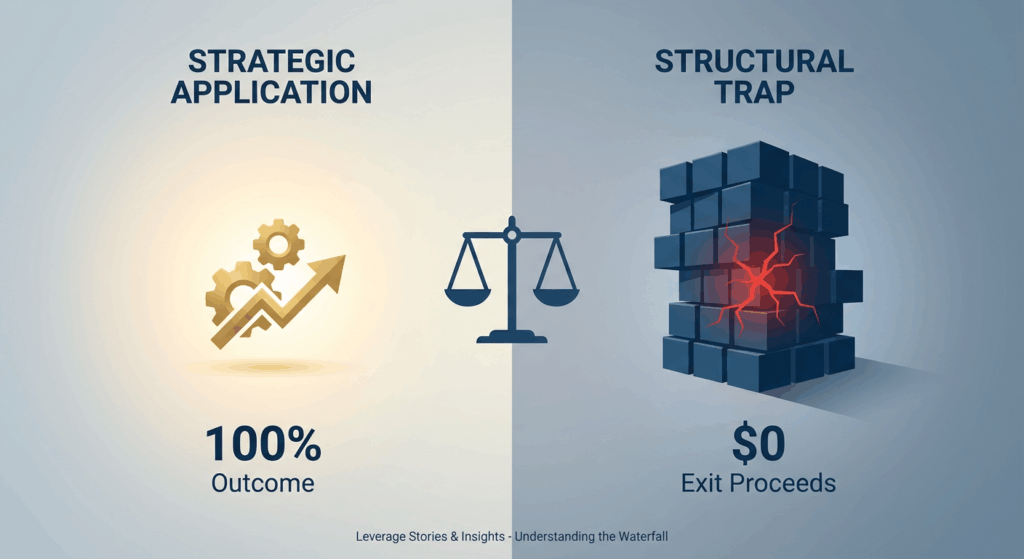
The Story: Same Tool, Opposite Outcomes
In September 2022, Greg and Timothy Holifield (a father-son team who had already built and sold three companies) walked into a conversation with TIMIA Capital looking for $1 million. No board seat surrendered. No equity on the table. Just a clean debt facility against the recurring revenue of their AI-powered weapons detection company, SafePointe.
Less than twelve months later, SafePointe was acquired by SoundThinking, Inc. (Nasdaq: SSTI), a leading public safety technology firm. The Holifields had tripled their monthly recurring revenue in that window. It was, by Greg’s own account, “the most satisfying exit process that we have ever had.” Their fourth successful exit. Funded, in its final and decisive chapter, by debt, not equity.
Now hold that story next to another one.
In October 2021, Divvy Homes (a rent-to-own startup backed by a16z and Tiger Global, carrying a $2.3 billion valuation at its peak) took on approximately $735 million in debt financing. On top of hundreds of millions in preferred equity with stacked liquidation preferences. When interest rates surged through 2022, the model fractured. Three rounds of layoffs followed. New home acquisitions halted. And in January 2025, Brookfield Properties acquired the company for roughly $1 billion.
The founders received zero proceeds. Employees received zero. Even most venture investors received zero. A billion-dollar exit. Nothing for the builders. As saastr.com put it plainly: “This isn’t just a failure story. This is a capital structure story.”
Two companies. Both used debt. Completely opposite outcomes. The difference was not the instrument; it was the proportion, the purpose, and the model it was attached to.
The Decision: What Each Team Was Actually Choosing
When the Holifields approached TIMIA Capital, SafePointe was a hardware-enabled SaaS business, AI weapons detection software powered by proprietary hardware installed at customer sites. The business model created a structural cash flow problem: hardware costs were embedded in license fees, which meant new contracts required capital upfront before recurring revenue could flow. Accounts receivable ballooned. Growth stalled against a working capital ceiling.
The decision was straightforward in one sense: raise equity (and dilute, likely heavily, at an early-stage valuation) or raise debt against their recurring revenue contracts. The Holifields, serial entrepreneurs with hard-won instincts about cap tables, chose debt. The $1M facility from TIMIA was drawn in three tranches, timed to contract milestones, and secured against MRR rather than warrants or equity. No board seat. No ownership change. Just fuel against a proven growth engine, as reported by timiacapital.com.
Greg made the cost-of-capital comparison explicit: “They think the interest rate is too high, but when there are no warrants associated with debt, it is truly fantastic money, and much cheaper than equity. I love this class of debt.” The equity investors who co-invested at the same time made 10x in nine months. TIMIA’s debt cost a fraction of that in real terms.
Divvy’s decision, by contrast, was made in the euphoria of late 2021. Rates were near zero. Housing prices were climbing. The logic for $735M in debt felt airtight: cheap capital, appreciating assets, a model that could scale. What the team did not model aggressively enough was the waterfall, the strict repayment hierarchy that determines who gets paid at exit, and in what order. Debt holders first. Transaction costs second. Preferred equity with liquidation preferences third. Common shareholders (founders, employees) last. At a $1 billion exit price, the line ran out of money before it reached the people who built the company.
The Outcome: Running the Numbers
The Holifield math is clean and instructive. A $1M debt facility, drawn in stages, enabled SafePointe to fund hardware for new customer deployments, close contracts, and triple MRR, all without surrendering a single basis point of equity before exit. When SoundThinking acquired the company, the founders captured the full value of that growth. The debt had already been serviced. What remained was theirs.
The Divvy math is brutal in its simplicity:
- Sale price: ~$1 billion
- Less debt repayment: ~$735 million
- Less transaction costs: ~$20–40 million (estimated)
- Less preferred equity liquidation preferences: remaining balance
- Left for common shareholders: $0
CEO Adena Hefets confirmed as much in her letter to shareholders. The waterfall consumed everything. As saastr.com frames it: “Equity dilution reduces your slice of the pie. Debt shrinks the entire pie before you get to eat.”
There is a third story worth noting briefly. Ken Hoppe, CEO of Modigi, a six-person SaaS company serving enterprise clients inside the Salesforce ecosystem, used $400,000 in revenue-based financing from Founderpath to hire his first salesperson and customer success manager. He reached $1.7M ARR profitably, retaining 100% equity, and positioned for $3–4M in EBITDA within 24 months. No board. No dilution. Debt sized precisely to the milestone it needed to fund, a strategy documented by founderpath.com.
Three companies, three debt decisions. The ones who won used debt as a precision instrument. The one who lost used it as a structural foundation for a business that could not withstand rate shocks.
The Lessons: A Framework for Founders Facing This Decision
The instinct to avoid dilution is correct. But the execution matters enormously. Here is the framework that separates the Holifields from the Divvy outcome:
1. Size debt against realistic exit scenarios: not aspirational ones.
Every dollar of debt raises the floor of your waterfall. Before signing, ask: At what exit price do I personally receive zero? If that number is within range of your most likely outcome, the debt is existentially dangerous. Divvy’s $735M in debt meant founders needed an exit well above their $2.3B peak valuation just to see proceeds. That is not a bridge. That is a trap.
2. Match the debt instrument to your business model’s cash flow rhythm.
SafePointe and Modigi used debt against predictable, contractual recurring revenue. The repayment obligation was structurally aligned with inflows. Divvy used debt to buy physical assets in a market where the macro environment, specifically interest rates, could sever the connection between asset value and carrying cost. When the macro shifted, the model broke. The debt did not.
3. Non-dilutive does not mean low-cost: it means differently priced.
The Holifields made this point explicitly. Debt carries an interest rate that looks high in isolation. But equity, especially early-stage equity with liquidation preferences, can be far more expensive when measured against exit proceeds. The correct comparison is not the interest rate versus zero; it is the interest rate versus the IRR your equity investors will demand, and what that costs you in a waterfall.
4. Know your waterfall before you sign anything.
Founders obsess over ownership percentages and valuation rounds. Almost none of them model their waterfall at five different exit prices. Your investors know exactly at what price they get paid. You should too. Build the table. Run it at $500M, $750M, $1B, $1.5B, $2B. Watch where your proceeds go to zero. If that number is uncomfortable, renegotiate the structure, or walk away from the debt.
5. Debt works best when it accelerates, not enables.
SafePointe did not need debt to survive, it needed debt to close contracts faster and reach an exit on a stronger trajectory. Modigi used debt to fund two hires, not to fund the business model itself. Divvy required debt to operate at all. When debt is structural, when the business cannot function without it, every macro shock becomes an existential event.
Key Insights
- Debt doesn’t dilute your ownership; it dilutes your outcome. Owning 100% of a company with $735M in debt ahead of you is worth less than owning 60% of a clean-balance-sheet company at the same enterprise value.
- Non-dilutive financing is only truly non-dilutive if the exit clears the waterfall. Size your debt so that even a conservative exit leaves meaningful proceeds for common shareholders.
- The best use of debt is against predictable, recurring cash flows with visible repayment paths. Hardware-enabled SaaS, contract-based services, and subscription businesses with low churn are structurally well-suited for private credit and venture debt.
- Serial founders use debt as a precision tool, not a growth engine. The Holifields are on their fourth exit. Each time, they bootstrapped, used targeted debt at the right moment, and captured the full exit value. The pattern is not accidental.
- Before raising any form of debt, run your waterfall at five exit prices. Know the exact dollar amount at which your equity goes to zero, then make sure your debt strategy keeps that number well below your floor-case scenario.


