
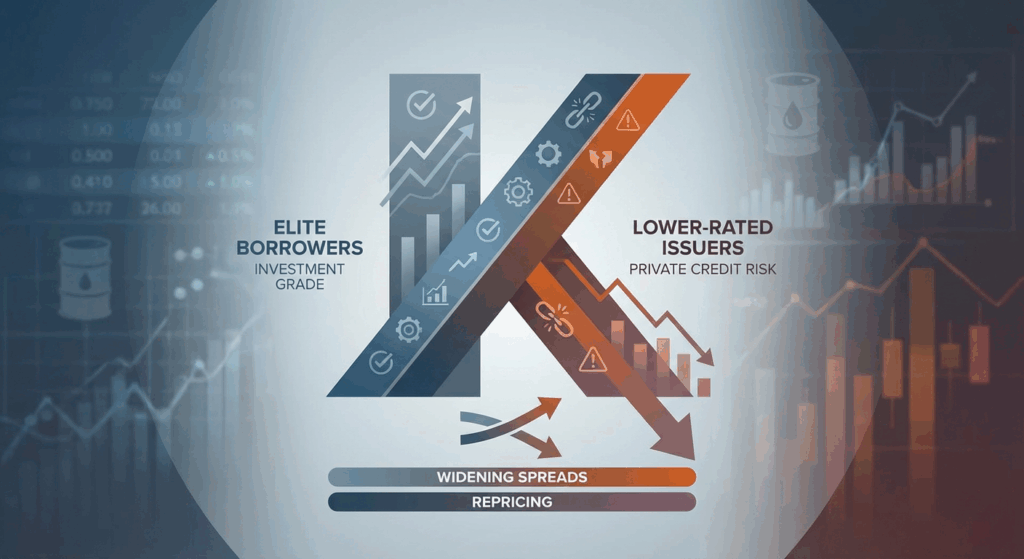
The Great Credit Bifurcation: K-Shaped Markets, Widening Spreads, and the Repricing of Private Credit Risk
Market Headline
The first quarter of 2026 has delivered the credit market’s most significant structural inflection point since the 2020 pandemic shock. A “K-shaped” bifurcation (where elite, investment-grade borrowers continue accessing capital freely while lower-rated issuers face existential liquidity pressure) has cemented itself as the defining dynamic of the current cycle. Total U.S. leveraged loan primary activity, including repricings, fell to approximately $235–$241 billion in Q1 2026, representing a 32–34% decline versus Q1 2025’s $355 billion pace, marking the slowest start to a year since the pandemic, according to Wedbush Financial Content and Sikich Corporate Finance.
The macro catalyst is clear: a “March Oil Shock” that drove Brent crude above $120 per barrel reignited inflationary fears, forcing the Federal Reserve to pause its anticipated rate-cutting cycle: a pause that has collapsed appetite for opportunistic refinancings and repricings, which fell 42% and 39%, respectively. Simultaneously, private credit’s semi-liquid wealth-channel vehicles are facing their first real-world redemption stress test, exposing structural liquidity mismatches that regulators and institutional investors can no longer treat as theoretical. The era of frictionless credit deployment is over. What replaces it is a market defined by selectivity, credit dispersion, and a fundamental repricing of risk at the lower end of the quality spectrum.
Quantitative Market Snapshot
The data below distills the current state of public and private credit markets, with direct implications for underwriting standards and KPI expectations.
| Metric | Current Value (Q1 2026) | Prior Period | Direction | Source |
|---|---|---|---|---|
| U.S. Leveraged Loan Primary Volume (Q1) | ~$241B (incl. repricings) | ~$355B (Q1 2025) | ▼ −32–34% | sikich.com |
| Middle Market Unitranche Spread | SOFR + ~450–550 bps | SOFR + ~450 bps (late 2025) | ▲ Widening under stress | mondaq.com |
| Single-B BSL Loan Spread (late 2025 baseline) | SOFR + ~319 bps (late Nov 2025); wider in Q1 2026 | SOFR + ~370 bps (pre-repricing cycle) | ▲ +~100 bps widening Feb–Mar 2026 | mondaq.com / sikich.com |
| High-Yield Bond Spread (B-rated) | +3.17% (Mar 2026) | +2.65% (Jan 2026) | ▲ +52 bps QTD | investor.wedbush.com |
| U.S. Private Credit Default Rate | 9.2% (2025, Fitch monitor) | 8.1% (2024) | ▲ Record high; <$30M EBITDA cohort in double digits | atlaspeakresearch.com |
| Leveraged Loan Distress Ratio (trading below 80 cents) | 7.23% (Mar 2026) | ~4–5% (Q1 2025 est.) | ▲ Highest in 3 years | investor.wedbush.com |
| Listed BDC Price / Reported NAV | ~78 cents on the dollar (Mar 12, 2026) | ~85 cents (Jan 2026); ~par (early 2025) | ▼ Steep public-market haircut to private marks | atlaspeakresearch.com |
| Software Sector Avg. Borrower Leverage | 7.4x EBITDA | 5.9x (broader loan pool) | ▲ 25% premium over market avg. | atlaspeakresearch.com |
Sources: Sikich Corporate Finance Q1 2026 Credit Market Update; Wedbush Financial Content; Atlas Peak Research, March 2026; McDermott Will & Schulte / Mondaq, Q1 2026.
For lenders, this data reshapes KPI thresholds in real time. Fixed Charge Coverage Ratios (FCCR) are under acute pressure for floating-rate borrowers, as Atlas Peak Research notes that more than one-third of private credit borrowers already had interest expense exceeding current earnings following the post-2022 rate shock. With base rates still elevated and the Fed on pause, any borrower carrying sub-1.2x FCCR should expect covenant scrutiny or margin increases at the next amendment cycle. Debt-to-equity underwriting norms are also tightening measurably: where 2021–2022 vintages tolerated 6–7x total leverage in software and healthcare, the emerging standard for new-money deals in Q1 2026 is gravitating toward 5.0–5.5x for investment-grade-adjacent credits and 4.0–4.5x for single-B issuers lacking recurring revenue or hard-asset backing.
Sector Analysis: Where Lenders Are Leaning In, and Pulling Back
🔴 Under Pressure: Software & Legacy Media
Software has become the most consequential pressure point in credit markets. Per Atlas Peak Research, software accounts for approximately 16% ($235 billion) of the $1.5 trillion U.S. loan market, with private credit’s software and services exposure estimated at around 20% of outstanding portfolios (BNP estimates, cited by Atlas Peak). Roughly 50% of software loans are rated B- or lower, and average borrower leverage sits at 7.4x EBITDA, a 25% premium over the broader market’s 5.9x. Meanwhile, software equity indices fell approximately 22% since January 2026, mechanically expanding loan-to-enterprise-value ratios and raising refinancing risk for the ~46% of software loans maturing within four years. The structural aggravant is the “SaaSPocalypse” narrative: as agentic AI tools from Anthropic, OpenAI, and others erode traditional SaaS seat-based revenue models, lenders are questioning the growth assumptions underlying 2021–2023 enterprise value underwriting. Cumulus Media’s second Chapter 11 filing and New Fortress Energy’s restructuring support agreement during Q1 are emblematic of the “lower arm” of the K-shaped market crystallizing into actual defaults, per Wedbush.
🟢 Capital Flowing Toward: Infrastructure, Energy, AI Data Centers, and Healthcare
The sector rotation out of software-heavy loan portfolios is benefiting hard-asset industries. Energy and infrastructure, historically defensive, are attracting disproportionate lender interest as elevated oil prices, while inflationary for the macro, improve cash flow coverage for upstream and midstream borrowers. AI data center infrastructure is commanding premium access: Oracle’s $38 billion debt package, priced despite market volatility, reflects that AI-infrastructure credits with investment-grade parentage can access capital at relatively tight all-in yields, per Wedbush. Healthcare, while facing tariff-driven supply chain uncertainty on pharmaceuticals, remains a lender-preferred sector for cash-flow-positive, non-commodity businesses, as evidenced by Hologic’s successful $7.25 billion loan pricing in a challenging Q1 environment. McDermott Will & Schulte noted healthcare and financial services as standout PE deal sectors in late 2025, a preference carrying into 2026 as investors seek insulation from macro volatility.
Structural Shift: The Retailization Vulnerability in Private Credit
Perhaps the most important structural development is the exposure of the private credit “retailization” model. As Atlas Peak Research documents in detail, semi-liquid perpetual BDCs more than tripled in size from end-2021 to mid-2024. These vehicles, carrying 10–40% of assets in marketable instruments versus 1–3% at non-redeemable publicly traded BDCs, have faced their first synchronized redemption stress test. Blackstone’s BCRED received $3.7 billion in Q1 withdrawal requests (7.9% of NAV), requiring sponsor capital injection of $400 million. Cliffwater’s Corporate Lending Fund saw approximately 14% in redemption requests, capping repurchases at 7%. Morgan Stanley’s North Haven Private Income Fund returned only 45.8% of tendered shares. Public BDC discounts to reported NAV have deteriorated to approximately 78 cents on the dollar as of March 12, a signal that public markets are applying a meaningful haircut to private mark-to-model valuations.
Implications for Institutional Investors and Operators
For Borrowers and Operators:
- Repricing is the new normal for refinancings. Borrowers in software, media, or high-leverage categories approaching 2026–2027 maturity walls should begin engaging lenders immediately. Waiting for spread normalization is not a viable strategy under an extended Fed pause. “Rescue financing” at double-digit all-in rates is increasingly the only option for lower-arm borrowers, per Wedbush.
- FCCR and leverage covenants will tighten. Any operator with FCCR below 1.25x or total leverage above 5.5x should proactively model amendment scenarios. Lenders are already applying tighter covenant packages for new-money deals, and amendment waivers will cost more in fees and margin step-ups than they did in 2024.
- Non-core asset sales are a strategic necessity, not a last resort. Blue Owl’s $1.4 billion asset sale across three funds (executed partly to restore liquidity and change withdrawal terms) illustrates the type of pre-emptive portfolio management now required at the operator and fund level alike.
For Institutional Investors and Lenders:
- Valuation opacity is a systemic risk, not a portfolio nuance. FSOC’s explicit concern (that the same or similar loans can be carried at different valuations and accrual statuses across BDCs and private funds) combined with rising payment-in-kind (PIK) income shares, means reported NAVs must be stress-tested against mark-to-market proxies. The 78-cent public BDC discount is the market’s current best estimate of that gap.
- Selectivity over deployment velocity. The Q1 data confirms that broad-based deployment strategies face asymmetric risk in the current environment. M&A-related financing activity in Q1 was concentrated: more than 40% of institutional loan volume came from just five mega-transactions, per Sikich. Credit selection (by sector, leverage multiple, and coverage ratio) has never been more determinative of outcome.
Forward-Looking View: Next 3–6 Months
The probability of near-term broad credit market normalization is low. The Fed’s rate pause, sustained by above-$100 oil and sticky inflation, keeps base rates elevated and FCCR pressure intense for floating-rate borrowers. Private credit’s redemption cycle is unlikely to abate quickly: as Atlas Peak Research notes, the sequence of deteriorating confidence signals (gate activations, sponsor capital injections, rising BDC NAV discounts, and selective bank collateral haircuts from institutions such as JPMorgan on software-exposed pools) is more consistent with a sustained repricing than an isolated dislocation.
The most investable opportunity over the next six months is likely concentrated in two areas: distressed and special-situations lending to “lower arm” borrowers with viable underlying businesses but untenable capital structures, and senior secured positions in hard-asset sectors (infrastructure, energy midstream, AI data center) where cash flow coverage is improving in a high-rate environment. For public credit, PIMCO’s Credit Market Lens analysis confirms that investment-grade and high-yield bond market liquidity (measured by depth, breadth, and bid-ask spreads) remains near post-GFC highs, providing a relatively more liquid alternative to private credit vehicles for institutions prioritizing exit optionality.
The defining variable for H2 2026 is whether the distress ratio (currently at 7.23% and three-year highs) stabilizes or accelerates toward the 10%+ threshold that historically precedes systemic restructuring waves. If oil prices moderate and the Fed resumes cuts, a soft landing for stressed credits remains achievable. If the macro backdrop deteriorates further, the “90/10” market reality described by Wedbush, where the bottom 10% of issuers faces existential liquidity pressure, risks becoming an “80/20” problem with materially broader systemic implications.
Key Market Insights
- 🔴 Spreads are widening asymmetrically. High-yield B-rated spreads jumped from 2.65% to 3.17% in Q1 2026, while investment-grade spreads remained relatively flat, the K-shaped bifurcation is now structurally embedded in spread pricing, not just in sentiment.
- ⚠️ Private credit’s retail liquidity promise is broken. Redemption gates at BCRED, HLEND, Cliffwater, and North Haven funds confirm that semi-liquid structures cannot honor periodic redemptions at scale during synchronized stress events, a risk now being priced into the 78-cent BDC NAV discount.
- 📊 Software is the sector to underweight. With 7.4x average EBITDA leverage, 46% of loans maturing within four years, ~22% equity index decline since January, and growing AI disruption of SaaS revenue models, software credit requires a significant risk premium adjustment in any underwriting model.
- ✅ Hard assets and AI infrastructure are the lender-preferred sectors. Infrastructure, energy, and AI data center credits with investment-grade sponsors are accessing capital at meaningfully tighter spreads, the structural rotation away from software is already underway and is likely to persist through year-end.
- 🔎 Mark-to-model valuation opacity is the next systemic risk flag. Rising PIK income shares, FSOC warnings on inconsistent nonaccrual practices, and the BDC discount to NAV collectively signal that reported private credit performance metrics should be interpreted with a material margin of skepticism until secondary market price discovery improves.


