
The Growth-Stage Financing Problem Nobody Warns You About
You have product-market fit. Revenue is climbing. Unit economics are working. And yet, the capital markets feel like they were designed for someone else.
This is the defining tension of the growth stage, roughly $2M to $20M in annual revenue, where the business has outgrown founder capital and bootstrapped lines of credit, but has not yet reached the scale, predictability, or collateral base that traditional senior lenders require. Venture capital is structurally mismatched for operators not chasing a billion-dollar outcome. And the equity dilution cost of Series A-style financing compounds in ways that founder economics rarely survive cleanly.
The solution is not a single instrument. It is a deliberate architecture, a capital stack built layer by layer, matched precisely to what the capital is for.
Step 1: Map the Use-of-Proceeds First
Every capital structure conversation should begin with the same question: what is this money actually doing? Use-of-proceeds is not a formality on a term sheet. It is the analytical foundation that determines which layer of the capital stack is appropriate, at what cost, and under what terms.
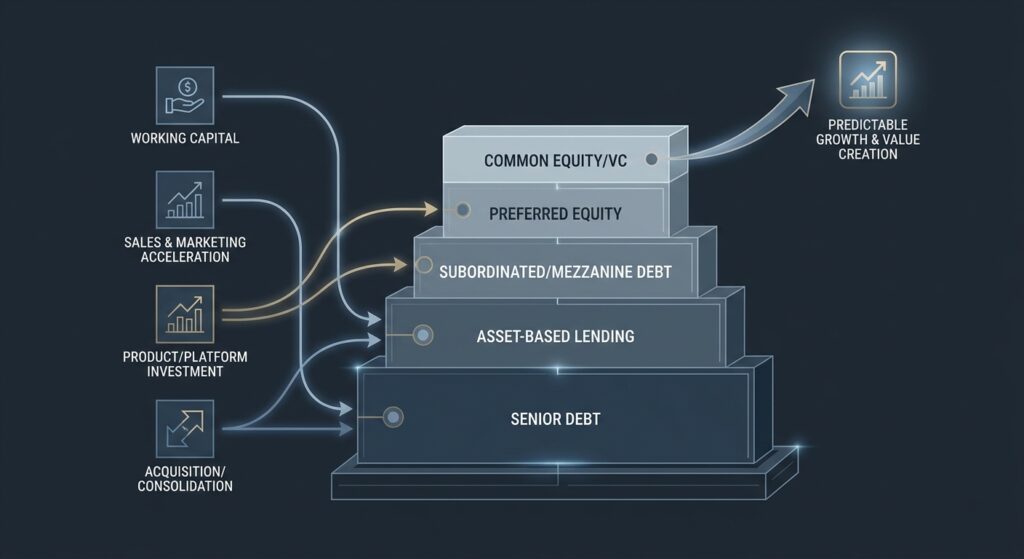
At the growth stage, use-of-proceeds typically fall into four buckets:
- Working capital: Funding the AR-to-cash cycle, inventory build, or seasonal payroll. This is short-duration, asset-linked capital. The right instrument is a revolving credit facility or asset-based lending line: ideally senior, secured, and priced at a spread to SOFR or prime.
- Sales and marketing acceleration: Hiring revenue-generating headcount, funding customer acquisition, expanding channel partnerships. This is cash-flow-financed, medium-duration spend. Revenue-based financing or growth debt, structured with repayment tied to monthly revenue, is purpose-built for this use case.
- Product or platform investment: Engineering buildout, R&D, infrastructure. Longer payback, no immediate collateral. This is where subordinated or mezzanine debt, and sometimes preferred equity, enters the conversation.
- Acquisition or market consolidation: Buying a competitor, an adjacent book of business, or a strategic asset. Acquisition financing typically requires a more complex stack, senior acquisition debt layered with subordinated notes or seller paper, sized against EBITDA or recurring revenue multiples.
Mismatching instrument to use-of-proceeds is the most common and most expensive structuring error operators make. Funding long-duration capex on a short-term revolver creates refinancing risk. Funding working capital with equity gives away permanent ownership to solve a temporary timing problem. As the CapitalXO capital stack framework notes, each layer’s pricing and availability is directly influenced by what sits above and below it, and mismatches stress the entire structure when conditions change.
Step 2: Price the Capital Stack from Senior to Equity
Once use-of-proceeds is mapped, the next discipline is pricing each potential layer against its risk position. The spectrum, from cheapest to most expensive, follows seniority in the repayment waterfall:
- Senior secured debt (bank or non-bank): First-lien position, asset-backed or cash-flow-based. Typically the lowest cost of capital available. Restrictive covenants and personal guarantees are common at the growth stage. Appropriate for working capital, equipment, and asset-backed use cases.
- Asset-based lending (ABL): Borrowing base structured against eligible accounts receivable (typically 70–85% advance rate) and inventory (50–70%). Particularly effective for businesses with Fortune 500 customer bases or contracted recurring revenue. As CFI’s capital stack analysis notes, senior debt carries the lowest borrowing cost because it carries the least risk, a principle that holds at every business stage.
- Subordinated or mezzanine debt: Sits below senior debt in the waterfall, priced accordingly higher. Often includes equity features (warrants, PIK toggle, or conversion rights) to compensate for subordinated risk. Fills the gap between what senior lenders will fund and what operators want to avoid funding with equity dilution. This is the workhorse of growth-stage gap capital.
- Preferred equity: No mandatory repayment obligation, but liquidation preferences and dividend accruals create a hidden cost that compounds if the exit takes longer than expected. Appropriate when debt service capacity is constrained but some return structure is acceptable to the operator.
- Common equity / venture capital: Most expensive in dilution terms, but carries no repayment clock. Rational when the business genuinely needs patient capital to fund an unproven strategy, a new market, or a product pivot, not when it is simply funding a predictable revenue engine.
As Angel Investors Network’s 2025 growth capital guide illustrates, the true cost of equity is measured not in interest rate terms but in exit value surrendered. A founder selling 25% at a $15M pre-money valuation on a company that exits at $50M has effectively paid $12.5M for capital that a structured debt instrument might have delivered for a fraction of that economic cost.
Step 3: The Gap Capital Playbook, Quantify, Prepare, Run the Process
Gap capital is the tranche of financing that sits between what your senior lender will provide and what you actually need to execute the plan. Structuring it well requires a disciplined four-step process:
Quantify the gap precisely. Build a 24-month cash flow model (accrual basis, monthly granularity) that shows the exact timing and size of the capital need. Identify whether the gap is structural (permanent working capital need) or transactional (one-time acquisition or buildout). The answer determines duration, instrument, and repayment structure.
Prepare your credit package. Growth-stage operators often lose deals not on fundamentals but on documentation. Lenders and mezzanine providers underwrite to unit economics: customer acquisition cost, lifetime value, gross margin, churn, and ARR growth rate. Have 24 months of bank statements, accrual-basis financials, a cohort analysis, and a capitalization table ready before the first conversation. As Lendity’s capital stack guide observes, lenders in this segment are transactional; they make decisions on data, not narrative.
Run a parallel process. Never negotiate with a single capital provider. Engage senior lenders, subordinated debt providers, and revenue-based financiers simultaneously. Parallel processes compress timelines from six months to 30–60 days and create legitimate competitive tension that lowers cost and improves terms. Disclose only what is required at each stage.
Model three exit scenarios before signing anything. At a $25M exit, a $50M exit, and a $100M exit, calculate exactly what each layer of the proposed stack costs you in economic terms. Liquidation preferences, warrant coverage, and PIK interest accretion can dramatically alter founder outcomes at modest exit multiples.
Step 4: Negotiate the Structure, Not Just the Rate
Most operators negotiate headline interest rate and loan amount and leave the structure (where real value is won and lost) on the table. The negotiation points that matter most at the growth stage:
- Covenant headroom: Maintenance covenants (tested quarterly against EBITDA or revenue thresholds) are materially more restrictive than incurrence covenants (triggered only at the point of a specific action). Push for incurrence-based packages wherever possible, or negotiate meaningful cushion above current performance levels.
- Prepayment flexibility: Growth-stage businesses change faster than loan agreements. Negotiate soft call protection (declining premium over time) rather than hard lockouts that prevent refinancing even when better terms are available.
- Warrant coverage: If a mezzanine or subordinated lender requires warrants, negotiate the coverage percentage (typically 0.5–2% of fully diluted equity), the exercise price (ideally pegged to the most recent round valuation), and a sunset or buyout mechanism.
- PIK toggle optionality: Payment-in-kind interest, where unpaid interest accretes to principal rather than requiring cash outlay, preserves liquidity during high-investment periods. Negotiate PIK toggle as an option, not a permanent feature, to retain flexibility without paying the compounding cost when cash is available.
The capital stack is not a static document. It is a dynamic architecture that should be stress-tested, renegotiated, and optimized as the business matures from growth into cash-flow stability, and ultimately into succession or exit. The operators who build the most durable businesses treat capital structure as a core competency, not an administrative function.
Key Takeaways
- Use-of-proceeds drives instrument selection: Match the duration and risk profile of the capital to the economic life and payback timeline of what it funds.
- Price the stack from senior to equity: Always exhaust cheaper, more senior capital before moving down the risk spectrum, every basis point of blended cost of capital compounds at exit.
- Gap capital requires a structured process: Quantify the need precisely, prepare a data-driven credit package, and run a parallel process to create competitive tension.
- Negotiate structure over rate: Covenant design, prepayment terms, warrant coverage, and PIK optionality are where the economics of a deal are actually won or lost.
- Model every scenario before signing: Liquidation preferences, PIK accretion, and warrant dilution can transform a seemingly attractive instrument into an expensive one, run the math at multiple exit values before committing.


