
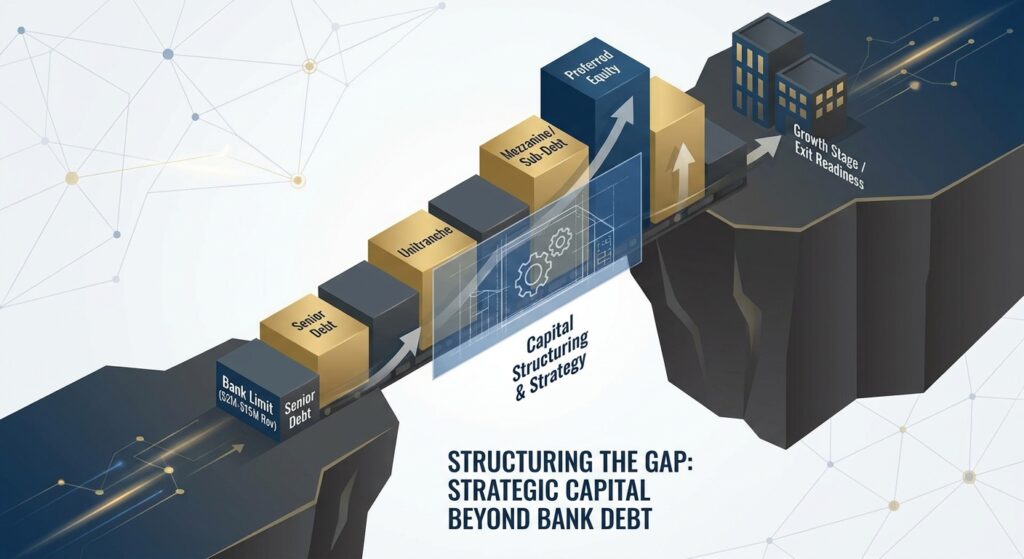
The Growth Stage Capital Problem
At roughly $2M–$15M in revenue, a privately held business enters one of the most structurally challenging phases of its lifecycle. The founding equity is largely consumed. The bank has extended a revolving credit facility, probably at prime plus 150 basis points, and is now signaling it has reached its lending limits. Meanwhile, the business has identified a clear use of proceeds: hiring a national sales team, funding a bolt-on acquisition, or building out the operational infrastructure needed to double revenue in 36 months.
This is the growth stage gap. And closing it requires precision: not simply raising more money, but architecting a capital stack that matches funding type to use-of-proceeds, minimises dilution, and preserves strategic flexibility for the next transition. As frameworks from practitioners like capitalxo.com make clear, every layer of the stack carries a different risk profile, repayment priority, and cost, and mismatching those layers to business needs is one of the most common and expensive errors a growing company can make.
Mapping Use-of-Proceeds to Funding Type
Before touching the cost of capital spectrum, the first discipline is precision on what the capital is actually for. Different uses of proceeds carry fundamentally different risk profiles, and lenders and investors price accordingly.
- Working capital and receivables financing: Low risk, self-liquidating, collateral-backed. This is asset-based lending (ABL) territory, revolvers priced at SOFR plus 150–250 bps, secured against eligible receivables at 80–85% advance rates. Banks and specialist ABL lenders compete aggressively here.
- Organic growth investment (headcount, go-to-market, product): No collateral, longer payback horizon, cash flow dependent. Banks retreat. Revenue-based financing, venture debt, or growth mezzanine step in. The cost rises sharply, 12–20% all-in, because the lender is underwriting future cash flows, not existing assets.
- Bolt-on acquisitions: Asset-heavy and deal-specific. Unitranche structures (a single-tranche facility blending senior and subordinated economics) have become the instrument of choice in the lower middle market, offering execution speed and structural simplicity that a traditional senior/mezz split cannot match.
- Recapitalisations and founder liquidity: Equity-driven. Preferred equity or structured secondaries allow founders to crystallise partial value without a full sale, but the cost is governance: dividend preferences, anti-dilution provisions, and potential board representation.
The core discipline, as alvren.com frames it, is sequencing intelligently: take cheaper, lighter instruments first and reserve more expensive, dilutive structures for the gaps that cheaper capital genuinely cannot fill.
The Cost of Capital Spectrum: Banks to Equity
The capital stack is not a menu; it is a hierarchy of risk, priority, and cost. Understanding where each instrument sits is essential for structuring efficiently.
| Layer | Instrument | Indicative All-In Cost (2026) | Primary Security |
|---|---|---|---|
| Senior Secured | Bank term loan / ABL revolver | 7–9% | First lien on assets / receivables |
| Unitranche | Single-facility blended term debt | 10–13% | First lien; single lender or club |
| Mezzanine / Sub-Debt | Subordinated notes ± equity kicker | 14–18% (cash + PIK) | Second lien or unsecured |
| Preferred Equity | Structured preferred shares | 18–25% (dividend + upside participation) | Liquidation preference, governance rights |
| Common Equity | PE sponsorship / strategic investment | 20–30%+ (implied return hurdle) | Residual claim; board control |
As capitalxo.com notes, senior debt is the cheapest capital in the stack precisely because it carries the least risk, and each layer below it demands incrementally higher returns to compensate for subordinated priority. The blended cost of the stack rises with every layer added. The strategic objective is to fill the capital need at the lowest blended cost that the business’s cash flow and collateral can legitimately support.
The Gap Capital Playbook: A Four-Step Framework
Once the use-of-proceeds is mapped and the stack is understood, the execution is a process, not a fundraise. Here is how practitioners should run it.
Step 1: Quantify the Gap Precisely
The gap is the delta between what existing facilities can provide and what the business plan requires. Quantify it with specificity: How much senior capacity remains? What is the maximum leverage a lender will underwrite against trailing twelve-month EBITDA? What is the incremental EBITDA generated by the use of proceeds, and over what timeline? If a business generates $3M EBITDA and a senior lender will lend at 3.0x, the senior ceiling is $9M. If the acquisition or growth initiative requires $14M total, the gap is $5M, and that is the mezzanine or preferred equity problem to solve. This precision matters because providers of gap capital underwrite the residual risk, and vague sizing signals poor financial command.
Step 2: Prepare the Lender Materials
Gap capital providers (mezzanine funds, growth lenders, family office credit desks) underwrite differently than banks. They are buying risk, not collateral. The materials that matter are: 24 months of trailing financials (accrual basis), a detailed use-of-proceeds memorandum, a three-year integrated financial model with downside case, customer concentration and retention analysis, and a clear articulation of the capital event that retires or refinances the gap layer. A well-constructed information memorandum compresses the diligence cycle from 90 days to 45. As angelinvestorsnetwork.com observes, growth capital lenders are objective underwriters; they want cohort data, unit economics, and cash flow visibility, not vision slides.
Step 3: Run a Parallel Process
Never approach a single gap capital provider sequentially. Run a structured process across three to five institutions simultaneously: specialist mezzanine funds, BDC lenders, and direct lending platforms. Parallel processes create the negotiating tension needed to drive down pricing, loosen covenants, and improve structural terms. A business approaching a single lender telegraphs desperation. A business running a competitive process signals financial sophistication and optionality.
Step 4: Model the Total Cost of Capital, Not Just the Rate
Gap capital often carries features beyond a headline interest rate: PIK toggle provisions, equity warrants, revenue-sharing components, or exit fees. The all-in economic cost of a mezzanine facility carrying 13% cash interest plus 3% PIK plus a 1% exit fee plus warrants representing 2% equity dilution is materially higher than 13%. Model the full internal rate of return (IRR) to the lender across base, upside, and downside cases. If the lender’s IRR in the base case is 18–20%, that is the true cost of capital, and the business needs to evaluate whether the use-of-proceeds generates sufficient incremental return to justify it.
Negotiation Guidance: Where to Push and Where to Hold
Once term sheets arrive, the negotiation is structural, not just economic. The points that matter most for growth-stage borrowers:
- Covenant design: Push for incurrence-based covenants over maintenance-based covenants wherever possible. Maintenance covenants (tested quarterly against a fixed leverage or coverage threshold) create unnecessary default risk during growth investment phases when EBITDA temporarily compresses. Incurrence covenants only trigger upon a specific action (making an acquisition, paying a dividend), giving operational headroom.
- PIK optionality: If cash interest coverage is tight in the near term, negotiate PIK toggle rights, the ability to elect payment-in-kind at the borrower’s discretion for an agreed number of periods. PIK accretes the principal balance but preserves near-term liquidity during the investment phase.
- Warrant coverage: Mezzanine lenders routinely request warrants representing 1–5% of fully diluted equity. This is negotiable. Push for strike price parity with current enterprise value (not a nominal strike), caps on warrant coverage as a percentage of fully diluted shares, and buyout provisions that allow the company to repurchase warrants at a predetermined formula prior to exit.
- Prepayment flexibility: Growth-stage businesses frequently reach refinancing inflection points (a larger equity raise, a strategic acquisition, or a bank facility expansion) ahead of schedule. Negotiate prepayment windows with step-down premiums (e.g., 3–2–1% declining over years one through three) and ensure no make-whole provisions extend beyond year two.
- Information rights and board access: Gap capital providers at the mezzanine and preferred equity level will request information rights and, in some cases, observer board seats. Granting an observer seat is materially different from granting a voting seat, accept observation rights where necessary, but resist any provision that converts observation to governance participation upon a covenant breach.
Key Takeaways
- Use-of-proceeds drives structure: Receivables financing is an ABL problem. Organic growth investment is a cash flow lending problem. Acquisitions are a unitranche or senior/mezz problem. Match the instrument to the risk profile of the proceeds, not to what is easiest to raise.
- The blended cost is what matters: Evaluate every gap capital structure by its total all-in IRR to the provider (including PIK, warrants, fees, and exit costs) not the headline coupon.
- Parallel process creates leverage: Running three to five gap capital providers simultaneously is not aggressive; it is the professional standard. Sequential approaches produce worse terms and longer timelines.
- Incurrence covenants protect operational flexibility: In a growth investment phase, maintenance covenants tied to trailing EBITDA can trigger technical defaults while the business is performing exactly as planned. Negotiate for incurrence-based packages wherever the lender appetite exists.
- Every gap layer must have an exit plan: Mezzanine and preferred equity are bridge capital, not permanent capital. Before closing any gap layer, define the refinancing event (whether a cash flow recapitalisation, a senior facility expansion, or an equity raise) that retires or converts the gap instrument within a defined horizon.


